The artistic beauty of tree bonsai is worth savoring carefully.
As a work of art, bonsai must not only possess the beauty of a painted scene but also express a profound artistic conception, so that when people appreciate it, they not only see the scenery but are also inspired by it to feel beautiful emotions, beautiful aspirations and beautiful ideals, thereby producing rich associations and perceiving meaning beyond the scenery, reaching a state where the scenery ends but the meaning is endless.
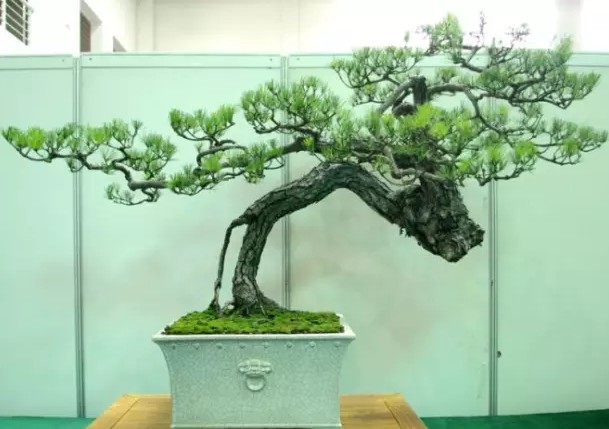
The beauty of artistic conception has a very strong power to move people. It makes bonsai works thought-provoking and gives them a charm that never grows tiresome no matter how often they are viewed. Since the creator of a bonsai has already blended his or her feelings into the composition during the creative process, when the viewer enters this artistic conception of beautiful emotions, aspirations and ideals, he or she can achieve a resonance of thought and feeling with the bonsai's creator.
Artistic conception is the highest realm of bonsai art. It is built upon the beauty of the painted scene, and the two interpenetrate and are hard to separate. Artistic conception is sometimes also expressed with the help of inscriptions and poems on the bonsai, so appreciating bonsai also requires a certain literary cultivation.
In the creation of bonsai, the hardest thing to express is the beauty of artistic conception, and in the appreciation of bonsai, what most requires aesthetic judgment is also the beauty of artistic conception. Take a pine bonsai as an example: when we see its new leaves and old trunk, we are only appreciating its natural beauty. But when we see its upright trunk and vigorous branches and foliage, we are also appreciating its beauty of painted scene. That is, from the vigorous and upright posture of the pine, we associate its character of "fearing no storm and remaining unyielding," and are thus spiritually inspired; only then have we appreciated its beauty of artistic conception.
In particular, water-and-land bonsai are rich in content and diverse in scenery, and can better embody the poetic and picturesque beauty of artistic conception. The associations that bonsai generate in viewers regarding bonsai works vary from person to person and carry a somewhat subjective element, being determined by factors such as the viewer's level of thought, artistic cultivation and life experience.
The depth of a bonsai's artistic conception does not depend entirely on the amount of scenery or the size of the scene. Sometimes, in a bonsai with very simple scenery and a very small scene, a profound artistic conception can also be expressed. For example, a water-and-land bonsai with several clumps of rock stonecrop growing on sand-stone, placed in a water basin and accented with a few small duck figurines, can lead the viewer to associate the famous line "when the spring river water warms, the ducks are the first to know," thereby making people feel the arrival of spring and a rich flavor of life.