Key Points for Appreciating the Overall Beauty of Tree Bonsai
The main materials of bonsai are themselves natural objects, possessing a natural charm. Among them, plants also have the characteristic of life and can present different scenery as time passes and seasons change. The forms and colors of the roots, trunks, branches and leaves, flowers and fruits of tree bonsai are organically combined to form the overall beauty of the tree scenery.
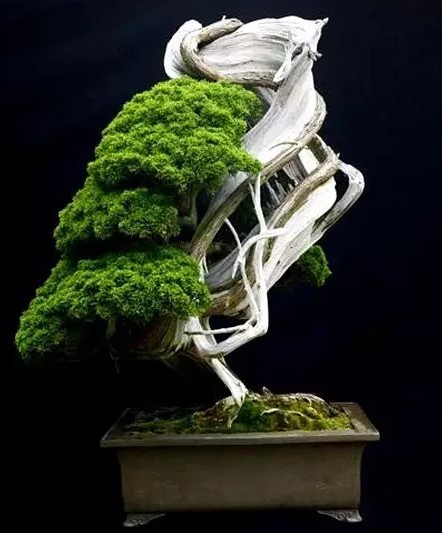
1. The beauty of seasonal change.
The forms and colors of bonsai plants change with the four seasons. For example, in spring new buds burst forth in green, in summer the branches are lush and the leaves abundant, in autumn the fruits hang heavy, and in winter the branches and trunk are rugged and vigorous. As the tree ages, it also gradually reveals a venerable, ancient posture. Watching the growth process of the trees and the changes of the four seasons is full of great appreciation interest.
2. The natural beauty of mountain stones.
The natural beauty of mountain stones mainly refers to their texture, shape and color.
Texture:
Mountain stones are divided into hard and soft types. For example, Yingde stone and tree fossil stone are hard in texture, while sand-accumulated stone, sea-mother stone and pumice are loose in texture, and the landscape scenery they express differs in each case.
Shape:
The natural shapes of mountain stones include the outer form and the texture strokes (cun patterns). As for the outer form: there are peak-shaped ones, such as axe-cut stone; there are layered ones, such as thousand-layer stone; there are rounded ones, such as pebbles; and there are rugged, jagged ones, such as Yingde stone. As for the texture strokes: there are axe-cut strokes, such as on axe-cut stone; there are disordered-firewood strokes, such as on reed-pipe stone; there are folded-belt strokes, such as on thousand-layer stone; and there are also interwoven texture strokes, such as on Yingde stone.
Color:
Stalactite stone is mostly blue-gray, tree fossil stone is mostly yellowish-brown, axe-cut stone is mostly dark gray, and Xuan stone is mostly pure white. In bonsai expression, each has its own strengths. For example, stalactite stone is used to express spring mountains, and Xuan stone is used to express winter mountains; both are relatively suitable.