The natural beauty of tree bonsai is worth savoring in detail
Appreciating the beauty of bonsai is like appreciating any other art: opinions always vary from person to person. Bonsai uses natural trees, rocks and stones as its main materials, and since plants have the characteristic of being alive, natural beauty is an important aspect of bonsai beauty.
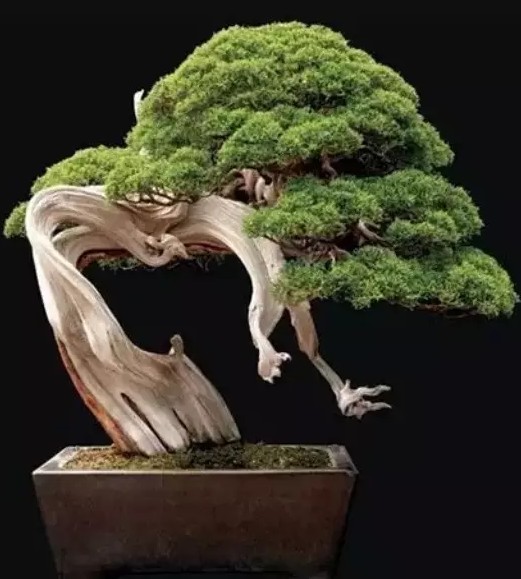
The natural beauty of trees includes the beauty of the roots, trunk, branches and leaves, flowers and fruit, and overall posture, as well as the beauty of color that changes with the seasons.
Roots:
Some tree roots are slightly exposed above the soil, giving a sense of solidity; some have raised roots exposed above the soil, with the imposing stance of a coiled dragon or crouching tiger; some have several roots linked together, forming a connected-root style; and some are rooted in rock crevices, carrying the imagery of “biting firmly into the green mountain and never letting go.” Thus in bonsai there are artistic forms such as the “raised-root style,” “connected-root style” and “rock-attached style,” in which the roots are the main object of appreciation.
Trunk:
Although the main trunk of a tree has undergone artistic shaping, it still retains natural tree momentum and spirit. For example, a straight trunk is firm and upright, while a curved trunk is ancient and full of varied charm, each with its own characteristics. The bark may be old or young, some rough, some smooth; for instance, the bark of the black pine is covered with scales, while bamboo plants are smooth and multi-noded, each rich in appeal. The color of the trunk also varies widely, including black, grayish brown, yellowish brown, emerald green, purplish black and more. In addition, some half-withered trunks contrast with flourishing branches and leaves, giving a sense of “a withered tree meeting spring.”
Leaves:
Leaf shapes differ with the tree species. There are needle-like, scale-like, ovate, fan-shaped, palmate and melon-seed-shaped leaves, as well as leaves with unusual shapes. Leaf texture may be hard or soft, thick or thin, leathery or papery. Leaf color is even more richly varied, including dark green, light green, yellow-green, red, variegated edges and variegated leaves.
Flowers and fruit:
The forms and colors of flowers are the most varied. Among flowering bonsai, common ones include azalea, broom, pomegranate flower, plum blossom and so on, presenting a thousand postures and a hundred attitudes. Fruit-bearing bonsai also come in many forms, such as firethorn fruit, tungfei fruit, Elaeagnus fruit and Buddha's hand fruit. The colors of the fruit are also very rich, including golden yellow, red, purplish red, yellow-green and so on.