Detailed Explanation of Huizhou-Style Tree Stump Bonsai Shaping Methods
The timing for shaping tree stump bonsai varies depending on the plant species. Generally, spring and autumn are the best seasons, because in spring plants begin to sprout, the branches are relatively soft, and deciduous plants have not yet grown leaves, making shaping operations easier; in autumn, plants have completed their growth cycle, and deciduous plants have already shed their leaves and are preparing for dormancy, which is equally suitable for shaping.
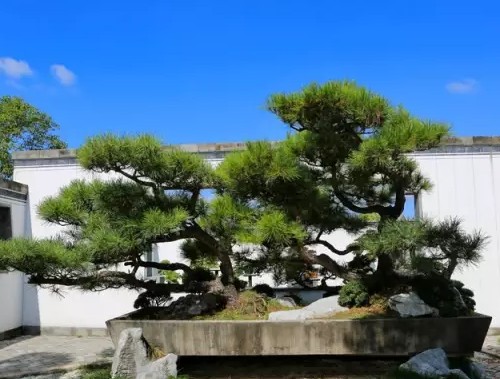
In summer, however, plants are in a period of vigorous growth, and shaping will directly affect their normal growth and development, so it is generally not advisable; in winter, with freezing cold and frozen ground, the branches become brittle and break very easily, so it is best not to carry out shaping.
However, the best time to shape a specific species depends on the flexibility of its branches; as long as the branches are supple and will not break when twisted, and the root system will not be damaged, then strictly speaking, shaping can be done at any time and in any place.
After the trunk bending and branch twisting of the tree stump bonsai are completed, the leaves and fine twigs must be dealt with.
Following the principle of "combining the substantial with the sparse," excessively dense small branches and leaves should be partially removed, and in areas that are too sparse, provided it does not affect the ornamental effect, branches and leaves should also be drawn from elsewhere to fill the gaps and blank spaces, or lightly pruned to promote the sprouting of axillary buds and latent buds, so as to grow more fine twigs and leaves to make up for the deficiencies.
Branches that are too luxuriant and extend outward should also be pruned as appropriate, to avoid branches becoming tangled and crossing one another, and to achieve a clearly layered effect.
Once the trunk, branches and leaves have been dealt with, the prototype of the wandering dragon stump is roughly formed.