Finishing and Embellishment Techniques After Completing a Landscape Penjing
To create a landscape penjing, one generally first determines the theme and carries out a preliminary artistic conception, then selects materials such as the pot, stones, plants and accessories, then processes and arranges the stones, and finally embellishes with plants and accessories.
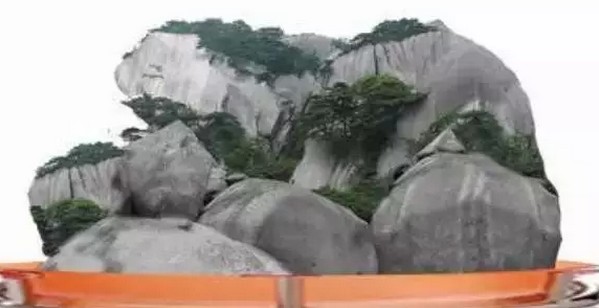
The pot is the main component of the penjing and also plays a major role in its appreciation. Landscape penjing includes three forms: water-and-stone, dry-stone and water-and-dry, which also differ in their use of pots. In addition, there are wall-hanging penjing. Water-and-stone penjing all use shallow-mouthed pots capable of holding water; they can represent rivers, lakes and seas, allow the plants on the rocks to absorb water, and at the same time play a role in helping the composition. People call landscape penjing three-dimensional landscape paintings: the pot is equivalent to the paper, and the arrangement of rocks, trees and so on is like painting within the pot.
The shapes of water pots are most commonly and most suitably rectangular and oval. Rectangular water pots are neat and dignified, often used to express majestic, towering peaks; oval water pots are soft and graceful, often used to express beautiful, open scenery. In addition, there are many other styles such as square, round, boat-shaped, crabapple-shaped, elongated hexagonal and elongated octagonal, which can be chosen according to different needs and individual preferences. Pots vary in height from deep to shallow, and nowadays very shallow pots are mostly used. The colour of water pots is generally best in light tones; common ones are white, pale blue, pale green and pale yellow, all of which are very attractive. When choosing, one should decide according to the content of the penjing and the colour of the rocks, so that there is both harmony and contrast. Water pots come in many materials, which can be divided into stone, porcelain, glazed, ceramic and cement, among others.
Dry-stone penjing and water-and-dry penjing, because they need to grow plants, mostly use dry pots, that is, pots with drainage holes.
After a landscape penjing is completed, in order to make it richer in the flavour of life and more realistic, it is very necessary to appropriately finish and embellish the surface of the pot. The purpose of finishing and embellishment is to make the poetic and pictorial quality of the landscape penjing more intense and the theme more distinct and prominent.
The methods of finishing and embellishment are, through just the right planting and moss-dotting, to achieve the artistic effect of dense trees veiled in emerald green and towering, elegant peaks; then, as needed, to add small bridges, pagodas, pavilions, towers, figures, animals and other ornaments, thereby further enriching the content of the work and highlighting its theme.
1. Adding moss and dotting with green:
Generally, root-textured stones have strong water absorption and readily grow green moss; hard stones, if placed in a damp, shady spot for a long time, can also grow a thin layer of green moss on their lower parts. As for the parts where moss grows, there is more moss on the lower part of the rock and less on the upper part; less moss on the light-facing side and more on the shaded side; less moss on the ridges and more in the hollows. This is the law of natural ecology. If it is spread all over from front to back, it lacks a sense of reality and damages the natural beauty of the rock.
You can scrape the green moss from damp shady rock faces or wall corners and spread it directly onto the artificial rock; you can also mash the collected green moss and mix it into thin mud slurry or rice water, then brush it onto the rock with a brush; you can also spray a dilute fertiliser solution onto the rock, cover it well with a plastic bag, and place it in a cool spot with scattered light, and before long green moss will grow on the landscape penjing.
2. Arrangement of plants:
When arranging trees on a landscape penjing, one should choose the tree species and ecological form according to the needs of the artistic conception. Tree species commonly used for planting include five-needle pine, small-leaved Buddhist pine, serissa, Chinese box, small-leaved elm, Japanese apricot blossom, small-leaved privet and so on; herbaceous plants such as asparagus fern, Selaginella uncinata, cattail grass, maidenhair fern and brake fern are all excellent plants for arrangement.
When arranging plants, special attention must be paid to the proportional relationship between the plants and the rocks. Woody plants are suitable with larger rocks, herbaceous plants with smaller rocks. According to the saying in Chinese painting, "zhang mountain, chi tree, cun horse, fen person", the plants should not be too large; the size and height of the planted plants must be consistent with the theme and content. Plants growing in different positions have different forms due to differences in ecological environment. On flat slopes at the foot of the mountain, clustered trees are suitable, with trunks generally rather straight; trees beside mountain streams mostly lean towards the water; trees growing on cliffs and precipices have a posture of hanging upside down and flying sideways; trees standing on the summit often show flat-topped crowns.
Therefore, when arranging plants, one must carefully examine the environment and position, and arrange and shape them according to the growth laws of plants in natural landscapes; one must never do as one pleases and cause distortion. The shaping of woody plants should be cultivated in advance; when planting them on the rock, the root base should not be too exposed but should be partly hidden and partly visible. It is best to plant the trees on the mid-slope of the main peak, on the secondary peak or at the foot of the mountain, or on the side or back of the rock, letting the trunk and branches extend beyond the stone to increase the sense of layering and further show natural beauty.
Plant arrangement should be properly sparse or dense; the trees must not be too dense, and the elegance of the peaks must be displayed. Plant where one should plant, and yield where one should yield; do not let the secondary overpower the principal, or be chaotic and disorderly, ruining the overall beauty of the landscape.
As for the method of planting plants, generally one first chisels out a hollow in the rock, plants the tree roots with soil into the hollow, and covers them with green moss on top, leaving no trace of human work. Some can be planted directly into large cracks in the rock. It is just like naturally growing trees, a magnificent sight.
3. Embellishment with accessories:
In placing accessories, besides paying attention to their position, one should also grasp the size proportions and at the same time consider conformity with real life. For example, in a penjing representing famous mountains and great rivers, the accessories generally mostly use garden architecture, such as pavilions, corridors, waterside pavilions and pagodas, so as to achieve harmony with the scenery.
The position of the accessories must also conform to the laws of layout. Generally speaking, a pagoda goes on the secondary peak; pavilions and towers are placed on the mid-slope; a wayside pavilion is placed at the water's edge; a small bridge spans across a stream or gully; a raft is placed at a rapid shoal; a boat is placed where the water surface is broad; cattle and sheep are placed on grassland; houses are placed in dense woods, and so on. As for the placement of figures, it should be based on the needs of the compositional conception; rigidness must be avoided, and it must be just right.
In a tray of landscape penjing, the accessories used for embellishment should not be too many, otherwise it will appear bloated. Generally, for small and medium-sized landscape penjing, embellishing with 2 to 3 pieces is enough, arranged in a well-spaced, scattered manner, with some hidden and some visible, some concealed and some revealed. The colours of the accessories should also not be too bright; they should be in harmony with the rocks and trees, so that the vivid colours of the accessories can be shown while still being unified within the overall colour scheme. At present, penjing accessories come in many kinds, such as pottery, porcelain, stone and plastic. When choosing accessories, one should repeatedly deliberate and consider, make many comparisons, and choose carefully, so that the accessories can truly play the role of the finishing touch.
Although the moss-spreading and green-dotting, plant growing and accessory embellishment of a landscape penjing cannot be rigidly arranged and embellished according to the traditional proportions of "zhang mountain, chi tree, cun horse, fen person", they also must not be excessively exaggerated, because only the lowness of the trees and the smallness of the pavilions can set off the majesty and height of the mountain form and display the sense of reality and natural beauty of the landscape penjing.