How to maintain and manage landscape penjing (bonsai)? A complete analysis of methods and key points
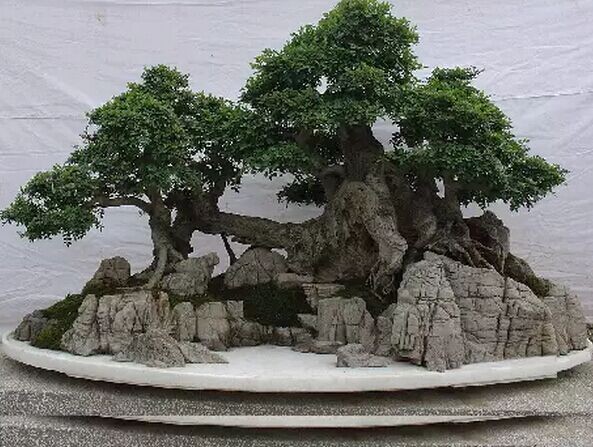
Penjing is an artistic treasure developed in China on the basis of potted plants and stone appreciation, using plants, rocks and other materials, employing the artistic modeling technique of “shrinking a dragon to an inch, a thousand miles within reach,” to present natural landscapes in a pot and express the creator's thoughts and feelings. It requires harmony among the scenery, pot, stand, inscriptions and other aspects, and must also possess a certain artistic realm and a certain thought and feeling of the creator.
First: Watering
Water landscape penjing pots are relatively shallow and hold little water, so moisture evaporates quickly, especially in hot summer, so it is necessary to frequently fill, change and add water to keep the pot constantly supplied with water; only then can the absorbent stone stay moist, which is favorable for the growth of plants and moss. If plants are grown on hard stone, the water supply must be ensured even more. For extra-large landscape penjing, the cement pot bottom should have a drainage hole, usually plugged with a stopper; when changing water and rinsing, pull out the stopper to drain the dirty water. Rocks and plants should be watered frequently to keep them moist so that the plants (including moss) can grow normally.
Second: Fertilizing
The roots of the plants on landscape penjing are placed in limited soil, the roots find it hard to penetrate deep into the soil, and changing the soil is inconvenient. To supply the nutrients needed for tree growth, regular fertilizing is necessary. But fertilizing must not be excessive; it is best to use a thin, colorless and odorless liquid fertilizer, preferably a liquid fertilizer made by soaking soybean cake, sesame residue, beans and the like in water; plants with flowers and fruit can be watered with rice-washing water to encourage more flowers and fruit; tablet fertilizers and granular fertilizers can also be used, but never in excess.
Third: Pruning
The trees on landscape penjing are not the main subject of the penjing; they only play a supporting role, and they must not be allowed to grow too large and ruin the modeling. Therefore, the trees must be pruned appropriately, mainly by cutting out overly dense branches, thin and weak diseased branches, dead branches and sideways-growing branches, and removing overly dense and oversized leaves, so that the landscape and the trees blend into one whole.
Landscape penjing is a type of penjing mainly for viewing rocks. To enhance the sense of reality of the penjing and give it more vitality, people plant some gracefully shaped plants such as asparagus fern, moss, orange jasmine (Aglaia odorata) and azalea on the rocks, to achieve the best ornamental effect. The maintenance of landscape penjing is mainly the care of these plants in the pot.
Landscape penjing generally uses very little soil, the development of plant roots is restricted, and improper management can very easily cause the plants to dry up, so we must take extra careful care to get the best ornamental effect. First we must confirm the phototropism of the plants in the penjing. If the plants grown are semi-shade plants such as five-needle pine, asparagus fern, camellia, orchid and azalea, then we should place the penjing as much as possible in a place with scattered light for care, but the precondition is that there must be good ventilation; if the plants grown on the rocks are light-loving plants such as orange jasmine, pomegranate and dragon juniper, they should usually be placed in a spot with ample sunlight, but in summer appropriate shading is needed.
No matter which kind of plant, the most critical thing is still to spray the plants with water more often, to maintain the humidity of the soil and the environment, especially in the dry and windy spring and summer seasons, when even more attention must be paid to ensuring air humidity, otherwise the plant leaves can very easily dry up. When watering, pay attention to the method; it is recommended to use a spraying method, because too forceful a water flow will wash away the soil. In addition, the water in the pot should also be changed frequently, and the pot should be cleaned, kept clean, to increase the overall ornamental effect of the penjing.
Plant growth must have a sufficient supply of nutrients, but the soil for plants grown on landscape penjing is very little, and changing the soil is inconvenient, so the plants very easily show a lack of nutrients, and therefore the fertilizing work in daily maintenance is especially important. We can usually prepare some thin nutrient solution, and as far as possible apply thin fertilizer frequently; with persistence, the desired effect can be achieved. (If the soil for the plants is too little, new soil can also be added at any time. When adding soil, pay attention to the method and do not dirty other parts of the rocks; after all, cleaning them up is rather troublesome.)
Most landscape penjing will grow moss plants; with proper maintenance, the moss grows very fast and can easily cover the original texture of the rocks, reducing the ornamental value. If this happens, it needs to be cleaned up in time, scraping off some unnecessary moss to keep the original clear stone appearance. Other plants growing on the rocks should also be pruned frequently to prevent the branches and leaves from growing excessively.
In addition, attention should also be paid to cleaning the rocks. Usually, when spraying water on the plants, you can take the opportunity to rinse the rocks, remove dust, and prevent the accumulation of dirt such as water scale.