Detailed Explanation of the Layout Methods and Techniques of Tree-Stump Bonsai
Tree-stump bonsai values "clear, strange, ancient, and grotesque," with the aged and picturesque being regarded as the finest. Whether a tree stump appears aged or young does not depend entirely on the age of the tree; as long as we pay attention to the characteristics of ancient and famous trees and fine bonsai works when admiring them, and seek out the patterns of agedness and youthfulness, it is entirely possible to use artificial methods to give smooth, delicate trees an aged and extraordinary form.
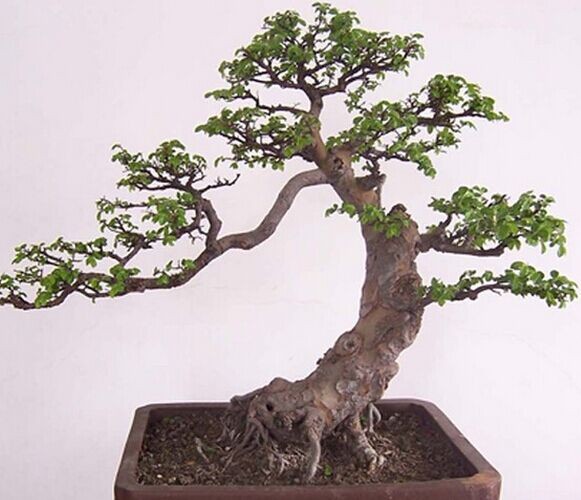
For a fine tree-stump bonsai, besides the posture of the tree itself, the choice of pot is also very important. The pot provides a living space for the bonsai plant and determines the compositional scope of the bonsai. At the same time, the pot is a craft object with a certain ornamental value of its own. In matching pots to tree bonsai, selections must be made regarding the pot's size, depth, style, color, and texture; only when tree and pot are properly matched can the best ornamental effect be achieved. Generally, upright-trunk-style trees are best suited to shallow pots, cascade style to deep cylindrical pots, and slanting-trunk style to pots of medium depth. The size of the pot should be determined according to the tree itself as well as the accompanying stones and accessories. If the pot is too large, it appears empty, and the tree looks low and young, unable to display the tree's majestic momentum. If the pot is too small, it appears bloated and cramped, top-heavy, which not only affects the artistic effect but is also unfavorable to the tree's growth. Generally, the size of the pot is determined by the size of the tree's canopy spread; it is usually required that the tree's canopy spread be appropriately larger than the pot surface, to the extent that it feels comfortable and suitable. For trees with thin, long trunks and smaller canopy spreads, the canopy does not necessarily have to extend beyond the pot surface, but a certain height must be reached. The pot size also varies somewhat according to different tree species; generally speaking, pines and cypresses are better suited to slightly smaller pots, while broad-leaved trees and wisteria, crape myrtle, osmanthus, and pepper-type plants are better suited to slightly larger pots.
The artistic conception of bonsai is expressed through layout; so-called layout means arranging and placing scenery, that is, composition and modeling. To express towering ancient trees and scenes of a thousand miles and ten thousand ravines within a tiny pot requires reliance on special artistic techniques. In layout, there must be distinctions of primary and secondary, large and small, far and near, and front and back; these must be handled in appropriate proportion, achieving harmonious unity amid variation, so as to obtain the artistic effect of seeing the great in the small. Bonsai layout also requires natural variation and distinctive charm in each case, because natural scenery itself consists of trees that do not line up evenly, groves that rise and fall, gather and scatter, solitary trees that bow and lift, lean and slant, colors that range from dense to light and bright to dark, and forms that vary in sparseness and density, emptiness and solidity. Therefore, in arranging scenery, front and back, high and low must be staggered and uneven, avoiding neat symmetry. In clump-branch-style bonsai, only one tree species should be planted per pot in terms of species selection. If two tree species are to be combined, one of them can only serve as a foil to the other.
In the layout of tree-stump bonsai, rocks are often added to make the bonsai appear more natural, harmonious, and poetic. For example, placing rocks beneath the tree makes the potted tree appear towering into the sky; in cascade-style bonsai, placing a stone peak beside the tree is like a tree growing across the sky leaning against a sheer cliff; in multi-trunk-style bonsai, placing a few small stones beside the roots gives a sense of the lush, dense wildness of mountain forests. In addition, birds and beasts, figures, pavilions and pagodas, boats and carts, and bridges and trees can be added as accents, which can enrich the scenery within the pot, bringing movement within stillness, making them more poetic and picturesque and full of mountain-forest charm. When placing figurines, they should be used according to the needs of the theme to set off the theme; the proportions must be coordinated, and excessive artificiality and contrivance must be avoided, otherwise it will give a sense of cliché.