Tree-on-rock bonsai: the bonsai art that ingeniously combines trees and rocks
In daily life, people with refined tastes often like to place artistic bonsai in their homes to cultivate their character and calm their minds. Generally speaking, bonsai are mostly flowers and grasses, or a single rock, and "tree-on-rock" bonsai are rarely seen. Dear reader, when a tree meets a rock, do you know what kind of wonder will be born?
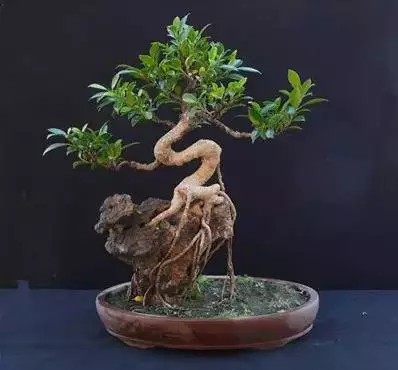
Rock-attached bonsai is a bonsai styling art in which the rock is the main element, the tree grows attached to the rock, and rock and tree become one.
In this kind of bonsai, the tree is planted attached among the rocks, with its root system extending into the crevices to grow, and its branches and trunk twisting into the stone holes or growing in clusters on the rock, or hanging down beneath the rock, or slanting sideways beside the rock, making the curious rock and the ancient tree set each other off beautifully.
Generally speaking, rock-attached bonsai fall into two types: water rock-attached and dry rock-attached.
Water rock-attached bonsai mostly use soft, porous stone materials, such as water-absorbing stone and sandstone, with holes drilled where the trees are to be planted. Trees of initially formed shape are mostly used: first lead the tree roots into the stone holes, fill the stone holes with crushed soil, press the soil and tree roots firmly with a bamboo stick, spray the soil and stone thoroughly wet with a watering can, then place it in a shallow water basin and put it in a cool place. Spray water on the stone and tree every day to maintain humidity; after the tree sprouts new buds, let it receive morning sun and gradually adapt to sunlight.
Dry rock-attached bonsai mostly use hard stone materials, such as Yingde stone (with diverse textures), embedding the tree roots into the stone crevices to create momentum and shape. Tree species with long root systems are mostly used, such as Fujian tea, elm, and baby's breath; the leaves are stripped off, the soil on the roots is cleaned away and the roots are combed straight, and following the texture of the stone, the tree roots are led into the stone crevices and then bound with wire loops.
To prevent damaging the roots, you can first pad with wooden strips wrapped in rubber and press the tree roots more tightly against the stone crevices, then place the stone and tree on the potting soil and bury the fine roots of the tree in the soil. The initial maintenance method is the same as the water rock-attached type, but do not let the westward slanting sunlight shine directly on the roots in the stone crevices, so as to avoid burning the roots after the stone absorbs heat.
Generally, banyan trees are suitable for the rock-embracing style of rock-attached bonsai.
Once the plant is attached to the rock, it cannot be changed, so before making it you must think carefully and choose stones and trees of suitable form.
PS:
Rock-attached bonsai is a bonsai styling art in which the rock is the main element, the tree grows attached to the rock, and rock and tree become one. The tree is planted attached among the rocks, with its root system extending into the crevices to grow, and its branches and trunk twisting into the stone holes or growing in clusters on the rock, or hanging down beneath the rock, or slanting sideways beside the rock, making the curious rock and the ancient tree set each other off beautifully.