How to Make and Combine Miniature Bonsai? A Detailed Guide to the Method
Miniature bonsai are made mainly with flowers and grasses, accented with small items such as rocks. They are small in form, exquisite and unique in shape, and place great emphasis on overall structure and fineness of detail. For general plant shaping, the optimal time should be after the onset of winter and before the plants bud the following spring. Before shaping, you should design the shaping concept and determine the shaping method based on the characteristics and posture of the tree being planted.
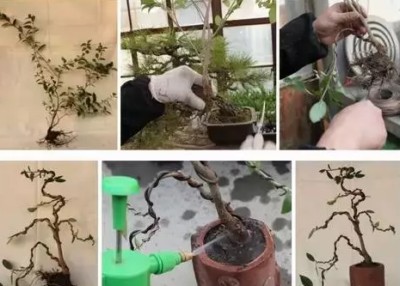
First, select the trunk, as the trunk is the main body of the miniature bonsai's shape. Then, prune away excess side branches so that the overall structure is clean and crisp. Next, you can apply wire, keeping it concise and smooth to fully display its natural beauty. After tidying it up, it can be potted. Choose a suitable pot according to the size and thickness of the selected plant to achieve a unified and harmonious effect. Since it has just been put into a new pot and the soil is loose, finally use a spray bottle to gently sprinkle the soil layer thoroughly, avoiding too rapid a flow of water that would wash the soil away.
The process of making miniature bonsai is simple; a skilled technician can finish making one in just over ten minutes. The choice of materials is wide, and the glossy privet (Ligustrum lucidum) used in this article is one that can be seen everywhere along the roadside, making it very suitable for ordinary people to create with. Using leisure time on weekends, you can make several pieces of your own work.
Miniature bonsai are also often displayed in combination, and the various decorative pieces of each small group of bonsai need to show different forms, with attention paid to the overall layout. Gathering and scattering appropriately, with a prominent theme, ultimately achieving the creator's artistic conception and aesthetic taste, this is where the vitality of miniature bonsai art lies.
Miniature bonsai is one of the bonsai schools prevailing today. It uses small pots, has precise conception and beautiful shapes, adorns the room, and is full of vitality.
1. Sourcing materials. For making miniature bonsai, generally choose materials with fine branches and small leaves, easy to keep alive after potting, peculiar roots and trunks, gorgeous flowers and fruits, and easy to shape. Commonly chosen ones include five-needle pine, small-leaf podocarpus, Chinese juniper, black pine, boxleaf holly, bamboo fern, fine-leaf holly, snow-in-June, asparagus fern, Japanese bush cherry, and nandina. The above tree species can be obtained by cuttings, sowing, and division. To achieve rapid formation, you can also dig up tree stumps from the wild such as goji, caragana, wisteria, and firethorn; after digging, through artistic shaping, they can be planted in pots.
2. Shaping. The making of miniature bonsai requires skill shown in the finest details, and one must "conceive the idea before putting pen to paper." Before making it, you should know the posture and habits of various trees like the back of your hand. Shaping should be highly generalized, and according to the characteristics of the trunk, appropriately make some finishing touches that bring it to life, so that it is well-spaced and clearly layered. Commonly used shaping methods include the palm-fiber binding method, lead-wire winding method, branch-breaking method, climbing-and-binding method, and inverted-hanging method.
3. Potting. While shaping, the trunk should be transplanted from the clay pot into a purple-clay pot or glazed box, and the shape, size, and color of the pot need to match the tree body. In general, tall deep cylindrical pots are suitable for cascade style; oval pots or shallow rectangular pots are suitable for planting upright or slanting trunk styles; round pots can be used for low, twisted plants; polygonal shallow pots are suitable for planting tall-trunk styles. In addition, the pot stand should also coordinate with the shape and color of the flower pot, blending into a complete artistic structure. The ancients, in appreciating potted plant art, had the famous saying "first the tree, second the pot, third the flower stand."
4. Care. The care of miniature bonsai especially requires thoughtfulness and meticulousness. The potting soil should be kept moist regularly, alternating between dry and wet, or watering can be done by the pot-soaking method. In midsummer, place it in a cool place and use a fine-nozzle spray bottle to spray water on the plants to maintain a humid environment. During the growing period, apply thin fertilizer frequently, generally once about every 10 days. You can use fully decomposed soybean cake water, or apply a complete-element compound flower fertilizer. The best fertilization method is also the pot-soaking method.