An Analysis of the Artistic Characteristics and Aesthetic Value of Miniature Bonsai
Miniature bonsai is a rare gem within the art of bonsai. As early as the Yuan Dynasty, there was the eminent monk Yun Shangren who wandered the four directions, condensing the beautiful scenery of nature into a tiny space, hence the name “xiezi jing” (tiny scenery). This is the ancestor of contemporary miniature bonsai.
In the 1930s, Chinese horticulturist and writer Mr. Zhou Shoujuan and horticulturist Mr. Shen Yuanru both began creating and cultivating “xiaopin” (small-scale) bonsai, with gnarled trunks and twisted branches, like poetry and painting.
In the late 1940s, Mr. Shen Yuanru's son, Shen Yinchun, followed in his father's footsteps, devoting himself to the study of miniature bonsai, and collected miniature pots from the Daoguang, Tongzhi and Guangxu periods of the Qing Dynasty, doing a great deal of meticulous and fruitful work for the study of the history of miniature bonsai development in China.
In the early 1980s, the book "The Art of Miniature Potted Landscapes" by miniature bonsai artist Mr. Shen Yinchun was published by Jiangsu Science and Technology Press, becoming China's first monograph on the art of miniature bonsai. Many countries and regions around the world have organizations and individuals engaged in research on this art. The 4-year-old cypress cultivated by French horticulturist Androu Montagny is no taller than a thumb, with a pot of only about 2 cm.
Over the past 10 years, China's miniature bonsai art has made great breakthroughs. Since the first China Bonsai Art Competition in 1985, miniature bonsai has been officially included as a competition category, reaching thousands of households, crossing national borders, active on the international cultural and artistic stage, and becoming an important part of China's commercial bonsai exports earning foreign exchange.
As an art form, miniature bonsai, with its rich forms, unified and harmonious color effects, and outstanding expression within limitations, displays its fresh and elegant artistic charm. Miniature bonsai uses plants and rocks as its main materials, and through artistic conception, employs techniques such as exaggeration and condensation, achieving “sentiment in every inch of wood, grace in every fragment of stone.” Expression within limitations is an outstanding artistic creation. The reason miniature bonsai is favored by most people, besides containing numerous artistic genes, is importantly that it has its own specific artistic language and exquisite technical expression, distinguishing it from others with a unique style.
Miniature bonsai embraces heaven and earth in the palm, unfolds creation upon the fingertips. With extraordinary techniques, miniature bonsai condenses, summarizes, distills and vividly expresses the beauty of nature and the beauty of art; expressing within a limited space, although it can only depict a certain part, a certain fragment, a certain posture, yet a successful work may enable viewers to feel the infinite that exists indirectly within the finite that is directly expressed.
The art of miniature bonsai, through changes beyond the ordinary, creates a novel visual impression that arouses the viewer's desire to explore; through the potential connotations of limited forms, the triggering power and appeal thus produced evoke symbolism and rational thinking, from narrow to broad, from form to spirit, from shallow to deep, from finite to infinite. It is both a generalized expression of image and a manifestation of the richness of inner meaning. In a tiny space, it expresses a unique artistic language so freely, naturally and thoroughly. Here art and technique, content and form, wisdom and will achieve full harmony and unity; the aesthetic characteristics of revealing the large through the small, viewing the many through the few, and seeing the macro through the micro, highly difficult and ingenious, astonishingly concentrating vast connotations within the smallest area, become a powerful embodiment of the artistic individuality of miniature bonsai.
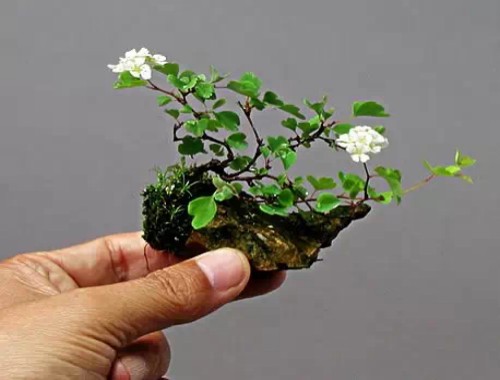
“Poetic sentiment and pictorial beauty in the palm of the hand.” Miniature bonsai, no larger than a palm at most, small enough to be placed on a fingertip at least, hence also known as “poetry and painting in the palm” and “gardening on the fingertips.” Displayed on balconies, by windows, on desks, one can enjoy and appreciate the charm of nature without leaving home, satisfying the longing for nature; through unexpected and extraordinary forms, boldly using human visual illusion, it produces magical suspense and deep interest. Tiny to almost the limit, yet full of life and vitality, it lets viewers spread the wings of imagination, merging fun and philosophy into one, remarkably true to life. Many “coarse and inexpensive” plant materials, moss, small grasses and stone fragments found everywhere, in miniature bonsai can become emerald-green lawns, towering towering trees, and undulating hills and dense forests without any sense of inferiority.
Miniature bonsai is a four-dimensional spatiotemporal form of expression, distinct from miniature sculpture and miniature painting. The changes in plants' forms and colors across different seasons constitute a rich aesthetic landscape, giving people endless reverie. Each miniature bonsai is exquisite and versatile; some are elegant and classic, some bright and charming, some simple and vigorous, some light and fresh, as if it were a miniature plant kingdom of a thousand postures and colorful brilliance.
The display and appreciation of miniature bonsai has a broad field of expression: richly colorful plants, pots of varying shapes, stands of endless variety, and the compositional changes among these three, free, casual, flexible and ever-changing. Miniature bonsai is also a comprehensive, multi-dimensional art, seemingly like vivid “poetry and painting,” in which rhythm, color, lines and so on give people a sense of beauty, “form resides in the painting, spirit extends beyond the image.” As a carrier of emotion, miniature bonsai breaks through limited space, transcends the constraints of external materials and images, and to a great extent evokes people's imagination. The artistic charm of miniature bonsai lies precisely in this.