Root-over-rock bonsai demands a high level of artistry and has a strong wild, mountain-and-field flavor.
Root-over-rock bonsai, also called "tree-and-rock" bonsai, is a bonsai form that ingeniously combines trees and rocks into one; its characteristic is that the tree is planted on the rock, with the roots either anchored in rock holes or crevices or clasping the rock as they grow, and its style is either delicate and elegant, or majestic and grand, or rustic and vigorous, or steep and precipitous, or open and spectacular. Root-clasping rock is generally called "root-over-rock," and in Japan it is called "ishitsuki." The "root-over-rock" art of several decades ago demanded a high level of artistry and had a strong wild, mountain-and-field flavor, making it hard to put down. The method is:
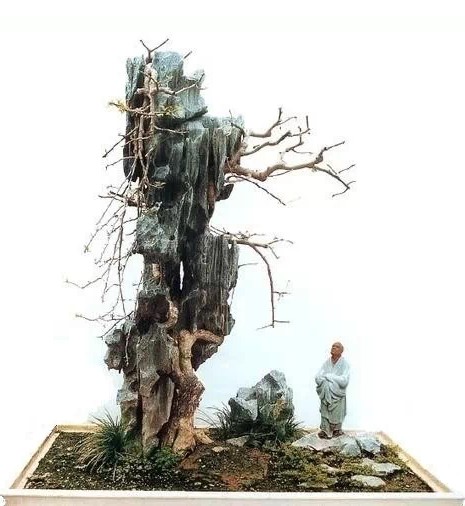
1. The rock is more than three to five times larger than the tree.
2. Use semi-water-absorbing stone, pumice, Yushan stone, and other stone materials that can absorb water or are semi-water-absorbing. For semi-water-absorbing ones, water more than twice a day and give half a day of sun.
3. The tree roots must not reach down to the bottom of the pot to absorb water; only then does it count as a true root-over-rock bonsai. Otherwise they are all fake root-over-rock and not up to standard.
4. With this planting method, the resulting tree does not easily grow larger (you should choose material with shaping potential from the start) and only grows older year by year. The rock also ages. It goes without saying that this is a naturally root-over-rock plant moved indoors. A high-grade bonsai for a desk or courtyard!
5. Some people also use hard stone (non-water-absorbing) with beautiful form, dig a slightly larger hole in a suitable place, and plant it with potting soil. But only its roots are allowed to be exposed, and it must not be allowed into the pot to absorb water. That is not bad either.
To learn to create high-grade works, you must innovate on the basis of ancient works -- rise to a higher level.