How to cleverly shape miniature bonsai? Sharing practical tips
Miniature bonsai shaping should also be expressed as poetic and picturesque, small but must be exquisite. For small trees, especially deciduous bonsai, the internodes must be short and the proportions must be harmonious to create something within a 15cm size. For pine and cypress miniature bonsai shaping, attention should be paid to the degree of compactness in the processing techniques. In particular, the changes in the trunk must be well controlled, highlighting the uprightness and character of the pine.
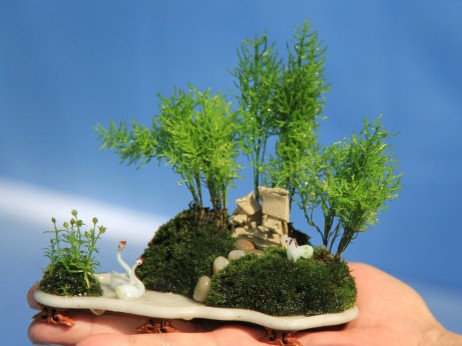
In shaping and production, miniature bonsai, like medium and large bonsai, equally emphasizes shaping principles and techniques, such as shaping according to the tree's tendency, combining movement and stillness, using both complexity and simplicity, clear primary and secondary elements, complementary gazing and responding, harmonious proportions, unity in variation, and both form and spirit, as well as the compatibility and application of various techniques such as dropping branches, hanging branches, flat spread boards, chicken-claw branches, and deer-horn branches. In addition to these common points, according to the characteristics of miniature bonsai, attention should be paid to dwarfing, airiness, and simplicity.
1. Dwarfing: Although miniature bonsai are short and small, they must express a tree image of gnarled vigor, aged appearance, and viewing the large from the small. Therefore, the contradiction of being both short and aged must first be resolved. On the one hand, pay attention to selecting the stump; on the other hand, during production, pay attention to dwarfing the tree, controlling the tree height to the maximum extent, and adopting planting and pruning methods such as short and dense curved trunk segments and rapid tapering to forcibly dwarf it.
2. Airiness: Miniature bonsai are small in volume, and the space available for branches to extend between each other is correspondingly small. Therefore, there is no need to insist on the lush foliage and sky-covering canopy of medium and large bonsai. Redundant branches and superfluous forks should be consciously removed, making the branch lines clear and airy, avoiding clumping, and appropriately pruning to leave space. Repeated in this way, as the tree takes shape, the leaves gradually become smaller, and the entire branches and leaves become airy and delicate.
3. Simplicity: Airiness mainly refers to the ethereal spacing between branches, while simplicity refers to the branch pads as a whole. Miniature bonsai should not have many branch pads; simplicity is best. As the saying goes, 1? sparse shadows slanting across two or three branches“, each branch refined, each leaf expressive. Large space and small volume, with complicated branch pads, not only increases production difficulty but also loses the charm of miniature bonsai's small and exquisite nature. But simplicity does not equal nothing, and small does not equal weak; rather, it is viewing the large from the small, using one to represent ten, and using less to represent more. Therefore, in addition to scientific care, one must have corresponding shaping skills and aesthetic cultivation.
In short, rules are summaries of regularities, and flexible application is advocated; blind application is not advisable. Moreover, differences in each person's aesthetic orientation and the form of the stump material make formulaic approaches even more impossible. This is the meaning of _the method has no fixed method, and within the method there is method”. Grasp and maintain purity, freshness, without deliberate effort, without being too rigid; the single word “clever” is the advantage and characteristic of miniature bonsai.