Material selection methods and techniques for making miniature bonsai
Miniature and small bonsai belong to the small-size category among bonsai artworks, with miniature bonsai being the smallest, generally under 10 cm, known as palm-top bonsai; small bonsai are 11 cm to 40 cm (Note: in this book, the first dimension given for a work is height, and the second is width). Precisely because they are known for being tiny, viewing the large within the small, being small and exquisite, as well as their relatively low cost, small space requirement, ease of moving, and convenience of cultivation and maintenance, they are favored by people.
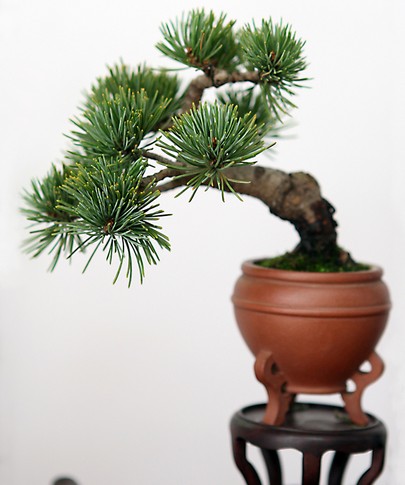
Material selection includes tree species and their basic forms.
1. Tree species: For making miniature and small bonsai, plants are generally chosen that have small, thick-textured leaves, short and dense internodes, gnarled and rugged nodes, are easy to keep alive, have strong stress resistance, high sprouting rate, tolerate pruning, have high plasticity, and have a relatively long lifespan. Commonly used ones include Chinese elm, Japanese bush cherry, Chinese hackberry, orange jasmine, Fukien tea, maple, trident maple, fine-leaf Buddhist pine, Japanese black pine, five-needle pine, boxwood, small-leaf banyan, small-leaf holly, serissa, Chinese wolfberry, crape myrtle, firethorn, Australian pine, golden bean, plum, ginkgo, and so on.
The sources of these raw materials can be purchased from nursery farmers; they can also be propagated by oneself. They can be obtained by methods such as cuttings, sowing, division, and grafting; they can also be collected in the wild. Although this is hard work, the joy is found within it, and you might even find an ideal, excellent piece of raw material. In addition, if handled properly, herbaceous and foliage plants can also have a unique charm, such as Japanese sweet flag, saxifrage, small horsetail, and red thatch grass. Then, by planting herbaceous foliage types together with woody plants, and through artistic refinement with ingenious touches, there are often unexpected effects. Compared with the meticulous structure and grand momentum of large bonsai, they often possess a unique elegant and leisurely mood, embodying a relaxed and pleasant state of mind.
2. Form: While understanding the variety, one must also master the basic forms of the raw stump material, such as straight trunk, slanting trunk, lying trunk, cliff-hanging, waterside, forest, rockery, and bizarre stump material, etc. But masters often have a unique eye in material selection, exercising original craftsmanship, applying skills according to the material, and producing something extraordinary from the ordinary.
Especially for miniature bonsai, people of free spirit are not constrained, follow their inclinations, pick things up casually, make slight additions or deletions, and with a bit of refinement and arrangement, it becomes a true scene, inspiring poetic enthusiasm and making one linger within it.