The exquisite beauty of rock-clinging bonsai, revealing the charm of nature within a tiny space
China's bonsai art has been passed down for more than a thousand years and is praised as “three-dimensional painting” and “silent poetry.” Rock-clinging bonsai is a further inheritance and development of bonsai art; the perfect blend of the firmness of stone and the softness of trees deeply attracts stone enthusiasts and bonsai lovers.
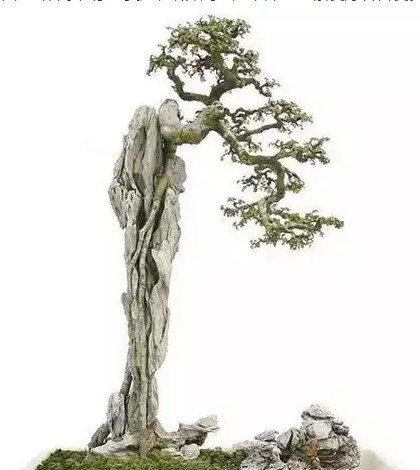
As usual, below are exquisite rock-clinging bonsai presented for your appreciation!
Bonsai uses containers to hold plants and blend in human wisdom, capturing a corner of nature to stand alone as a landscape.
In the world of bonsai, there is a category that ingeniously combines trees and mountain stones into one: the tree grows clinging to the stone, the tree has posture, the stone has presence, creating the unique rock-clinging bonsai.
Rock-clinging bonsai is also called stone bonsai. It reflects the natural appearance of trees growing on stone and is an exaggeration and close-up of the image of trees tenaciously growing in cliff crevices or on mountain peaks and rocky summits.
It is rich in content and profound in artistic conception, with beautiful modeling, ingenious design, diverse forms, simple and easy-to-master production, and a short cultivation cycle, making it deeply loved by bonsai enthusiasts.
Not being bound by proportion and allowing a certain degree of exaggeration is a major characteristic of rock-clinging bonsai. When the tree is large and the stone is small, with the focus on viewing the tree, it can be classified as tree bonsai; when the tree is small and the stone is large, with stone appreciation as the focus, it is classified as landscape bonsai.
In the bonsai, the tree grows clinging to the stone, extending its roots into the stone crevices to grow, with branches and trunks coiling into stone holes or growing in clusters on the stone, or hanging down below the stone, or slanting sideways beside the stone, making the strange stone and ancient tree set each other off beautifully.
Rock-clinging bonsai is divided into two types: water rock-clinging and dry rock-clinging. Water rock-clinging mostly uses soft stone materials, such as water-absorbing stone and sandstone, drilling holes where trees need to be planted, mostly using trees with initial form. First lead the tree roots into the stone holes, fill the stone holes with crushed soil, press the soil and tree roots firmly with bamboo sticks, spray the soil and stone thoroughly wet with a watering can, then place it in a shallow water basin and put it in a cool place.
Spray water on the stone and tree every day to maintain humidity. After the tree sprouts new buds, it can be allowed to receive morning sunlight and gradually adapt to sunlight.
The dry rock-clinging type mostly uses hard stone materials, such as Ying stone (with diverse textures), embedding tree roots into stone crevices to create momentum and shape, mostly using Fujian tea, which has long roots.