Illustrated Tutorial on How to Make a Tree-Rock Water-and-Land Penjing
Tree-rock water-and-land penjing uses plants, rocks and growing medium as materials, applying respectively the creative techniques of tree penjing and landscape penjing, combining them into a scene according to a conceived theme, and carefully shaping the terrain and landforms, dotting them with ornaments such as pavilions, boats and carts, cattle and horses, and human figures, to represent a water area in a pot, typically reproducing the natural landscape where water surfaces, dry-land groves and rocks all coexist. The proportion of its companion rocks is smaller than that of landscape penjing. Water-and-land penjing combines the strengths of tree penjing and landscape penjing, with an elegant artistic conception, like a poem and a painting. According to the expressive techniques, water-and-land penjing is divided into the waterside type, the stream-and-ravine type, the rivers-and-lakes type, the island type, the comprehensive type, and so on.
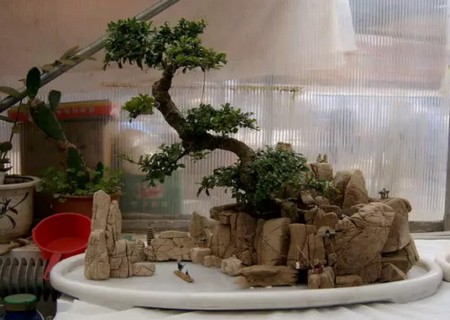
1. Selecting materials: turtle-vein stone, a white marble stone pot, cloud-stone glue, one penjing plant, and several landscape ornaments. Clean the stone materials with a brush.
2. Positioning: fill two bags with soil and set fix points at the positions where the landscape is to be created, so as to facilitate fixing.
3. According to the conception thought out in advance, pile the selected stone materials around the bags. Repeatedly deliberate until the best effect is achieved.
4. Use cloud-stone glue to firmly fix and bond the stones to the pot and the stones to one another.
5. Apply white cement (with an appropriate amount of 107 glue added to the white cement) to the gaps between the stones. The cement needs to be applied twice, and finally a coat of plain cement slurry is brushed on. Add water only to the extent that it does not leak.
6. After testing with water and finding no leakage, drill a 3 cm hole in the center of the stone to facilitate drainage.
6. Plant the selected penjing and arrange the scene.
Done. The whole process took one week in total, most of the time wasted on waiting for the cement to dry. The overall effect is still quite good.
Tree-rock water-and-land penjing forms beautiful scenes, with a fresh style, implicit and meaningful, a broad range of applicable themes, and considerable market prospects. How to bring it into thousands of households: simplifying its care and management is an important link.
Tree-rock water-and-land penjing uses extremely shallow pots, and the combination of soil and stone uses little soil, mostly in the water-and-land style. Its care and management may seem a difficult problem. For example, with a shallow pot, little soil and no water opening, watering easily runs off outward, so it needs to be done repeatedly many times. When applying fertilizer, fertilizer is also wasted, causing environmental pollution.
It seems troublesome and laborious, but in fact simple and effective methods can be used for care, which not only saves time and effort but also makes the plants in the pot grow vigorously and bear flowers and fruit. For watering, you only need to ladle in a scoop of clear water when the soil has already become hard or whitish, and let it seep into the soil. For fertilizing, you only need to drip in about ten drops of vegetable oil each month.