A Detailed Guide to the Cultivation and Care of Wild-Dug Sageretia Stumps
Sageretia (Sageretia thea) belongs to the buckthorn family (Rhamnaceae). Its roots and trunk are naturally striking, and its tree form is rugged and elegantly ancient. It is one of the main species for Chinese stump bonsai, one of the five famous trees of Lingnan bonsai, and one of the bonsai plants exported to the United States after China's entry into the WTO. The fruit of sageretia is edible, with a sweet-and-sour taste, hence the name "sour plum fruit"; the young leaves can be used as a substitute for tea. Sageretia is native to China's Yangtze River basin and the southeastern coastal provinces, and is also distributed in Japan and India; it is a subtropical adaptable tree species. Its roots and trunk are naturally striking, and its tree form is rugged and elegantly ancient. It is one of the main species for Chinese stump bonsai, one of the five famous trees of Lingnan bonsai, and one of the bonsai plants exported to the United States after China's entry into the WTO.
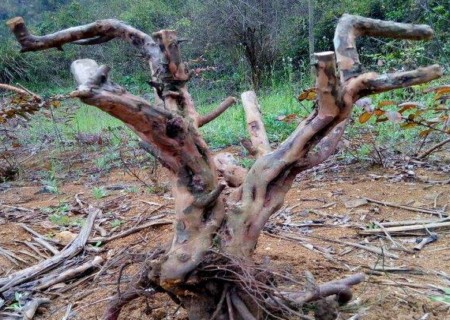
Using wild old-root sageretia stumps collected from mountain areas to make bonsai is relatively common and also yields quick results. In the low hills and mountains of Jiangnan, beside rocks and ditches, old sageretia stumps that have sprouted after years of cutting are dug out; after digging them back, take care to protect the root system. Apart from broken and severed roots, do not prune for the time being. How many lateral roots and fibrous roots are retained, and how good their quality is, is the key to survival. The branches and trunk should be pruned once, keeping the main branches and trunk and buds, and cutting away all remaining branches; at the same time, consider the shape of the stump and its future styling. Now let's look at the cultivation and care methods for wild-dug sageretia stumps!
I. The stump-collecting period for sageretia
The climate in the south is warm, the plant dormancy period is short, and buds sprout early. The best stump-collecting period is during the period from Minor Cold to Major Cold. After dormancy, the tree has accumulated a large amount of nutrients, which is beneficial for sprouting and rooting. Roots and buds complement each other. Good development and growth of both is the premise and key to ensuring the stump survives and to preventing drying out and withering of branches.
II. Pre-planting treatment of sageretia
1. Cleaning the stump blank. After the raw blank is collected, remove or keep branches and trunk according to the tree's vigor and requirements, then cut off about 10 mm from the old cut left during digging. After the cut is made flat, use a stiff bristle brush in water to clean the bark on the root portion of the trimmed raw blank, then let it dry.
2. Disinfection and soaking solution: soak the cleaned tree blank's roots in a 0.3% potassium permanganate solution for about one hour, then let it dry; then soak the tree blank's roots overnight in an aqueous solution of about 0.4% naphthaleneacetic acid, to replenish the water lost during digging and transport and to enhance the healing capacity of the wounds.
III. Initial planting management of sageretia
To plant sageretia well, you must first get through the initial planting stage. Initial planting refers to the period when the tree blank comes down from the mountain; it generally carries no soil, so the root-tip cells are prone to necrosis.
During the stage of styling and branch selection, pay attention to the following points:
1. The treated tree blanks are planted in rows on a sand bed, with a plant spacing of about 20 cm, with large and small ones interspersed among them. The planting depth is 5 to 10 cm, depending on the size of the stump blank. Alternatively, use clay pots or wooden boxes; the principle for choosing a container is "rather too large than too small, rather too deep than too shallow."
2. One month after initial planting, sageretia tree blanks generally can form new roots and send out new buds. After three months they enter a stable growth period. In the sixth and seventh lunar months, the weather is hot, plant transpiration is fast, and those with poor root development are very prone to heatstroke and death. Therefore, at noon during the high temperatures of summer, the stump must be placed in a shaded spot, watered once each in the morning and afternoon, and sprayed all over the tree with a sprayer at noon.
IV. Potting management
In daily management, full sun is the main practice. Note: whether in a greenhouse or outdoors, when the temperature rises above 35°C, shade treatment should be applied. On the eve of the plum rain season during care, you can push aside the sand at the roots to observe the rooting situation. At this time the roots should be growing well, with many and long fibrous roots. If the new fibrous roots at the roots have reached 10 to 15 cm, they can be potted and planted; do not delay, and be sure to finish potting a few days before the plum rain. The soil used for potting must be clean and loose; preferably half mountain soil and half cinder ash, as such soil helps new stumps survive and grow in the pot. After potting, place them in a greenhouse or plastic shed for a transition of four to five days. Then move them outdoors during cloudy and rainy weather.
When exposed to sunlight on clear days, if the new bud tips do not droop, then they have adapted to the outdoor environment and have survived. For potted new stumps that have adapted to the outdoor environment, under routine care, after one and a half months apply a light fertilizer once as appropriate according to the growth situation. At this time the tender branches growing on the new stump blank have reached a length of about 30 cm, and their thickness has also reached about 2 mm. Such branches are still relatively weak, and management should be strengthened. According to the growth situation, apply slightly more concentrated fertilizer water every 10 days to half a month until the Start of Autumn, so that by early September of that year they can be tied and styled.
V. Care methods
1. Water must be sufficient
The water used is best natural water such as river water, pond water, or rainwater. If tap water is used, it needs to be stored for one or two days so that the chlorine in it escapes before use; this is more appropriate. Soapy laundry water, as well as water with oil stains or salt content, must never be used.
2. Fertilizing must be done carefully
If sageretia is fertilized too much, the branches and leaves grow excessively; if it lacks fertilizer, the branches become thin and weak, the leaf color turns yellow, and it becomes susceptible to pests and diseases. Therefore, fertilizing must follow principles: newly planted, newly potted, just repotted, or root-damaged plants must not be fertilized within one month. In spring and summer, during the peak growth season of the potted tree, more fertilizer must be applied. After autumn begins, when the potted tree grows slowly, less should be applied. In winter, when the potted tree enters dormancy, fertilizing can be stopped. Fertilizing is not suitable on rainy days or around noon in midsummer. It is best to apply fertilizer solution on cloudy days or in the evening; when the potting soil is slightly dry, loosen the soil to help the fertilizer water seep into the soil. To speed up the decomposition of the fertilizer, be sure to water the next morning.
3. The potting soil must be good
Sageretia stumps originally grew in wild areas, with well-developed root systems and tolerance to both drought and waterlogging. Once dug up by people and planted in a shallow pot only a foot or so wide, their growth conditions are restricted, and with improper care they easily die, so they must be tended with special care. Choose flower soil with good drainage; during the care period, it is best to put the potting soil in a thicker layer. Replace the soil with new soil every two years, and apply some base fertilizer to keep the soil fertile, so that the stump landscape can grow normally.
4. Pruning must be timely
The general pruning time is late spring and early autumn, as in these two seasons the sageretia stump has the strongest sprouting ability and the most vigorous growth. Water shoots, overlapping branches, crossing branches, radiating branches, dead branches, and pest- and disease-damaged branches should be cut off at any time. But note that in hot weather, new buds are easily scorched, causing curled leaves; therefore, after pruning, it is best to place the plant in a cool place until it sprouts normally before exposing it to strong light.
5. Pest and disease control
Common pests and diseases of sageretia stumps include the longhorn beetle, commonly known as the "heart-boring worm." The female longhorn beetle bites through the bark and lays eggs on the branches and trunk; the newly hatched larvae bore and feed under the bark, and when grown they bore into the trunk and roots. Affected plants are often hollowed out and die. The location of the longhorn beetle damage can be judged by the excrement; insert a suitably sized wire into the worm hole to stab the larvae to death, or soak a cotton ball with 200-times diluted dichlorvos and plug the bore hole to poison the larvae, then seal it with wet mud.
The red spider mite, also called the fire spider, is also a common pest of sageretia stump landscapes. It is less than 1 mm in body size and is orange-red or reddish-brown and oval. The red spider mite spins webs on the plant's leaves and uses its mouthparts to pierce the branches and leaves and suck the sap. The chlorophyll of the damaged leaves is destroyed, the color turns pale yellow, fine dense grayish-yellow spots appear on the leaf surface, and the leaves gradually wither, yellow, and fall; in some cases even all the leaves of the whole plant drop off and the plant dies. Spray 1000-times to 1500-times diluted dichlorvos or dimethoate to eliminate them.