Planting Methods and Technical Key Points for Collected Bonsai Stumps
Opinions have always differed on determining the transplanting time for bonsai stump material. Based on my own experience in planting stumps, I believe it generally varies with time and place, and should not be treated rigidly. In our southwestern region, the transplanting time should generally be chosen when there is no rain, snow, or frosty weather. Deciduous tree species and pines and cypresses can be transplanted from early winter to before Jingzhe (Awakening of Insects) the following year. Evergreen tree species and cold-sensitive tree species can be transplanted after the warm spring weather turns mild, with the best time being from early March to late April. During transplanting, care should be taken to retain as many fibrous roots as possible, as these are the lifeline for the stump's survival and its ability to normally transport nutrients in the future. Therefore, understanding the ecological habits of various tree species and the climatic conditions of each locality when choosing the transplanting time is the key to whether a new stump can survive.
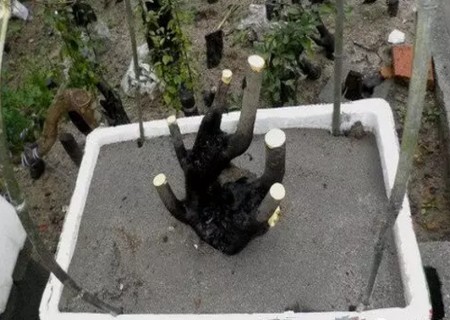
Collected stumps are beautiful and inexpensive, but they carry certain risks. How can the risks be minimized and the survival rate maximized? Below, I will explain how to plant collected bonsai stumps.
1. Promoting Root Growth
To improve the survival rate of newly collected tree stumps, the key lies in making them root early and grow rapidly. To make the roots of a new stump form quickly, attention must be paid to cutting the ends of the main roots cleanly, allowing new roots to grow out from around the new cut surfaces. In addition, you can also make a few light cuts with a sharp knife in different directions around thicker roots; young roots will generally grow from around the wounds. Plant growth regulators can also be used to encourage the stump to root.
2. Shortening the Time the Stump Is Out of Soil
Generally, stumps are dug back from the mountains and wilds, and the time out of soil is at least three or four days, or as much as eight or ten days. If left too long, the tree only loses moisture through evaporation without any replenishment, and it will easily dehydrate and wither. Therefore, the timing must be grasped and planting done as soon as possible to shorten the time the stump is out of soil. Soil is the main source of nutrients for plants. When covering the soil over a newly planted stump, attention should be paid to air permeability and drainage, and the soil should be gently compacted so that every root is in close contact with the soil, ensuring that roots adhere to soil and soil clings to roots.
3. Sealing Cuts
After a new stump has been trimmed and shaped, it has many wounds from knives, saws, axes, and chisels. The simplest method is to smear the wounds with beeswax, paraffin wax, or white glue, or wrap the wounds with strips of cloth. Note that any old wounds should all be re-cut or re-trimmed, and sealed immediately after cutting or trimming. Sealing wounds not only prevents bacterial invasion but also plays a certain role in preventing water evaporation.
4. Water Supply
Newly planted stumps should not be watered too much, otherwise the stump will sprout too many buds while root growth is slow, unable to supply the evaporation needs of the buds, causing the stump to wither. Therefore, the water amount must be controlled as much as possible. After new roots and new buds have emerged, water an appropriate amount according to the number of buds. Plants tend to root easily in dark places. When the branches and leaves are luxuriant, more water and more sunlight can be given to benefit the plant's growth.
5. Fertilizing
It is generally believed that newly planted stumps cannot be fertilized, and that especially premature fertilizing will cause the stump to suffer "indigestion." But practice has proven this is not the case. As long as the stump's development can be assessed, especially after new roots have grown, timely application of an appropriate dilute liquid fertilizer can better promote the growth of fibrous roots and the vigorous growth of branches and leaves.
Good stumps are hard to come by, and keeping them alive is not easy. Practitioners engaged in bonsai creation must, in managing stumps, follow the combination of tree growth laws and the local conditions at the time, emphasize science, prefer diligence over laziness, be careful and cautious, serious and conscientious, turn the rotten into the miraculous, and make the ordinary exquisite, keeping one dull wooden lump after another alive and processing them into high-grade artworks -- tree stump bonsai. The following are taboos in the care of collected stumps:
1. Avoid Shallow Planting
Even for relatively fresh stumps with split bark yet green wood, due to their injuries they must be treated as "seriously ill patients" and must be planted deep, basically buried to the point where only the top is exposed. The top should also be covered with loose soil or enclosed with a plastic bag. In this way, after deep planting of the whole stump and thorough watering, moisture can be maintained for a longer time, making it easier to promote bud emergence and survival. With shallow planting and the upper part exposed, wind and sun make it difficult to dry out and survive.
2. Avoid Frequent Checking
For buried stumps, even if they have sprouted and grown strong, one should not rush to take them out as living stumps and pot them, because sprouting and branch growth on the upper part often occur while roots are growing below. If you always check whether the lower part has rooted and repeatedly take the stump out and bury it again, it will undoubtedly hinder normal rooting; moreover, once new roots are present, they should even less be moved casually and injured, damaging the tender, fragile, fine roots.
3. Avoid Infrequent Watering
After the stump is buried and thoroughly watered, do not forget to water again after it dries somewhat. An injured stump originally lacks roots in the lower part, while the upper wounds evaporate moisture. Among "life" dangers, water loss is the most feared, so ensuring constant moisture without waterlogging is most important; it is very possible that just one longer period of failing to maintain moisture can cause death by drying out. Do not be negligent about the issue of moisture retention.
4. Avoid Misjudging
In the process from felling and collecting the stump to maintaining it until survival, the earlier stage of cutting roots and breaking branches causes the plant to be suddenly severely injured, prolonging dormancy and entering "false death." At this time it must be properly tended, for if dormancy lasts too long, it is not easy for it to "awaken again." When temperature and moisture preserve the stump and its vitality rises, tender buds first emerge from the vitality within the stump, entering "false life." At this time new roots have not yet grown, and even when new roots do grow, true survival has still not been reached, because these tender roots are not enough to absorb sufficient water and nutrients to supply what the stump needs, so the stump must still continue to be kept buried to encourage vigor. Therefore, do not judge whether it is alive or dead merely by observing its surface appearance.
5. Avoid Impatience
For the first design of the stump's posture as a bonsai, it is best to think repeatedly. The removal of main roots, large roots, large branches, and other heavier processing should all be carefully deliberated before being decided, and once decided, should not be changed lightly. Cutting and then changing repeatedly often prolongs the stump's dormancy, and frequently changing one's mind and removing new buds can also cause the stump to go from "false death" to true death. Impatience and restlessness are extremely unfavorable for cultivating stumps.