How to grow miniature bonsai? Master these care tips
Although miniature bonsai are relatively small, they are very exquisite. You could say they are simply a scaled-down display of a larger landscape scene. After all, miniature bonsai often focus on flowers, grasses and green plants, with small accessories such as rocks as supplementary decoration, pursuing an effect of seeing the large within the small. Moreover, miniature bonsai take up very little space; even placed indoors they will not occupy too much room, yet they can achieve a fascinating ornamental effect. The smaller the bonsai, the harder it often is to care for, so we need to master the care techniques involved.
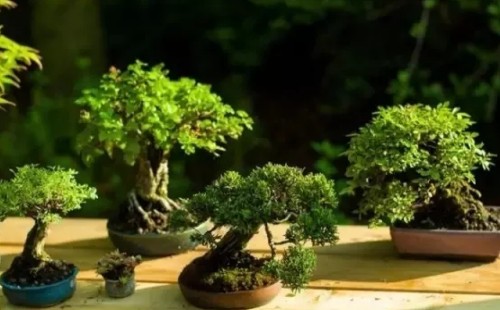
For miniature bonsai suitable for placement in the home, two basic conditions are often needed during care and management: light and ventilation. Usually the places available for placement include balconies, windowsills, air wells and similar spots, but sometimes to save space, miniature bonsai can even be placed in the empty gaps of larger bonsai. This not only saves space but also allows the miniature bonsai to thrive in a relatively suitable environment. The care techniques for miniature bonsai mainly cover five aspects:
1. Reasonable light
Because miniature bonsai often look very refined, many people like to place them indoors for appreciation, thereby forgetting to provide the necessary light conditions for the bonsai. If miniature bonsai do not receive sufficient light for a long time, the plants tend to grow poorly. Especially in peak growing seasons like spring and summer, they generally should not be placed indoors for more than 1 week; more often they should be placed outdoors in a semi-shaded environment for care and management.
2. Moderate water and fertilizer
Because miniature bonsai are small in size, their nutrient requirements are naturally relatively low, but water and fertilizer management cannot be neglected either. After all, miniature bonsai are also true bonsai in the real sense - small as a sparrow may be, all its vital organs are complete. If miniature bonsai are kept in an environment lacking water and fertilizer for a long time, it often easily causes yellowing and dropping of leaves; if water and fertilizer are too abundant, not only will these problems also occur, but leggy growth may also result. Therefore, the intake of water and fertilizer must be moderate - not too much, not too little, just right is best. But beyond normal watering and fertilizing management, it is also recommended to mist them more often to retain moisture, especially in summer when water evaporates heavily. Misting more not only retains moisture and lowers temperature, but also makes the plant's branches and leaves cleaner and fresher green.
3. Timely pruning
For miniature bonsai, generally only a small amount of branches and leaves need to be kept on the crown, which better allows the trunk to be revealed, so branches and leaves that do not need to be kept should be pruned away or shortened. By cutting back long branches, the branches and trunk can maintain a more suitable proportion, making the whole miniature bonsai look more harmonious and beautiful. Of course, if dried-up branches or leggy branches appear at ordinary times, they also need to be pruned away together, mainly to avoid wasting nutrients and to avoid affecting the beauty of the plant's shape.
4. Regular repotting
Everyone knows that many large, medium and small bonsai often need regular repotting - on the one hand to supplement nutrients, and on the other hand to increase the effective space for the bonsai, thereby better promoting plant growth. The same is true for miniature bonsai; generally they need repotting once every 1-2 years. But repotting miniature bonsai is often more difficult than ordinary bonsai, and it is harder for them to establish and survive. After all, the plants chosen for miniature bonsai are relatively small, and their root systems are naturally not as developed as those of ordinary bonsai trees, so the whole repotting process must be done cautiously. In particular, seize the timing: generally deciduous trees are repotted in early spring before budding, while evergreen plants are generally repotted after spring budding or after the weather turns cool in autumn.
5. Pest and disease control
Ordinary bonsai need to reduce pest and disease attacks by improving the environment, and the same is true for miniature bonsai. Not only does the growing environment need to be suitable, but pest and disease prevention and control work also needs to be done well. Moreover, for miniature bonsai this is often no less difficult than for ordinary bonsai - in fact it is even more difficult. Because the bonsai are relatively small, pest and disease problems are more easily hidden, so once attacks by leaf spot disease, aphids, red spider mites, scale insects and other pests and diseases are found, they must be dealt with promptly. Generally a combination of manual cleaning and spraying medication is used, which gives better results.