How to water a water-and-land bonsai? Master the correct watering method
In making a water-and-land bonsai, the most crucial part is to set the water level line well, and the water bank line should remain winding and varied, so as to better reflect a natural effect. Besides setting the water level line well, after it is made, watering is also very important in the daily care and management process. Not only does the water level line in the pot need to always be kept appropriate, but the water also needs to be changed regularly, and at the same time watering is also needed to keep the plants moist, so as to ensure the normal growth of the plants and keep the water-and-land bonsai lush and full of vitality. So, how do you water a water-and-land bonsai?
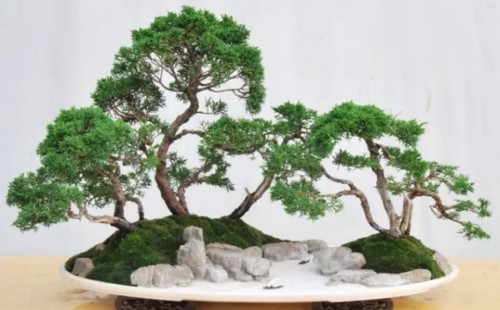
For a water-and-land bonsai, care and management work should vary by season. Since different seasons have different temperature environments, certain skills are also needed in the watering management of the plants. Unlike ordinary bonsai, a water-and-land bonsai generally has sloping banks, and even if moss is laid on the banks, the watering method cannot be like that of ordinary bonsai, pouring water directly into the pot. This is because if a water-and-land bonsai is directly watered with a large amount of water, it is very easy to wash the soil on the sloping banks down to the bottom of the pot.
In this situation, it is just like a mountain forest encountering heavy rain and triggering a mountain flood, which not only easily washes the mountain slopes into a mess, but may also trigger landslides, mudslides and similar phenomena. After all, a water-and-land bonsai is also equivalent to a miniature version of natural mountains and waters. When we make a water-and-land bonsai, we often lay it out according to the scenery of mountains and waters in nature, and there are even many places shaped by artificial processing into scenes of towering peaks and precipices. Therefore, watering a landscape bonsai should not be done by directly pouring water, and even less by washing it with a tap water hose.
For watering a water-and-land bonsai, on the one hand we must not destroy the original appearance of the bonsai, and on the other hand we must achieve the purpose of replenishing water. So, a relatively scientific method is to mist it or soak it with a small amount of water. And the timing of watering must also be grasped well; water cannot be given at any time, because if the moisture in the soil on the sloping banks is too high, landslides and collapse may still occur, especially at crafted towering peaks and cliff walls. Therefore, usually watering can only be done after the soil is seen to have become dry, and attention should be paid to controlling the amount of water, the humidity and the watering time.
Of course, watering also needs to be decided according to specific conditions. For example, summer often has strong light, high temperatures and hot weather, which often causes a large amount of water evaporation. So in addition to appropriately taking shading measures, it is also necessary to ensure that the place where the water-and-land bonsai is placed stays well ventilated, and watering should also be timely and moderate. If there is too little "river water" in the pot, replenish it in time; if the "river water" has been used for a long time, change it regularly to ensure the water quality is clean. More importantly, plants near the water-land junction often do not suffer from a lack of water, so the amount of watering for this part of the plants must be well controlled, and they may even not need watering, to avoid making the local soil too moist.
Because in the process of making a water-and-land bonsai, fresh moss is often used to cover the ground, and moss generally needs sufficient moisture to maintain a fresh green growth state, so when misting the trees to replenish water, the moss also needs more misting to maintain the necessary humidity. Of course, a water-and-land bonsai is a unified complex of plants, mountains and waters, and in the daily care and management process it needs to be considered comprehensively as a whole. Whether it is light, water and fertilizer, or the care and management of the rocks and trees, all must be carried out regularly to avoid phenomena that affect the ornamental effect of the bonsai.