How to Secure Stones in Rock-Climbing Bonsai? Practical Methods and Techniques Explained
Rock-climbing bonsai is a way of perfectly blending stone and plant science; as a form of potted planting, it both reflects the natural landscape and creates a sense of beauty through this fusion. Rock-climbing bonsai generally involves planting plants on stones, mainly relying on the plant's root system to grip the rock surface, and the plant's roots can either be fully attached to the stone or partially attached, each producing its own distinctive effect. Since plants are grown on stones, from a load-bearing perspective we have to consider the stability of the stone. So, how do you secure the stone in rock-climbing bonsai?
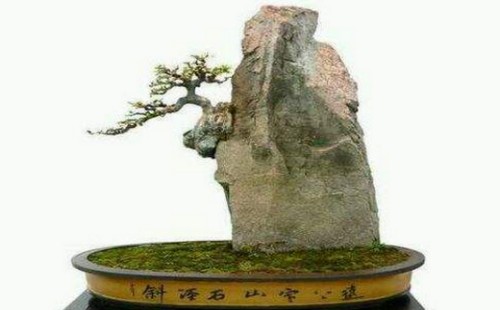
In the process of making rock-climbing bonsai, keeping the stone stable at all times is a very important step. If the stone is simply placed in the pot, and the plants growing on it, especially trees, keep growing larger, the stone along with the plants may topple due to loss of balance, thereby destroying the originally beautiful shape. Therefore, securing the stone is of utmost importance.
Rock-climbing bonsai takes stone as its foundation, with trees clinging to the stone to keep growing, forming a unified whole of tree and stone. To keep this overall balance from being broken, we need to fix the stone firmly onto the pot surface. But rock-climbing bonsai is divided into water rock-climbing and dry rock-climbing. For water rock-climbing bonsai, there are certain requirements for the choice of stone material: on one hand, the stone needs a certain weight to facilitate fixing; on the other hand, it needs a certain water-absorbing and water-retaining capacity, with plants growing on the stone; and furthermore, the rock surface must be suitable for the plant's roots to cling to. Stones of materials such as water-absorbing stone and sandstone accumulation stone are recommended.
If making dry rock-climbing bonsai, stones with strong hardness such as the richly textured Yingde stone are generally used, mainly so that the plant's roots can take hold within it, which both helps them grip firmly and facilitates shaping. But whether making water rock-climbing bonsai or dry rock-climbing bonsai, we need to fix the stone firmly onto the pot surface to avoid overturning caused by the gravity of the upper part and a shift in the center of gravity. A relatively common approach is to use cement and river sand mixed in a certain ratio to make a strong-viscosity adhesive, firmly bonding the stone to the pot surface. Of course, if necessary, we can also use wire to help secure it.
However, some merchants, in order to increase the ornamental value of the pot, make the pot surface into a shiny, smooth surface; in fact, this is very unfavorable for fixing the stone to the pot surface, especially with porcelain pots, where fixing the stone is often even more difficult. So in this case, we might try changing our approach. First make a large and heavy base for the stone used in the rock-climbing bonsai, and after securing it, place it in the pot, so it is less likely to topple due to an unstable center of gravity caused by the plants growing above.
But this approach also runs into a problem: how to bond the stone and the base firmly together without them coming apart. Besides using wire to secure the two, it is often also necessary to use epoxy resin adhesive to bond them together. After all, using only wire to secure the two will create many gaps, and using wire for securing also affects the appearance. So generally you can directly use epoxy resin adhesive to bond the two together.
If there is no epoxy resin adhesive, we can also use marble glue for bonding. Marble glue is based on unsaturated polyester resin; it works well for setting stone, is easy to use, and dries quickly, making it very suitable for bonding, repairing and filling gaps between stones. Moreover, this material has strong adhesion and good resistance to external forces, so using it to secure stones in the process of making rock-climbing bonsai gives very good results.
Of course, here at the editorial desk we also have a relatively rough-and-ready way to secure the stone, which is to use metal wire to secure the stone to the pot. First choose a shallow pot with multiple holes in the bottom, then lay a layer of wire mesh on the pot bottom, and use metal wire passed through the holes in the pot bottom and the wire mesh to secure the stone. But for the sake of appearance, you can also bond the gaps formed between the two. Although this method looks rather crude, it secures the stone very well. Why not give it a try!