Can flamboyant trees be grown in the north? A feasibility analysis
The flamboyant tree (Delonix regia) has a graceful form, with red flowers and green leaves, and holds extremely high ornamental value. It is often used in urban landscaping and beautification, with very good results. But the flamboyant tree cannot be grown just anywhere; it also has certain requirements for its growing environment. Because our country is vast, the climate and environment differ considerably between the different regions of north and south, so when planting flowers and trees we must also be selective, otherwise we will not be able to achieve the effect we need. So, can flamboyant trees be grown in the north?
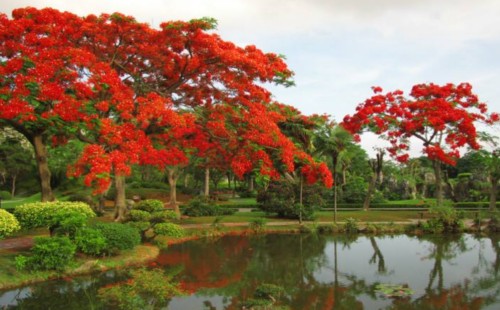
The flamboyant tree is a tropical tree species. It likes light but is not cold-tolerant, while the southern regions of our country often have plenty of light and relatively high, stable temperatures, so they are very suitable for growing tree species like the flamboyant tree. As for the northern regions, because the four seasons are distinct and the temperature difference between summer and winter is large, especially in winter, when temperatures are often very low and extreme cold weather can even occur, this goes against the flamboyant tree's growing habits, so it is not suitable to grow flamboyant trees outdoors in the north.
But some gardening friends in the north have also tried growing flamboyant trees in pots at home, mainly because winter temperatures are too low and the flamboyant tree is not cold-tolerant, while indoors it is easier to regulate the temperature. Even so, growing flamboyant trees in pots indoors in the north still faces many problems. So although potted flamboyant trees in northern homes will not freeze to death, they grow very slowly. This is mainly because the flamboyant tree is a tropical tree species that likes light and warmth; although it is relatively easy to adjust the temperature indoors in the north, ventilation and light are not easy to provide. But it also cannot be placed outdoors for care in cold weather, and over time this naturally affects the tree's growth. This shows up as slow growth and low ornamental value.
Given the characteristics of the growing environment where the flamboyant tree originated in the tropics, the tree itself has long since adapted to the tropical climate. If it is suddenly grown in the north, it will inevitably disrupt its physiological growth, thus showing various poor growth symptoms. If grown in the north, at best it will affect growth and reduce ornamental value, and at worst it will simply freeze to death. It can be seen that climate and environment have an important influence on the growth of the flamboyant tree, so the northern regions are not suitable for growing flamboyant trees.
And even when growing flamboyant trees in the relatively warmer southern regions of our country, light and temperature must first be guaranteed, especially during the peak growing season and the flowering period. The flamboyant tree's flowering period is generally from June to July. Based on its preference for high temperatures and plenty of light, we need to promptly provide safeguards for light and temperature. In the winter in the south, temperatures are generally not very low, but if a cold spell arrives, for flamboyant trees grown outdoors we often have no way to take timely insulation and cold-protection measures, so slight poor growth may occur. But for potted flamboyant trees, we need to promptly take cold-protection and warmth measures, such as bagging them or moving the pots indoors for care, to ensure the plants are not frostbitten.