Detailed Explanation of Fertilization Methods and Techniques for Miniature Bonsai
Although miniature bonsai have a short stature and fine branches and leaves, they still possess the same morphological characteristics as ordinary bonsai, and can be described as a reduced-size version of bonsai. Therefore, like ordinary bonsai, they also need timely nutrient supplementation to maintain growth. Miniature bonsai have a relatively short stature, so their nutrient requirements are naturally relatively low, but the matching pots are also very small, so it is destined that the space inside the pot is correspondingly very small, and the amount of potting soil placed in it will also be much less, while the nutrient content in the potting soil is naturally also very low.
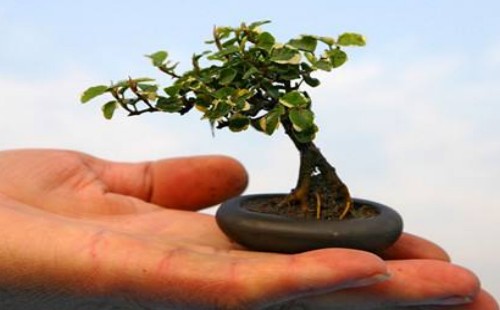
However, as bonsai plants continue to grow and old and new tissues replace each other, the nutrients in the pot will quickly be consumed. Therefore, timely nutrient supplementation is also an issue that cannot be ignored in the process of care and management. The most direct way to supplement nutrients is topdressing, so how should miniature bonsai be fertilized? Today, the editor will share with you the fertilization methods for miniature bonsai, hoping to be of help to everyone.
Because the amount of soil in the flowerpot of a miniature bonsai is very small, its fertility is naturally very limited, so timely nutrient supplementation is one of the prerequisites for ensuring that bonsai plants maintain vigorous growth. If a miniature bonsai is in a state of nutrient deficiency for a long time, it will also show the same poor growth phenomena as ordinary bonsai. For example, branches and leaves may wilt, turn yellow, and fall off. Of course, fertilization also needs to vary according to the tree species. If it is a flowering tree species, after flowering it is necessary to apply some light fertilizer to restore the tree's vigor, and at the same time store sufficient nutrients for the next round of flowering.
But if it is a fruit-bearing ornamental tree species, 1-2 applications of light fertilizer can be made before flowering to ensure sufficient nutrients to support flowering and fruiting. However, after flowering, it is also necessary to timely apply some fertilizer with a slightly higher concentration to restore the tree's vigor and promote growth. This is mainly the topdressing work done for flower-and-fruit type tree species, but for deciduous tree species, there is often no need to apply too much fertilizer, otherwise excessive nutrients will cause excessive growth of branches and leaves, thereby damaging the beauty of the original plant shape and reducing the ornamental value of the miniature bonsai.
In addition, the timing of fertilization for miniature bonsai also needs to be grasped well. Generally, around Qingming Festival, the pot-soaking method can be used to supplement the plant with some dilute liquid fertilizer, but green manure and cake fertilizer are often suitable. For foliage-type tree species, topdressing is generally mainly nitrogen fertilizer, supplemented by phosphorus and potassium fertilizer; while flowering and fruiting tree species are exactly the opposite of foliage-type tree species, often mainly topdressing with phosphorus and potassium fertilizer, supplemented by nitrogen fertilizer.
Fertilization is not a management action that can be carried out anytime and anywhere. In addition to applying different fertilizers at different growth stages of tree species, topdressing usually also needs to be carried out on sunny days when the potting soil has become dry, in combination with watering. This can not only achieve the purpose of topdressing, but also avoid fertilizer damage. Especially in the plum rain season, because the ambient temperature and humidity are relatively suitable, bonsai trees sprout and grow branches relatively quickly and need to consume a large amount of nutrients, so they should be topdressed in time to supplement nutrients.