How do you make a miniature tree stump bonsai? A detailed production method for you
Tree stump bonsai is a living work of art, often with graceful forms and distinct personality traits, a perfect expression of beauty no matter how you look at it, with many aspects worth savoring. The miniature tree stump bonsai is, as it were, a condensed version of tree stump bonsai, yet it can carry on and inherit the fine characteristics of the former, revealing the great within the small. But its production techniques often demand more, and its care and management are also more difficult, so how do you make a miniature tree stump bonsai?
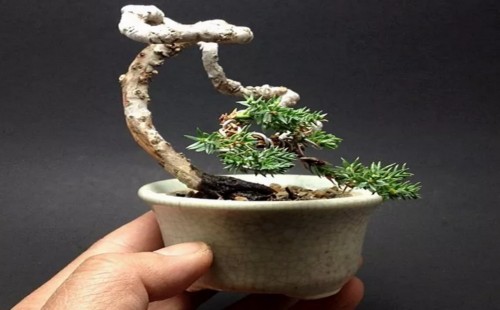
Usually, making a miniature tree stump bonsai should master four major stages: material selection, shaping, potting, and scene arrangement. As long as you can handle each of these stages well and get them just right, you can often produce a satisfying fine miniature tree stump bonsai. What remains to be done afterward, besides care and management, is simply to enjoy it to the fullest. Below, let us take a look at the production method for miniature tree stump bonsai!
I. Focus on material selection
Miniature tree stump bonsai is very strict about material selection. Generally, it is best to choose dwarf tree species with small branches and leaves, easy to pot, easy to keep alive, and easy to shape. If you can find tree species with peculiar roots and trunks or bright flowers and fruits, that is naturally even better. Common tree species suitable for making miniature tree stump bonsai include five-needle pine, gold bean tree, small pomegranate, serissa, and small-leaf podocarpus. These are all excellent materials for making miniature tree stump bonsai.
II. The potting process
Since this is making a miniature tree stump bonsai, in order to improve the survival rate of transplanting, it is generally necessary to follow conventional practice and cultivate the stump specimen first. Unlike the cultivation of large tree stumps, miniature tree stumps can be cultivated in small flower pots rather than planted in the ground; generally, simply growing them in clay pots is enough. So cultivating miniature tree stumps is somewhat more convenient. When the time for shaping is ripe, we can transplant the stump specimen in advance into a display pot for final planting. As for the size, shape, material, and color of the display pot, it generally needs to match the miniature tree stump being transplanted, and the planting depth should be 1/3 of the pot used.
But note that because the bonsai shapes being created differ, the flower pots chosen are generally different too. For cascade-style miniature tree stump bonsai, a rectangular simple purple clay pot or ceramic pot is generally used; for upright or slanting trunk style effects, a relatively shallow rectangular pot or a round-bodied bowl pot is generally chosen; while for curved trunk style, a square pot is generally chosen for planting.
III. Determining the shape
The branches and leaves of miniature tree stump bonsai should be sparse and small, able to follow the inherent characteristics of the trunk, with appropriate original artistic processing and shaping carving. Tree species such as small-leaf podocarpus and serissa often have strong sprouting ability and are also easy to twist and wire for shaping, so they are very suitable for making curved trunk style and cascade style bonsai effects. The shaping method is mainly the lead wire wrapping method: first, according to the thickness of the stump specimen's branches and trunk, choose lead wire of appropriate thickness respectively, then bend it along the branches and trunk into the form we need.
But note that shaping is generally carried out in early spring, especially for evergreen tree species. In the process of wrapping lead wire around the branches and trunk to bend and shape them, the lead wire should be kept close to the branches and trunk, with proper spacing, and when wrapping, the lead wire should generally be kept at a 45° angle to the branches and trunk. After 1-2 years, once the branches and trunk have basically taken shape, we need to remove the lead wire promptly. Also, branches that grow during this period and spoil the original plant shape's beauty or hinder shaping should be cut off or shortened promptly.
IV. Bonsai arrangement
For miniature tree stump bonsai, the height of the scene arrangement is generally kept between a few centimeters or more than ten centimeters, but the ornaments should not be too many; it is enough if they can set off and embellish it. If there are too many ornaments, not only will it look too crowded due to the limited space of the flower pot, but it will often look rather messy and disorderly, thereby reducing the ornamental value of the bonsai as a whole. The focus of the arrangement lies in the cultivation and shaping of the miniature tree stump.
V. Preparing the stands
Miniature tree stump bonsai is generally placed on indoor stands and similar positions for viewing, so there are certain requirements for the stands as well. These are mainly certain requirements for the size and shape of the stands, so when choosing a stand, you should consider whether it matches and harmonizes with the miniature tree stump bonsai you have made, especially in terms of form and color harmony. In actual life, the more commonly used stands include curio shelves, combination stands, and assorted display stands; you can choose a suitable stand according to your own miniature tree stump bonsai.