Detailed Explanation of Field Collection and Grafting Techniques for Old-Stump Rose Bonsai
Every spring, go to hillsides and ditches to dig up wild rose (Rosa multiflora) stumps with unusual shapes and naturally tapering tips. After the stumps are collected, cut the roots and trunks into place as much as possible, and plant them in plain sandy soil mixed with a little sawdust; either pot planting or ground planting is fine. Cover the whole stump with a plastic bag, and after new shoots grow 3-5cm, choose a rainy day to remove the plastic bag, then spray water on the stems and leaves every morning and evening to ensure survival. Fertilizing can begin in August, once every half month, preferably with cake fertilizer water. For branches with natural transitions, prune in the spring of the second year and strengthen management; when the new shoots of that year grow to a certain thickness, grafting can begin. A few that need trunk thickening can continue to be grown on.
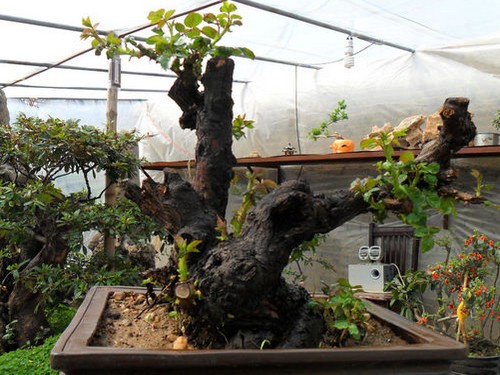
After collecting the stumps, the roots and trunks must be cut into place. When planting, a little sawdust can be mixed into plain sandy soil, and the whole stump should be covered with a plastic bag. After new shoots 3-5cm long grow, remove the plastic bag on a rainy day, and afterward water the leaves and stems every morning and evening. Starting in August, fertilize once every half month, preferably with cake fertilizer water.
Normally growing branches need pruning in the spring of the second year, and management should be strengthened at the same time; when the new branches have grown to a certain thickness, grafting can be carried out.
Bud grafting is a relatively commonly used grafting method for bonsai roses. It is fairly simple to perform, offers more choices in timing, and can be done from May to September. At the same time, it has a high survival rate, and the ability to repeat grafting at the original site for those that did not survive is also a major advantage of this method.
The flower color and variety of the grafted rose can be chosen according to personal preference. Miniature roses are recommended as the first choice for grafting; this variety has the characteristics of small plants and flowers, a large number of flowers and a long flowering period.
Three steps to help you improve the survival rate of rose grafting:
1. Selecting buds
Graft buds should be selected from robust branches. The best time is the early stage of bud break. Fertilize preferentially after cutting off the flowers, and after growing on for a week, select the sprouted buds for grafting.
2. Taking buds
Generally, roses use the method of peeling off the bark to take buds. However, miniature rose branches are relatively thin, so the bud-taking branch needs to be cut to about 2 cm long, then cut obliquely from the middle of the back of the bud toward both ends, then peel the bark along the base of the bud, slowly separating the bark from the xylem; the vascular bundles inside the bud piece must be protected. After taking the bud, the two ends of the bud piece should be cut flat according to the height of the rootstock cut. Place the rootstock cut gently, press it tightly against the xylem of the rootstock, and bind it tightly with plastic strips, exposing the bud eye.
3. Moisture retention
After grafting and binding, if conditions permit, the grafted bonsai roses can be cultivated in a plastic greenhouse, or maintained in the natural environment by covering a single branch with a plastic bag. After 7-10 days, remove the plastic bag and loosen the binding. Depending on the survival situation, appropriate supplementary grafting can be carried out.
After extensive research and experiments, using perennial Rosaceae plant mountain wood rose (Rosa banksiae) as rootstock, selecting rose branches of different colors as scions, and comprehensively applying various promotion and control techniques such as cuttings, root cultivation, trunk training, grafting, pruning and shaping, it is possible to cultivate tree roses with a distinct trunk and flowers of multiple colors on one plant.