How to collect and cultivate material for a trident maple bonsai?
In the past, when cultivating trident maple material, I would generally let it grow freely in the ground for 5 years. During those 5 years, I would not prune the roots at all. However, I found that after 5 years, the roots had grown thick and long, making them very difficult to dig out of the ground, and the root flare had not developed ideally. Now I dig them up every year and prune the roots. Not only is it much easier to dig them out, but pruning the roots every year also promotes the production of fine roots. Once the tree is fully formed in the future, the root flare will be more symmetrical and attractive. Of course, annual pruning will slow down the growth rate, but I think trading a loss in growth speed for a substantial improvement in quality is still very worthwhile.
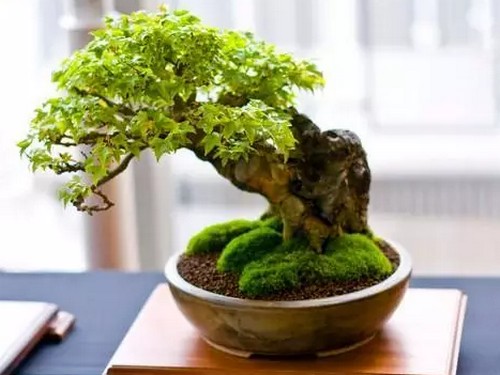
Miniature trident maple bonsai have solid, twisted, protruding main roots that are highly ornamental. In summer, they cast dense shade over the ground, and in autumn the leaf color turns dark red, a feast for the eyes. The trident maple has a graceful tree form and elegant leaves, with three shallow lobes at the leaf tip, just like a duck's webbed foot, and is quite a pleasure to admire. In early spring, the new leaves first emerge, delicate and emerald green; after autumn arrives, the leaf color turns dark red or old yellow, becoming even more delightful to the eye.
Artificial propagation:
There are methods such as cuttings, grafting and sowing, but sowing is usually the main method of propagation.
The seeds mature in October and should be collected promptly. Select plump, well-filled seeds, remove the winged fruit debris, wash them clean and dry them in the shade, then stratify them in sand storage. Sow in early spring of the following year, in February-March. Either drilling or dibbling may be used, with a sowing depth of 1-2 cm. Cover with fine soil, preferably until the seeds are no longer visible, cover with rice straw, and water thoroughly. About 40 days after sowing, they will sprout and emerge, and the straw cover should be removed promptly after the seedlings emerge. In summer, a shade frame should be built to provide shade to prevent scorching by the fierce sun, and water frequently to keep the soil moist. During the seedling growth period, 1-2 applications of thin, well-rotted cake fertilizer water may be given to promote growth. With proper seedling management, they can reach 30-40 cm in height in the same year, and after staying in the bed for another year they can be divided and potted.
For cuttings, the plum rain season is the best time. Select semi-mature softwood shoots of the current year, 10-20 cm long, keep 3-7 leaf nodes, retain 2-4 leaves at the top and remove the rest; insert to a depth of 1B2. After inserting, build a shade frame, water moderately, and after about 1 month they will root. Remove the shade frame and give them full light so the cuttings grow strong and healthy. Transplant and pot in the following spring. For grafting, the approach grafting method is used, with the original maple species as the rootstock, carried out in March or during the plum rain period, and the survival rate is also relatively high.
Collection from the wild:
Use wild trident maple old root stumps from mountainous areas. After digging them up, first "nurture the stump" for 1-2 years. Once the root system has developed and new branches and leaves have sprouted, then pot them and work on them, carrying out pruning and wiring to create a stump bonsai of a certain form. A trident maple bonsai made this way is antique and simple, forms quickly and has high ornamental value, achieving twice the result with half the effort.
Cultivation of trident maple bonsai material:
In the past, when cultivating trident maple material, I would generally let it grow freely in the ground for 5 years. During those 5 years, I would not prune the roots at all. However, I found that after 5 years, the roots had grown thick and long, making them very difficult to dig out of the ground, and the root flare had not developed ideally. Now I dig them up every year and prune the roots. Not only is it much easier to dig them out, but pruning the roots every year also promotes the production of fine roots. Once the tree is fully formed in the future, the root flare will be more symmetrical and attractive. Of course, annual pruning will slow down the growth rate, but I think trading a loss in growth speed for a substantial improvement in quality is still very worthwhile.
▲Digging out the trident maple in winter
▲Then the roots are sorted and pruned. The shortening is quite drastic. You can see that the root flare has already developed quite well, and this is thanks to the earlier root cultivation. How to cultivate the roots will be explained below.
▲Then the trunk is cut back short and the branches are selected.
▲These are all pruned.
Some of the material in the photo above will be used directly for potting and maintenance, and the rest will continue to be grown out in the ground.
To cultivate a trident maple with an attractive root flare, generally before the initial sapling is planted in the ground, the main root needs to be cut off. The main root usually grows vertically downward and is very long. Cutting off the main root stimulates the sprouting of lateral roots.
▲The first root pruning: cut off the main root and keep only the lateral roots.
▲The photo above shows material cultivated after cutting off the main root.
▲Pruning the roots again, the result is still quite satisfactory.
There is another method that can form a more symmetrical eight-direction root flare even better.
That is to first find a suitably sized iron plate with a small hole drilled in the middle, the hole being slightly larger than the trunk diameter of the trident maple sapling. Thread the trident maple sapling through the small hole and plant it, so that the sapling's roots are below the iron plate and the trunk is above it. As the trunk diameter thickens and fills the small hole, the water and nutrient supply to the upper part of the trunk is gradually cut off, and the upper trunk will produce many lateral roots near the iron plate. These lateral roots tend to be evenly distributed and on the same horizontal plane.
This method is similar to the air layering (binding method) we discussed earlier. Interested bonsai friends can take a look at the previous article.
▲A trident maple grown using an iron plate.
▲After removing the iron plate and pruning the roots, the roots are very flat and even, and potting in a shallow pot is no problem at all.
To sum it up in one sentence: inhibit the growth of the main root and stimulate the growth of lateral roots. "Inhibit the main root, stimulate the lateral roots" can not only cultivate an excellent root flare, it also has another benefit. When the stump relies more on lateral roots for growth, the base of the trunk will thicken rapidly, and the entire trunk can form a better taper transition.
The above humble observations are a bit of my experience cultivating trident maples over many years. These methods are of course not limited to the cultivation of trident maples. They also apply to other tree species. Interested bonsai friends can give them a try.