Sourcing methods and cultivation techniques for Caragana bonsai
The Caragana trunk resembles ancient iron, and when it blooms the whole tree turns golden yellow. It is suitable for planting at forest edges, along roadsides or beside buildings. This species has bright green leaves and beautiful flowers. In gardens it can be planted beside rocks, along small paths, or used as a hedge, and it can also be used as bonsai material. For Caragana bonsai styling, those with a single gnarled trunk and an elegant, antique posture are considered the best. It can also be shaped so that the branches and leaves cascade downward; or the roots can be raised to expose the claws, showing its aged appearance; or the branches and leaves can be pruned and wired into cloud-like forms, achieving both beautiful form and brilliant flowers. It is also a good nectar plant and a soil and water conservation plant.
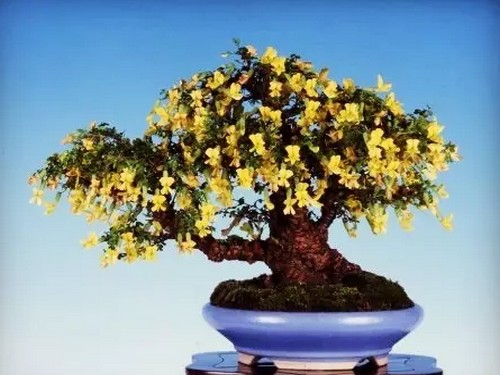
Caragana has elegant branches and leaves, brightly colored flowers that look like flying sparrows, and golden-yellow blooms, so it is also called golden sparrow flower. It is suitable for bonsai making.
Artificial propagation:
It can be propagated by cuttings, division, layering, sowing and other methods, generally mainly by cuttings.
From February to March, hardwood from the previous year's growth can be used, or in the plum rain season, semi-ripened softwood from the current year's growth can be used for cuttings. Cut the cuttings into 8-12 cm lengths, insert them to 1/2 depth, and after insertion B set up a frame for shade and water moderately.
After rooting, remove the shade frame and give full exposure to light for healthy growth, and the survival rate is relatively high. Division propagation is carried out in spring from February to March. Sowing propagation is carried out from March to April. Before sowing, soak the seeds in warm water (40°C) to promote germination, and the germination rate is high. For bonsai use, old stumps collected from the wild can also be used to create shapes, with quicker results. Choose those that show an aged appearance and have a single trunk, as these are best.
Wild collection:
Besides cultivating seedlings, the stump material for making bonsai can also be collected from the wild as old stumps of many years, choosing those with an aged look and fine posture, which can achieve rapid formation. Collection can be carried out throughout the entire dormancy period and the rainy season. The collection method is to first cut off most of the aboveground stems, then push aside the surface soil, clarify the growth direction of the main root, and dig patiently and carefully along the trend of the main root from far to near. This helps protect the root system and reduce damage.
The excavated root system is often very long. When planting, there is no need to shorten it; instead, place it in a shaded place, and when the roots are slightly dry, coil and shape them to use the roots in place of a trunk, then plant them in a pot. Never coil the roots while wet, otherwise they break easily. Treated this way, after formation the roots become intricately twisted and very pleasing to the eye.