What are the methods for obtaining material for pear bonsai?
Pear trees are suitable for making many different styles of bonsai, such as formal upright, slanting, curved trunk, double trunk, forest, cascade, and semi-cascade. Pear trees have well-developed root systems and can be raised as needed to enhance the bonsai's sense of age and antiquity.
There are many suitable rootstocks for pears, such as Ussurian pear (Pyrus ussuriensis) and birchleaf pear (Pyrus betulifolia), which can be propagated from seed and are also easy to collect in mountainous areas. When collecting from the wild, Ussurian pear is a better pear rootstock, and it has strong growth vigor and a well-developed root system; after collection, whether returned to a nursery or directly potted for care, the survival rate is high. Using small trees or large saplings with low branching points from culled orchards, moderately heavy pruning and shaping of their branches and roots, and then directly potting them for care can all achieve the goal of rapid growth and formation.
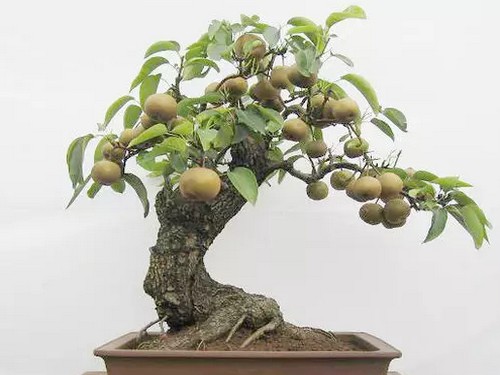
For pear tree propagation, Ussurian pear, Ussurian pear, birchleaf pear, and callery pear (Pyrus calleryana) can be selected as rootstocks, and pear tree varieties with robust growth, excellent quality, and easy fruiting can be used as scions, grafted by bud grafting or stem grafting. Rootstocks can be artificially propagated, or old pear trees culled from orchards can be used, or old stumps of varieties such as Ussurian pear with short stature, peculiar form, low branching, and aged, vigorous character can be collected from the wild; after "raising the stock" to rejuvenate them and make them grow new branches, grafting is then carried out.
Tree stumps are generally dug up and transplanted after leaf fall in autumn or before budbreak in spring. They are first planted in the ground or in a larger clay pot. Before planting, the plant is shaped first, overly long main roots are cut off, and lateral roots and fibrous roots are retained as much as possible; excess branches should also be cut off. After planting, water thoroughly and place in a wind-sheltered, sunny spot for care to ensure survival.
After the tree shape is basically stable, attention should be paid to maintaining vigorous tree growth so that it bears fruit year after year. Combined with pruning and shaping, cut off water sprouts, crossing branches, overlapping branches, and dead branches, and shorten strong vigorous branches to encourage lower buds to develop into branches, so as to cultivate compact fruiting branch groups. Also make the bonsai layers clear and the density well-proportioned, achieving a natural and graceful artistic effect.