Sourcing Methods and Cultivation Techniques for Winter Jasmine Bonsai
Winter jasmine (Jasminum nudiflorum) is a "fine flower of the new spring" that blooms early before spring arrives. It grows by courtyard walls or in roadside flower beds and is not conspicuous, but when the new spring begins, it opens its arms to the embrace of spring, blooming first to welcome the splendid spring light. Yet it is not self-important, not proud, and does not show off as a hero of welcoming spring, but instead adorns the spring scenery together with all the other flowers, bursting into bloom and releasing fragrance.
Winter jasmine has slender, supple branches, a well-developed root system, strong sprouting ability, and tolerance for pruning. With its golden flowers and green calyxes, it is showy and appealing, making it a good bonsai material. Winter jasmine has strong suckering ability, so division can also be used for propagation. To cultivate winter jasmine bonsai material, it should first be planted in the ground, pruned from time to time to form a single trunk, and once it shows an aged appearance, it can then be planted in a pot.
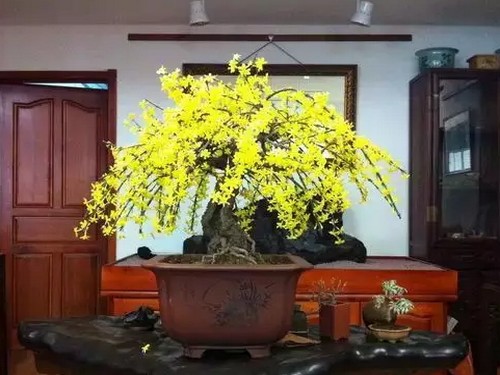
The materials for making winter jasmine bonsai are mainly artificially cultivated plants and thick old stumps dug from the wild, because it tolerates pruning and has strong sprouting ability. A heavy pruning method can be used: after the plant grows to about 0.3 m or reaches a certain design requirement, cut off the terminal buds to cultivate a certain crown. Or through a certain amount of shaping and pruning, remove the basal buds at the roots at any time to encourage more branching and flowering.
Artificial propagation:
Propagation is usually carried out by cuttings, division, layering, and other methods. Cuttings are simple and easy, with a high survival rate. In February to March, select one-year-old thick branches as cuttings, or in the plum rain season, semi-ripened branches can also be used for cuttings. Cut the cuttings to 10-15 cm, with the lower end flush with a node, insert to a depth of 2B3, firm the soil after inserting, water thoroughly, cover the seedbed with some chopped rice straw, keep the soil moist, and roots will form around mid-to-late April. From June to July, apply diluted cake fertilizer water several times to promote growth, and they can be transplanted the following spring.
Wild collection:
When collecting from the wild, the priority is to protect the roots, keeping the root system as intact as possible, removing damaged and dead roots, straightening out the roots, planting deep in a pot, and gradually carrying out root exposure. The method of root exposure is: fill the lower half of the pot with nutrient soil, and add fine sandy soil to the upper half. When planting, first bury the entire root system in the pot, then firm it, water thoroughly, and carry out careful management.
After a period of cultivation, the root system develops normally, fibrous roots grow in the growing medium, and the plant is already deep-rooted and leafy. At this point, the fine sandy soil can gradually be removed, causing the upper roots to slowly become exposed. After another period of cultivation, the exposed roots have gradually aged, and the lateral roots are also relatively thick. At this point, the plant can be moved into a shallow pot. When transplanting, fully protect the roots and bring the original growing medium. In this way, a winter jasmine bonsai with exposed hanging roots and claws and an antique, vigorous look can gradually be cultivated.