A Detailed Guide to Sourcing and Cultivating Juniper Bonsai
Juniper bonsai has long been renowned in bonsai circles at home and abroad for its gnarled old trunks, fine dense foliage, and graceful posture. Especially in Japanese bonsai exhibitions, shari (deadwood trunks) made from century-old junipers are commonly seen, with white deadwood and red bark interleaved, sweeping like a roaming dragon, vigorous and ancient, truly possessing an immortal's air, and can be called the finest among bonsai. As for the juniper of Taiwan, China's bonsai circles, besides Japanese lineage varieties, field-cultivated juniper is also suitable for growing into bonsai and has been adopted for this purpose, commonly known as Taiwan juniper. Its foliage pads are compact and solid in structure, with a jade-green color; the xylem is rich in resin, and its red grain can rival the Japanese mountain-collected Itoigawa juniper. It is very firm and durable, making it an excellent variety.
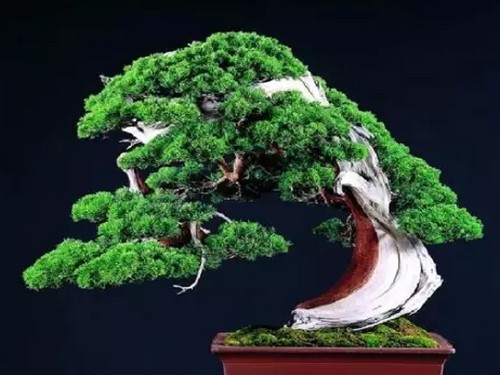
[Mountain-Collected Juniper]
Over a decade ago, during the heyday of mountain collection, many were collected, but the survival rate of mountain-collected varieties was very low. Through in-depth investigation of the reasons, it was learned that this was due to the issue of climate acclimatization (climate acclimatization is a specialized botanical term, meaning that after a plant is transplanted from its high-mountain native habitat to the lowlands, its seeds, through several generations of reproduction, gradually adapt to the climate of the transplant site. If the climate difference is too great, it still cannot acclimatize and survive.)
The juniper of its native habitat belongs to the high-mountain type of plant. On high mountains, the temperature difference between day and night is large, the four seasons are distinct, and the dormancy period is long. In the lowlands, the temperature difference between day and night is small, and there is almost no dormancy period. Therefore, when this high-mountain native juniper is transplanted to the lowlands, due to the climate differences between high mountains and lowlands, these junipers find it difficult to survive, and only a very few can remain alive. Every mountain-collected juniper is a seedling-grown plant. In botanical physiology research, seedling-grown plants have a high probability of genetic mutation, with almost one variety per plant, so the leaf type and leaf color of each plant differ. The foliage pads of mountain-collected juniper are mostly slightly flattened, with a dark green leaf color.
[Field-Cultivated Juniper]
Taiwan, China's field-cultivated juniper, according to verification with the juniper master Mr. Wu Sanlang, was initially propagated more than forty years ago by cuttings from five old junipers with a diameter of over one chi in the Yangmingshan nursery, cultivated for use as cut-flower material. Later, bonsai enthusiasts discovered that its leaf characteristics were good and that it was suitable for growing into bonsai, and adopted it for this purpose. Whether these five junipers were native or introduced species can no longer be traced. Field-cultivated juniper is generally commonly known as Taiwan juniper. Its foliage pads are compact and solid in structure, with a jade-green color; the xylem is rich in resin, and its red grain can rival the Japanese mountain-collected Itoigawa juniper. It is very firm and durable, making it an excellent variety. The Japanese mistakenly believed that Taiwan juniper, after decades of field cultivation, could not produce firm and lasting shari, and therefore discarded it, which is truly a pity.
[Artificial Propagation] Juniper is usually propagated by cutting or layering. For cuttings, one-year-old tender branches are best, with a cutting length of 10-15 cm; remove the small branches from the lower middle portion, and insert to a depth of 1B2; the seedbed should use leaf mold mixed with sandy soil, and should be fertile, loose, and well-drained. After inserting, water thoroughly, and set up a shade frame at once; roots will form after 2-3 months. In the following spring, carry out separate planting and transplanting to cultivate large seedlings. Juniper often grows prostrate on the ground, and adventitious roots develop accordingly, so it can also be propagated by layering. Grafting propagation using hinoki cypress or Chinese arborvitae seedlings as rootstock also easily survives.