Sourcing Methods and Cultivation Techniques for Chinese Elm Bonsai
Chinese elm (Ulmus parvifolia) is also known as small-leaved elm, and it is not the same as the common elm. Its form is rather elegant, and its most striking feature is the mottled bark and trunk. Its leaves change color in autumn. It is a deciduous tree, very easy to grow casually, but not really suitable for beginners! Its horticultural varieties are prone to pests and diseases, but that does not stop people from liking it!
Chinese elm is an ordinary tree, found in mountains and wild fields all across the land. The Chinese elm has an elegant tree form, small emerald leaves, a free and bold bearing, and abundant vitality. Its layers are clear, dense and sparse are well arranged, roots are gnarled and twisted, and exposed roots show their claws. Regardless of the size of the trunk, it has a stately and elegant air and a majestic momentum. Ancient trunks in particular are even more full of patterned hollows and ridges, vigorous and simple, twisted and unusual, and venerable in appearance. The branches are unrestrained and upright, giving a strong sense of an old tree greeting spring.
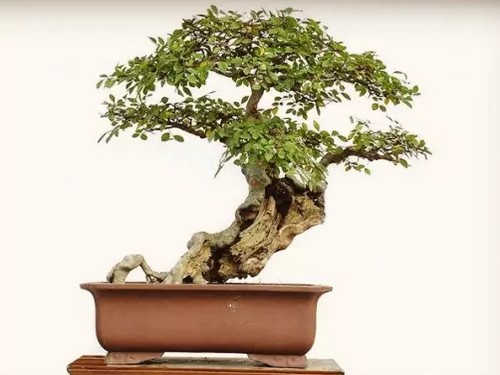
Chinese elm can be propagated from seed to produce seedlings. The seeds mature from October to November, so collect them in time, spread them out to dry in the sun, winnow away debris, and store them dry in bags. Sow in March of the following spring. Choose a windless, sunny day and sow on a level seedbed, cover with fine soil just until the seeds are no longer visible, then cover with rice straw. They will sprout and emerge in about 1 month. Remove the straw in time and thin the seedlings appropriately. During the seedling growth period, manage water and fertilizer well, loosen the soil, and remove weeds. Seedlings of the current year can reach 30-40 cm tall. It is best to transplant them into beds for several years of cultivation, then after pruning and shaping, pot them up for further training. You can also dig up old Chinese elm stumps from the wild or from watersides, choosing those with exposed roots, thick trunks, strong and twisted lines, slanting branches and trunks, fine leaves, and an ancient, unadorned posture. After raising the embryo, when the root system has developed and the new branches and leaves are lush, pot it up and shape it.
Artificial propagation:
Chinese elm is usually propagated by seed. The seeds mature from October to November, and the fruit wings turn yellow-brown, so they should be collected in time, spread out to dry in the sun, winnowed free of debris, and stored dry in bags. Sow in March of the following spring, either by broadcasting or drilling. For drilling, the row spacing is 25 cm. Choose a windless, sunny day for sowing, cover with fine soil just until the seeds are no longer visible, then cover with rice straw. They will sprout and emerge in about 30 days, and the straw should be removed in time, with appropriate thinning. During the growth period, manage water and fertilizer well, remove weeds, and loosen the soil. Seedlings of the current year can reach 30-40 cm tall. Young saplings have thin trunks and sparse branches, and their leaves are rather large, so they are generally not suitable for making bonsai. It is better to cultivate them for several years, then prune and shape them before potting up. In addition, Chinese elm can also be propagated by root cuttings to produce material for trunk-style bonsai, with faster results, and this is used fairly widely in South China.
Collecting from the wild:
Chinese elm grows in many places in the wild and along watersides in Jiangnan, and it is even more common in limestone mountainous areas. You can select old stumps that have sprouted repeatedly after years of cutting, especially elm stumps growing on barren slopes, by ditches, or in rock crevices in the wild. These grow slowly and are long-lived, and having been shaped by natural wind and waves, those with exposed roots, thick trunks, strong and twisted lines, slanting branches and leaves, small leaves, and an aged, ancient, unadorned posture are the best. Dig them before spring sprouting, cut off unnecessary roots and branches, protect the secondary roots and fibrous roots, coat them with mud slurry, and wrap them in wet moss. After digging them out, choose a ventilated, light-transmitting place with loose, moist soil for deep planting and cultivation, called "raising the embryo." When the root system has developed and the new branches and leaves are lush, pot them up and shape them. Using old stumps as bonsai material can shorten the time needed for bonsai processing, and their form is natural and unadorned, unlike ordinary specimens, and they are easy to keep alive.
When Chinese elm wild old stumps are collected and cultivated, they generally need at least 2-3 years to take shape. Here is a quick-training method, especially suitable for bonsai growth. For Chinese elm stumps dug up in early spring, first plant them in clay pots for cultivation. After they survive, pay attention to removing unwanted buds at any time. Begin shaping from late April to early May. When the branches grow to 15-18 cm long, use fine metal wire for bending and shaping, and pay attention to care and management. When new branches sprout and grow 4-6 leaves, pruning can be carried out. Generally, only two leaves are kept on each small branch, and then a nitrogen fertilizer is applied at once to encourage new buds to emerge again on the new branches. Repeat this pruning and fertilizing many times so the leaves grow dense as quickly as possible. As the branches continue to thicken, the metal wire must be removed in time to prevent "wire bite." For branches that have not yet been shaped, they can be bent again to fix their form. In this way, by September a pot of Chinese elm bonsai can take preliminary shape.
The key to this rapid shaping method is mainly to bend and shape while the branch xylem has not yet hardened, so special care must be taken during production. The thickness of the metal wire must also be chosen appropriately, and when wrapping it should not be pressed too tight, to prevent bruising the tender branches. In addition, the work of "raising the embryo" must be done well, so as to achieve the goal of potting up and making bonsai in the same year the stump is dug.