What Kind of Wire Is Best for Bonsai Shaping? A Full Breakdown of Material Selection Key Points
There are quite a few shaping techniques for bonsai trees, and different shaping techniques often need to be carried out with different tools or materials. Among them, the most commonly used is wire, but considering that ordinary wire wrapped around bark will oxidize, corrode and so on over time, the wire may rust and break before we achieve the shaping effect we need. Moreover, rusty wire tends to easily cause certain damage to the branches and trunk being wrapped, so using ordinary wire will not work. So, what kind of wire is used for bonsai shaping?
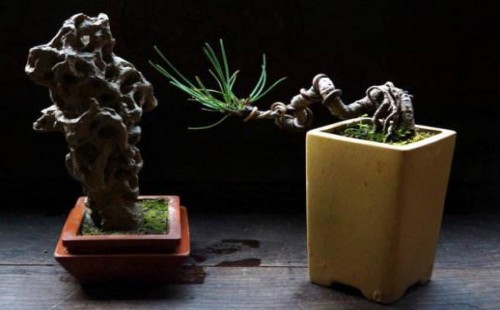
In the shaping process of bonsai, techniques such as bending, branch pulling and hanging are often used. Besides rope, especially palm fiber, the most used is wire that will not oxidize or rust. And after a comprehensive comparison, aluminum wire or copper wire is usually the most suitable. This is a fairly common wiring and bending technique in the Su-style bonsai shaping process. By using aluminum wire or copper wire to treat the branches, effects such as wiring and fixing the shape can be achieved, ultimately completing the bonsai shaping treatment and making the bonsai more ornamental.
Using metal wire for wiring and shaping treatment of bonsai is one of the most commonly used methods in the bonsai shaping process, but wiring should first be applied to the main branches, then extended to the secondary branches, and finally to the small branches, following the principle of from bottom to top, from inside to outside, and from thick to thin. The metal wire can be used as a single strand, or multiple strands can be used at the same time. After fixing one end, press it tightly against the branch. The metal wire is generally wound upward at a 45° angle to the branch, until it is wound to the required position, while the end of the metal wire should be pressed tightly against the branch and must not be left sticking out randomly so as not to get in the way.
However, there is no unified requirement for the size of the aluminum wire or copper wire used in the bonsai shaping process, but the size of the aluminum wire or copper wire is directly related to the size of the branch being wired. The purpose of using metal wire is to fix the growth direction of the branch during the shaping process, and the size of the metal wire used depends on whether it can play a role in fixing the direction of the branch being wired. In practice, the most commonly used metal wire is about 1 mm in diameter.
However, considering the cost, we generally need to choose the more economical metal wire between aluminum wire and copper wire. Because copper wire of the same size and thickness is heavier than aluminum wire, its price is also higher. So, economically speaking, aluminum wire is often more affordable, and aluminum wire is also lighter and more convenient to use. But aluminum wire also has its drawbacks: it tends to harden after being exposed to air for a long time, becomes twisted after use, and if used again, it is easily broken because it has hardened and become brittle.
If we want to continue using aluminum wire, we can try heating it to make it softer and more flexible, similar to annealing steel. But aluminum wire generally needs to be heated to about 500 degrees Celsius and then allowed to cool naturally to room temperature before it can be used. However, it should be noted that aluminum wire also has its melting critical temperature. If the temperature is too high, it is easy to burn it, so we should pay attention to controlling the temperature when heating it with fire. After the aluminum wire cools and softens, the twisted shape it takes on after use can be easily straightened out, and then it can be reused.