How to Grow Dracaena? A Detailed Guide to Cultivation Methods
The Dracaena has elegant foliage and is an excellent choice for all kinds of indoor displays. Before bringing it indoors, if the humidity can be appropriately lowered to help it adapt to a drier environment, and after bringing it indoors the leaves are misted frequently, it can be enjoyed indoors for a long time without the leaf tips drying out. Dracaena care is mainly divided into two stages: cultivation and subsequent maintenance. It is a plant that needs a lot of attention, so extra care must be taken when growing it.
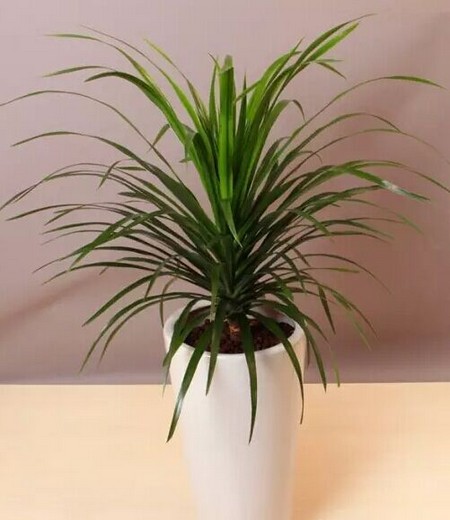
1. Cultivation requires technique.
A mix of 1 part humus soil, 1 part peat soil and 1 part river sand can be used as the growing medium, and it should be cultivated under 70-80% shade. During the growing season, apply a compound fertilizer 1-2 times a month and keep the soil moist. In summer, mist the leaves more often to raise air humidity; the leaves will become thicker and the leaf color more brilliant. In winter, protect it from the cold and keep the temperature above 8°C. Reduce watering of the potting soil, but regularly wetting the floor to increase humidity helps maintain leaf color and prevent dry tips.
2. It is mainly divided into two types: growing management and fertilizer-and-water management.
Growing management: Dracaena likes warmth and fears severe cold; it likes light but fears scorching sun exposure. It grows best in a warm but not overly hot environment. Spring, summer and autumn are the seasons of vigorous growth for Dracaena. During this period, growers must fully satisfy its needs for water, nutrients and temperature so that it grows robustly.
Fertilizer-and-water management: Dracaena likes loose, fertile, well-aerated growing media. A soilless cultivation method can be used for growing and management. For the container, choose a beautiful and elegant Yixing purple clay pot, or select a high-grade porcelain pot from Jingdezhen City, Jiangxi Province. The growing medium can be a thorough mix of vermiculite, perlite and peat soil. This kind of medium has good aeration, is clean, sterile and odorless. Moreover, when Dracaena is grown in such a medium in a high-grade container, it can go several years without repotting or changing the soil, and the plant will have a well-developed root system and grow robustly.
3. Temperature and light must be appropriate.
Dracaena likes both warm, humid conditions and sunlight exposure, and it can also tolerate shade. However, if grown indoors and placed in too shady an environment for a long time, the leaves will also fade. So it is best to put the pot on a southeast-facing windowsill so that it receives plenty of sunlight.
If the Dracaena is grown on a balcony, when the summer sun is too intense, move the pot indoors, especially at noon, and provide appropriate shading; generally a light level of 40-50% is sufficient, so as to avoid the scorching sun burning the leaves.
Dracaena likes warmth and cannot tolerate severe cold. Its most suitable growing temperature is 20-28°C. If summer temperatures are high and the air temperature exceeds 32°C, or if the winter temperature falls below 15°C, the Dracaena will enter a dormant or semi-dormant state. In the Yangtze River basin and areas to its south, after late October, Dracaena should be moved indoors one after another to prevent damage from early frost.
Throughout the winter, it is best to keep the room temperature between 10-20°C, and it must not be too low. At the same time, place the potted plant inside a south-facing window so that sunlight falls directly on the plant, and rotate it regularly so that it receives even light. If there is no sunlight for a long time, you can turn on a light at night and place the Dracaena under a 40-watt light for supplementary artificial lighting to keep the leaves attractive. At night, place the Dracaena inside the curtains and use thick curtains to block cold air, or place the pot in a warm corner of the room so that it overwinters safely.
4. Dracaena is a plant that attracts pests, so pest prevention must be paid attention to.
Because the environment is dry, growing Dracaena on a balcony or an indoor windowsill for a long time makes it prone to red spider mites. Red spider mites, commonly known as "fire dragons", are a type of mite pest. They mostly gather on the underside of the plant's leaves, spin webs as cover, and pierce and suck the sap. When Dracaena is harmed by them, the leaves fade, the chlorophyll is damaged, dense small yellow spots and small yellow patches appear on the surface, and the leaves gradually shrink, turn yellow and wither, and in severe cases drop off, losing their proper ornamental value.
Control methods:
Red spider mites often hide on the back of branches and leaves or in places where the foliage is dense, hiding behind webs. Manual catching is relatively easy. If chemical agents are used for control, a 20% dicofol emulsion can be added to 800-1000 times its amount of water to make a solution for spraying. This pesticide has a good killing effect on adults, nymphs and eggs. A 50% dichlorvos emulsion can also be added to 1000-1500 times its amount of water to make a solution for spraying. When spraying, be careful to spray the underside of the leaves as well; this way the killing effect is even better.