How to grow a Pearl Boxwood bonsai? A full analysis of care and management techniques
As a precious endangered tree species endemic to our country and the world, the wild population distribution range and growth quality of the Pearl Boxwood have shown a declining trend year by year due to factors such as natural conditions, tree species characteristics and human destruction. Protecting and cultivating natural resources and achieving the sustainable development of the ornamental plant industry should become our shared philosophy.
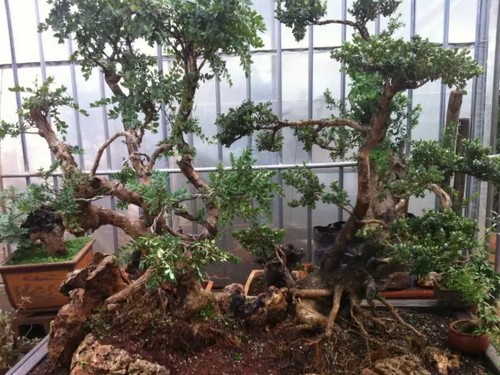
After nearly eighteen years of domestication and selective breeding, the Pearl Boxwood has gone through a process regionally from high mountains to mountain foot and then to plains, and in cultivation methods from intensive to extensive, and has fully adopted a cultivation model under open-air natural conditions, having withstood the tests of severe climates such as winter ice and snow, summer scorching sun, and waterlogging and drought, and possesses strong adaptability.
Its tree species characteristics, growth vigor, stress resistance and cultivation techniques are all clearly different from those of the wild Pearl Boxwood. Long-term and large-scale cultivation trials under extreme conditions show that for the care and management of potted Pearl Boxwood, as long as you master the following key points, which are basically similar to those for other trees, maintaining its normal growth state is not a difficult task.
1. Placement and protection——appropriate light
The Pearl Boxwood is a shade-loving tree species, and indoors it is best placed in a ventilated and light-transmitting spot. Under conditions of high temperature and high humidity in summer, it is best to choose early morning, evening and rainy days to place it appropriately outdoors or on a balcony. Long-term shading and poor ventilation easily make the plant's branches and leaves weak. The Pearl Boxwood has strong cold resistance and can withstand severe cold of around minus 20 degrees, but plants that sprout new branches in late autumn or early spring should be kept warm, preferably placed indoors, to prevent frost damage.
Secondly, the leaf color of the Pearl Boxwood differs in each of the four seasons; more light during the dormant period can turn the leaf color red, otherwise it will remain green.
2. Potting——avoid summer sun exposure
The Pearl Boxwood can be potted in all four seasons, with the plant's dormant period or the plum rain period being the best. The soil for potting is mainly leaf mold, paddy field soil or mountain soil, and the soil should preferably be slightly acidic, neutral or slightly alkaline. If you are not satisfied with your local soil, you can mix the soil attached to the plant with one third orchid soil or vermiculite, peat, etc. At the same time, you can first add a small amount of bean cake or bean crumbs, etc. to the soil, and let them ferment and volatilize in the soil to become a slow-release type of nutrient, so that the plant benefits slowly. Field-planted plants have very developed root systems; when potting, part of the main root can be appropriately cut off, and if there are too many fibrous roots, some can also be pulled out; do not let them ball up inside the pot. When potting, first fix a sieve mesh or tile piece at the bottom hole of the flower pot, then place the plant in, fill in the growing medium and water thoroughly. After repotting in summer, it should initially be placed in a cool and ventilated place. In spring and autumn, more light should be given.
3. Watering——do not water if not dry, and water thoroughly when you do
Watering is the main measure in the care of potted Pearl Boxwood. After the plant is potted, it should be watered sufficiently or soaked thoroughly, and afterwards you can follow the principle of not watering if not dry, and watering (soaking) thoroughly when you do. So-called dry means the soil surface begins to show a dry white state, not that it is completely dried out.
When a tree is planted in a pot, the soil is always limited, and the water it contains is also limited. If water is not replenished for a long time, the tree will drop leaves and even wither due to lack of water. Generally speaking, when the Pearl Boxwood is placed indoors, watering does not need to be too frequent. If watering is too frequent and the pot soil remains too wet for a long time, and there is also a lack of ventilation and sufficient light, it is easy to cause root oxygen deficiency and rot; at the same time, the number of waterings should be determined according to seasonal changes, cold and warm weather, and the permeability of the soil. Watering can be done by spraying the leaf surface, or by watering the roots or soaking the whole pot for several minutes; be careful not to water "half-way water" and cause the phenomenon of a wet pot surface and dry inside. If you often go out and it is inconvenient to water, depending on the size of the flower pot, use 2-3 cotton yarns or wool threads, thread one end in through the bottom hole into the pot, and immerse the other end in a basin, cup or other container, supplying water according to the principle of water self-absorption. In winter, water evaporates more slowly, so 1-2 threads immersed in water are enough; in summer it can be appropriately increased, and the specifics can be decided according to the climate conditions in your area.
4. Fertilizing——apply fine fertilizer lightly
The soil in a bonsai pot is limited, and therefore nutrients are also limited, so attention should be paid to supplementing fertilizer. However, the Pearl Boxwood grows relatively slowly, so fertilizing does not need to be too much or too frequent; twice a year, in early spring and early autumn, is suitable. Fertilizing potted Pearl Boxwood is mainly nitrogen-based. Generally, for a plant with a 20cm crown spread, about 20 soybeans or soaked and fully decomposed bean cake can be diluted with water and applied into the pot soil.
When applying other liquid fertilizers, be careful not to make them too concentrated, so as not to damage the roots; plants that have just been potted or newly repotted should not be fertilized in a hurry.
5. Pruning——master the seasons
The Pearl Boxwood has extremely strong tillering ability, and new buds may sprout almost anywhere. If allowed to grow naturally without suppression, it will inevitably affect the tree's shape and reduce its ornamental value. Therefore, it should be pruned in a timely manner to maintain a graceful tree shape and appropriate proportions. But remember: pruning branches should be done after the plant enters the dormant period in autumn. Except for newly sprouted tender branches, pruning during the peak growing period in midsummer can easily cause the branch tips to shrink.
Pinching: for branches growing too fast, in order to suppress their height growth and promote the development of side branches in a flat and spreading manner, the tender tips of their branch ends can be pinched off.
Removing flower buds: for older plants, after August-September each year, some bead-shaped flower buds often grow on their branches or branch ends. If there are too many, the parts growing on the branch stems should be removed at any time, while those at the branch ends can be kept for flower appreciation. This can avoid consuming too many nutrients and ensure that the plant's branches and leaves are luxuriant.
Pruning branches: the Pearl Boxwood often grows new branches from the base of the trunk, and to maintain its beautiful shape, attention should be paid to removing them appropriately. The pruning method should be decided according to the tree shape; for example, for a cloud-layer shape, the branches should be pruned into a flat form. Generally, dead branches, parallel branches, crossing branches, etc. that hinder the appearance should be cut off.
6. Repotting——no need to be too frequent
The Pearl Boxwood has a developed root system, and after pruning, the sprouting ability of new roots is very strong. After growing in a pot for one year, the fibrous roots can densely cover the bottom of the pot. If it is not repotted for several years and old roots are not pruned, watering will be difficult to penetrate and drain, and fertilizer will also be hard to absorb, which will affect the normal growth of the plant; at this point, repotting and changing the soil should be considered. For repotting, the original pot can be used or a pot one size larger can be used, decided according to the size of the tree. Changing the soil can improve soil aeration and permeability, increase soil nutrients, help the plant grow robustly, and improve its ornamental effect. Pruning old roots can promote the sprouting of new roots, increase root vitality, and facilitate nutrient absorption.
The soil and method used for repotting the Pearl Boxwood are broadly the same as for potting, and the repotting time can be decided according to the following aspects:
Generally, miniature bonsai are repotted once every 1-2 years, medium bonsai once every 2-3 years, and large bonsai once about every 4 years.
Repotting can be decided according to the root growth situation. When the pot soil is neither dry nor wet, turn the pot upside down and pat the bottom of the pot with your hand to tip out the whole tree together with soil and roots, and check the compactness of the soil block and the distribution of the root system. If the soil block is compacted and the root system densely covers the bottom surface of the soil block, it indicates that repotting is necessary. Repotting can be done in all four seasons, with the best time being after new branches sprout in early summer or during the plum rain period.
7. Pest and disease control——deal with it when you see it
Apart from the occasionally visible boxwood webworm in spring and summer, the Pearl Boxwood rarely has other insect pests. The damage symptom is localized yellowing of leaves; once found, it is enough to remove them promptly or spray with common pesticides such as trichlorfon.
For diseases occurring on the Pearl Boxwood, refer to the disease characteristics of the Chinese boxwood (Buxus sinica). If symptoms such as black spots on the leaf surface and withering of small branches appear, it may be branch blight or leaf spot disease, and broad-spectrum fungicide solutions such as carbendazim and mancozeb can be sprayed continuously 3-4 times at intervals of 5-7 days.