How to care for air plants? Learn the correct care method
Have you ever seen a plant curtain? It can even bloom in midair - this is a rare and beautiful sight. The blooming air plant curtain is made from bromeliad-type plants; it needs no soil and no fertilizer, and placed on a flower stand, it blooms red flowers all on its own - absolutely gorgeous!
What is a plant curtain?
It is said that the biggest difference between this air plant (Tillandsia) and ordinary plants is that it has no root system, and its growth requires no soil. The water and nutrients it needs are absorbed entirely through the stomata on its leaf surface; if planted in soil or in the ground, it cannot survive. It also has a lovely name: Daughter of the Wind. It originally grew in deserts, and when the wind blows, it rolls along with it. Its greatest advantage is that it is easy to grow, and even when placed on a shelf there is no need to worry about it.
Based on this characteristic, air plants can be tied onto a line, allowed to grow attached to it and hang down naturally, making a living curtain.
Let us admire a curtain of air plants:
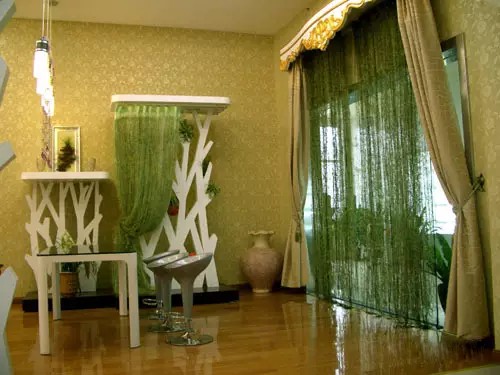
Anyone who has grown plants knows that whether they grow in soil or in water, they all need careful tending, and they easily die for all sorts of reasons. Today I want to introduce a plant that grows in the air——the air plant, which will absolutely make you fall in love with it!
Plant introduction:
It is a perennial herbaceous plant with a great many varieties and diverse forms. The plant is rosette-shaped, tube-shaped, linear or radial; the leaves are lanceolate or linear, upright, curved, or curled at the tip. Besides green, the leaves can also be grayish-white, blue-gray or even red. The leaf surface is densely covered with white scales. The spike inflorescence comes in colors such as green, purple, red, white, yellow and blue, with 3 petals, and the flowering period is about August to April of the following year. The capsule splits open automatically when ripe, and its seeds with feathery pappus drift with the wind and spread everywhere.
It is the only plant on Earth that lives entirely in the air. It can grow luxuriantly without soil and can produce bright flowers. It offers both foliage and flowers to admire, with extremely high ornamental value, and more importantly it is easy to care for. In a busy, fast-paced life it is the first choice for combining indoor greenery with home decor, and in recent years it has won increasing favor among flower-growing enthusiasts.
Cultivation methods:
Air plants have no root system; the water and nutrients they need are absorbed entirely through the stomata on the leaf surface. If planted in soil or water, they cannot survive. They are extremely adaptable to harsh conditions and can tolerate drought, light, wind, shade, heat and cold; they need no pot, no soil, and breed no mosquitoes or insects.
The suitable growing temperature is 15°C-25°C; reduce low temperatures; mist with a spray bottle 2-3 times a week, and once a day in the dry season. Do not let water accumulate on the leaf surface. If you find them very dry, you can give them a soak so they fully absorb water, and add some appropriately diluted liquid fertilizer. After soaking, be sure to drain the water off the leaves; light must be sufficient; their fertilizer requirements are very low, so fertilizing a few times a year is enough.
Common diseases:
1. Sunscald. It often occurs because water sprayed on the leaf surface does not dry in time, and under strong light the water droplets act like a convex lens and burn the leaf surface.
2. Heart rot and root rot. They are often caused by excessively high temperatures and poor ventilation.
3. Common pests include scale insects, snails and slugs. They are caused by a poorly ventilated environment.
Ornamental value and functions:
1. Hanging style. The hanging method is relatively simple; you only need a thread or string to hang it in midair.
2. Adhesive style. It offers more variation than the hanging style and is even more beautiful. It is suitable for giving as a gift, or as a small decoration for the home or office. When attaching plants you must use hot melt glue, because it contains no chemical substances and so poses no threat to the plant's health; other glues or adhesive strips cannot be used as substitutes.
3. It has the function of purifying the air and absorbing harmful gases; during the day it absorbs formaldehyde and benzene compounds, and at night it absorbs carbon dioxide.
Precautions:
1. Do not grow it in containers made of copper wire or aluminum alloy; these metals will slowly poison the air plant to death.
2. Do not grow it in a jar; air plants need a great deal of air circulation, and they will rot in a stuffy jar.
3. Varieties in the silver-leaf group are even more drought-tolerant than others, so the watering frequency can be appropriately reduced to prevent rot.
This is simply wonderful news for flower-growing enthusiasts. Not only is it easy to cultivate and easy to care for, but above all it is a one-of-a-kind potted plant: it can decorate the home, purify the air, be placed wherever you like, stuck on walls, hung on trees…… it is simply a universal plant! Enough said - pick one you like and put it in your home!