How to grow a hawthorn bonsai? These care tips you need to master
Hawthorn is a courtyard landscaping tree species with relatively high economic value. The tree form is tall and magnificent, the branches spread out and twist, and the young leaves are light green and beautiful. Hawthorn, with green leaves, white flowers, and red fruits, can be enjoyed in all four seasons. In spring, new shoots sprout and countless leaves compete in beauty; in summer, small jade-like flowers are graceful and charming; in autumn, red fruits hang in abundance, weighing down the branches; in winter, iron-like twisted branches inspire noble feelings. It is a greening and beautifying tree species for gardens and courtyards with a wide range of adaptation and strong vitality.
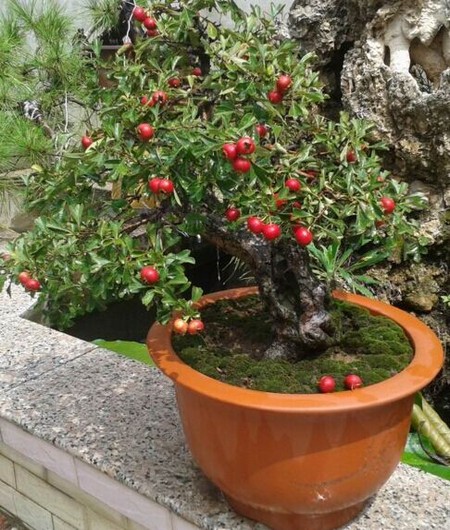
Soil requirements:
Hawthorn prefers warmth and sunlight, and can also tolerate cold, drought, and poor soil. Hawthorn has strong habits, liking a sunny, warm, and humid environment, slightly tolerant of shade, cold, drought, and barren conditions, and is not strict about soil, but grows better in fertile, loose sandy soil with good drainage and aeration.
Fertilizing:
During the growing season, place it outdoors in a ventilated and well-lit place for care, and water according to the rule of "do not water if not dry, water thoroughly when watering." From March to April before flowering, apply 1 to 2 times a liquid fertilizer mixed with phosphorus and nitrogen. During the fruit development period, apply a liquid fertilizer with relatively high phosphorus and potassium content every 15 days.
Pruning and pinching:
Because its root system is developed and its sprouting ability is strong, pay attention to thinning overly dense branches and leaves during normal times. For new shoots with vigorous growth, when they grow to about 20 cm, keep 4 to 6 leaves and pinch off the tips to promote short branches that bear fruit.
Pruning and shaping:
During the dormant period, carry out pruning and shaping, cutting off thin and weak branches, overly dense branches, and water sprouts that disrupt the tree shape, retaining thick medium and short branches, and cutting back overly long branches extending outward to encourage the rear branches to become thick and strong. Also pay attention to cutting back the crown, removing branches on the upper part of the crown, retaining branches on the lower part, and cultivating them into a shorter new crown.
Winter care:
In winter, place it in a wind-sheltered, sunny place for care, pay attention to soil moisture, and replenish water in time. Repot once every other year in spring or autumn to increase its fruit-bearing rate. After hawthorn loses its leaves in winter, although it can withstand severe cold, its most suitable growth temperature is 18~32°C. If the temperature during the growing season is too low, or light and nutrients are insufficient, or the summer temperature exceeds 38°C, the plant's growth will be inhibited. Therefore, growers must choose the cultivation environment according to the climate characteristics of their region to meet the plant's requirements for temperature and light conditions.
Pest and disease control:
Hawthorn has relatively few pests and diseases. Individual plants are prone to chlorosis during the growing season, mainly caused by soil alkalization. Control method: mainly apply complete-element fertilizer, adding 2% ferrous sulfate to organic fertilizer to promote the leaves to quickly turn green again.
The main pests of hawthorn include star caterpillars, leaf roller caterpillars, fruit borers, armyworms, scale insects, and so on. Control method: spray with 50% monocrotophos, or a 1500~2000 times aqueous solution of synthetic pyrethroid, once a week, and the above pests can be eliminated after 2~3 consecutive treatments.