How to grow a tamarisk bonsai? Master these care methods
Tamarisk, also known as weeping tamarisk, West River willow, West Lake willow, red willow, shade willow; of the family Tamaricaceae (tamarisk family), tamarisk is a deciduous small tree. The young branches and leaves of tamarisk are used in Chinese herbal medicine. It is produced throughout China. Used fresh or dried. The tamarisk's branches are slender and soft, with a graceful, swaying form, and its flowers resemble those of the red knotweed, making it quite beautiful. It is often planted as an ornamental garden plant. It can be used for poor eruption of smallpox rash or inward invasion of rash toxin, colds, cough, and rheumatic bone pain.
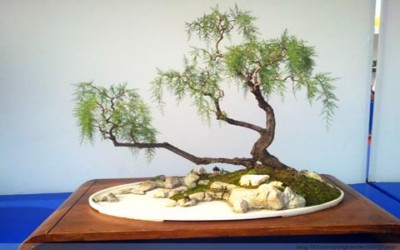
Appreciation and evaluation: The tamarisk bonsai has an elegant posture, with luxuriant branches and leaves, a jade-green color like that of cypress, and slender, soft branches that droop naturally, natural and unrestrained; when a breeze blows, it dances gracefully and is full of charm, endearing it to people. Here is a discussion of the care methods for tamarisk bonsai:
Repotting: The tamarisk's habits are tolerance to saline-alkali soil and preference for moisture, so the potting soil should preferably be neutral or slightly saline-alkaline, breathable, loose, sandy soil; repot, trim roots, and replace with new soil once a year. The new soil should mainly consist of leaf mold and honeycomb coal cinders, with an appropriate addition of fertilizer and lime residue. Tamarisk grows relatively fast; generally, bonsai are repotted once every 1 to 2 years, and old-stump bonsai are repotted once every 2 to 3 years. Repotting should be done in February to March each spring before the tamarisk buds. When repotting, cut off dead roots and appropriately remove some overly dense roots; removing too many fibrous roots at once can cause branch death. Tamarisk in a vigorous growth stage should be moved to a pot one size larger, while old stumps can remain in the original pot. Replenish the pot with fresh, fertile growing medium.
Location: After planting or repotting, water the tamarisk thoroughly and first place it in a shaded area for 10 days; if the roots were damaged rather severely, then place it in semi-shade for about 5 days, and afterward place it in a spot with ample sunlight and good air circulation for care. In hot summer, it should be placed in semi-shade or a shade net should be set up over the care area. In the Beijing area, in late autumn and early winter, potted tamarisk should be moved into a low-temperature indoor space, or the pot should be buried in a wind-sheltered, sunny spot with soil mounded around the trunk, which can also allow it to overwinter outdoors. In the south, place it in a wind-sheltered, sunny spot in winter, and it can overwinter outdoors.
Fertilizing: Tamarisk has a well-developed root system and prefers nitrogen fertilizer. Normally, apply a dilute alum fertilizer solution once every half month, following the method of frequent but light applications. During vigorous growth, apply frequently and appropriately more; when growth is poor, apply slowly and less. Before leaf fall in late autumn, apply monopotassium phosphate once to promote branch aging and nutrient storage, and to prevent branch dieback in winter. For tamarisk already placed in an ornamental pot, apply 1 time per month a fully decomposed organic liquid fertilizer. Excessive fertility can cause leggy branches and ruin the tree's shape. Do not fertilize during the plum rain season or in winter.
Watering: Although tamarisk is drought-tolerant, it prefers moisture; the potting soil should be kept moist rather than dry, and the potting soil should be maintained as constantly moist. Although tamarisk is drought-tolerant, it prefers moist soil even more. Normally keep the potting soil damp, but water must not accumulate in the pot. In hot summer, in addition to watering the pot, also sprinkle water on the ground. In winter, water less, but the potting soil should also be kept moist. During the growing season, dry potting soil often causes yellow leaves and withered branch tips, and in severe cases causes the entire tamarisk to die.
Shaping: Tamarisk has strong sprouting ability and grows fast. During the vigorous growth periods of spring and summer, prune once a week to maintain the tree shape. For new buds sprouting on the trunk, all those not needed for the design should be removed promptly to avoid consuming nutrients. To improve the ornamental value of tamarisk, you can take advantage of its strong sprouting ability by removing all the leaves during the vigorous growth period, then placing it in a spot with ample sunlight, strengthening fertilizer and water management, and spraying water on the branches once each in the morning and evening; new buds can sprout in 5 to 6 days, and in 20 days the leaves will be as full as before, tender green and lovely.
Pruning: Although tamarisk is tolerant of pruning, improper pruning timing can easily cause branch dieback and dead branches, so pruning should be done in spring and summer. Pruning in autumn, when newly grown branches have insufficient aging and nutrient storage, can cause branches to die back after overwintering. Do not prune in winter; wait until after budding in spring to prune, cutting away dead branches, excess branches, and weak, thin branches to maintain tree vigor. In addition, after each flowering, the faded flowers should be cut off promptly.
Light: Tamarisk is a strongly heliophilous tree species and is not shade-tolerant. It should be placed in a spot with good ventilation and ample sunlight, but during the dog days when sunlight is too intense, it may be slightly shaded.
Pest and disease control: Tamarisk has relatively few pests and diseases, with occasional occurrences of aphids. They can be killed by spraying with 40% omethoate emulsifiable concentrate at 1500 times dilution. If the pest infestation is severe, spray again with omethoate after 7 to 10 days. The main disease of tamarisk is powdery mildew; pay attention to ventilation and spray with thiophanate-methyl or chlorothalonil once every half month for prevention. The main pests of tamarisk are red spider mites, scale insects, and whiteflies, which can be controlled with pesticides such as decis, methamidophos, and propargite.