How to Grow and Care for Zonal Geranium (Pelargonium) and Key Precautions
Geraniums are well-known ornamental plants valued for both their foliage and their flowers. The leaves of geraniums are usually alternate, palmately lobed or pinnately divided, and generally have long petioles; some species have leaves with light and dark markings. Each flower has five petals, and the flowers cluster together in an umbel-like arrangement known as a "false umbel." Flower shapes range from star-shaped to funnel-shaped, and colors include white, pink, red, orange-red, purple, and even near-black, in every variety. They are truly gorgeous and dazzling to the eye.
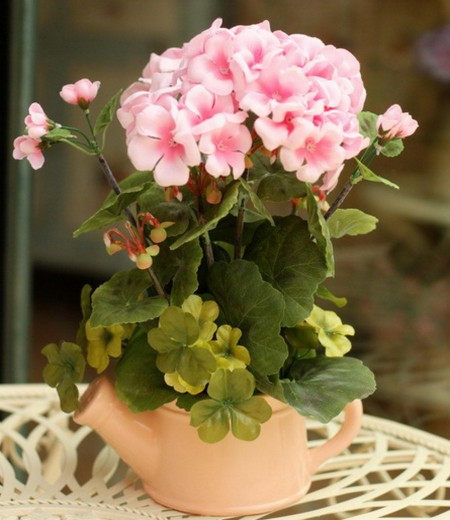
Many people are very fond of zonal geraniums, which are colorful, pleasing to the eye, and highly ornamental. Below, we introduce how to grow zonal geraniums and the precautions to take.
How to grow zonal geranium (Pelargonium):
1. Soil
For growing zonal geraniums, a loose, fertile, well-drained sandy loam is best. However, flower color is affected by soil pH: in acidic soil the flowers are blue, and in alkaline soil they are red.
2. Temperature
The suitable growing temperature for zonal geraniums is 18-28°C, and the winter temperature should not fall below 5°C. Flower bud differentiation requires 6-8 weeks at 5-7°C. A temperature of 20°C can promote flowering, and maintaining 16°C after the flowers appear can extend the viewing period. Note that high temperatures cause the flowers to fade quickly.
3. Light
Zonal geraniums are short-day plants. During normal cultivation, avoid direct blazing sun; 60%-70% shade is ideal. When the light is too intense in midsummer, appropriate shading can extend the viewing period.
4. Watering
The potting soil for zonal geraniums should be kept moist, but do not water too much. Especially in the rainy season, pay attention to drainage to prevent waterlogging from causing root rot. For indoor potted plants in winter, slightly dry conditions are better. If it is too humid, the leaves rot easily.
5. Fertilizing
The flowering period of zonal geraniums is June to July. During flowering, fertilizer and water should be sufficient, with fertilizing once every half month.
6. Pruning
After zonal geraniums bloom, be sure to remove the flower stems to encourage new branches. Appropriate pruning can keep the plant's shape attractive.
7. Pests and Diseases
Zonal geraniums mainly suffer from wilt disease, powdery mildew, and leaf spot. Spray a 600-fold dilution of 65% zineb wettable powder for control. Pests include aphids and mirid bugs, which can be killed by spraying a 1500-fold dilution of 40% omethoate emulsifiable concentrate.
Precautions:
(1) Zonal geraniums prefer acidic soil and do not tolerate poor, barren soil or saline-alkaline soil. They grow poorly in alkaline soil, with yellowing branches and leaves, and do best in loose, fertile, humus-rich acidic soil. Because flower color is affected by pH, it can change from white to red, and from red to blue-green.
(2) Move them indoors in early to mid-October, control watering, and keep the room temperature at around 5°C to induce dormancy. Before bringing them indoors, remove the leaves to prevent leaf rot. From mid-December, move them to a sunny spot and keep the temperature at 15-20°C to promote the growth of branches and leaves, then move them outdoors in late April the following year.
(3) During the annual growing period, pinching can generally be done twice to promote branching. After flowering, keep 1-2 nodes on the old branches and cut them short to control plant height and encourage new branches. After autumn, cut off the tips of new shoots to stop branch growth and help the plant overwinter.
(4) Seedlings propagated by cuttings in March can be moved into 10 cm pots after rooting, and then planted into 16 cm pots in mid-June. Carry out the first pinching in June. If pinched in early June, flower buds can form by mid-August. Seedlings propagated by cuttings in May-June can be planted into 16 cm pots in July-August. To encourage flower bud formation in the same year, the last pinching must be done before September, otherwise flower buds will not form that year.