How to Grow Lavender in Pots? A Detailed Guide to Care Methods
Lavender is very useful. It not only has a beautiful appearance and high ornamental value, but can also be used to make medicine, lavender pillows, and extracted essential oils for making perfume. To give their homes a healthy environment, many friends also grow lavender in pots at home. How to grow lavender from seeds? How to improve the germination rate of lavender? For experienced gardeners, this is no longer a problem, but many friends who are not very familiar with planting still have plenty of doubts. Growing flowers is not that easy; it requires skill and patience. Everyone can develop patience, so let us explain the planting techniques for you.
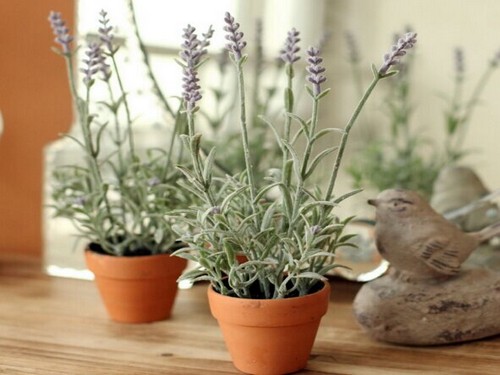
1. Soil: Lavender seeds are suitable for slightly alkaline or neutral sandy soil. Good drainage is required. You can use a mix of 1/3 perlite, 1/3 vermiculite, and 1/3 peat moss. If cultivating in open ground, pay attention to soil drainage; you can mound the soil higher before planting. Lavender seeds are tiny, so it is best to raise seedlings and then transplant. In warm regions, you can sow and raise seedlings at any time throughout the year; in cold regions, it is best to sow in spring. Before sowing, first level and finely break up the soil, water it thoroughly, and after the water has seeped down, evenly sow the seeds, then cover with a layer of fine soil at a thickness 2-3 times that of the seeds, and cover with grass or plastic film to preserve moisture.
Seed treatment: The suitable germination temperature for lavender seeds is 15-25°C. Because they have a relatively long dormancy period, before sowing they need to be soaked in gibberellin for 6 hours before sowing, and germination takes about 2 weeks. If not treated with gibberellic acid, it will take more than one month to germinate.
2. Watering: Lavender does not like water lingering around its roots. After one thorough watering, you should wait until the soil is dry before watering again, aiming for the surface growing medium to be dry and the interior moist, with leaves slightly wilted as the indicator. Watering should always avoid sunlight, usually in the morning, and water must not splash on the leaves and flowers, otherwise they easily rot and breed pests and diseases. A continuously damp environment will leave the roots without enough air to breathe, causing poor growth and even sudden death of the whole plant. This is often where lavender cultivation fails.
Lavender does not have high water requirements. In summer, it is best to place it outdoors, and receiving eight hours of sunlight a day is ideal, but you must replenish water in time to prevent the soil from drying out completely. This differs from ground planting, so you must promptly check whether the potting soil needs water. When about 1 cm of the soil surface has dried, you can water. In winter, only when the top 2 cm of soil has dried do you need to water.
3. Light: Lavender is a full-sun plant and needs ample sunlight and a suitably humid environment. An environment with full sun is better, though it can also grow with half-day sun. In summer, at least 50% of sunlight should be blocked, and ventilation should be increased to lower the ambient temperature. In this way, although growth will be weaker, the plant will not die. In winter, lavender can grow well on flat ground and should be cultivated under full sun.
4. Temperature: Lavender is semi-heat-tolerant, prefers coolness, and likes warm winters and cool summers. The suitable growing temperature is 15-25°C, and it can grow at 5-30°C. Limiting temperature: above 35°C; if long-term above 38-40°C, the top stems and leaves turn yellow and wither. In northern winters, when it is below 0°C for a long time, it begins dormancy, and during dormancy mature seedlings can withstand low temperatures of -20 to -25°C.
5. Fertilizing: For fertilizing, bone meal can be placed in the potting soil as a base fertilizer, usually once every quarter. For small seedlings, Huabao No. 2 (20-20-20) can be applied; after the plant matures, apply a fertilizer higher in phosphorus, such as Huabao No. 3 (20-30-20). Apply dilute fertilizer.
6. Pruning: Lavender flowers have the richest essential oil content. When using them, the flowers or inflorescences are the main part. For convenient harvesting, in the early cultivation stage some small inflorescences may as well be trimmed flat entirely with large scissors; the newly grown inflorescences will then be at a uniform height, which helps with harvesting all at once. Some varieties can reach 90 cm in height, and this method can also be used to keep the plant low and promote more branching and flowering, increasing the harvest. After flowering ends, pruning must be carried out. The plant can be pruned to 2/3 of its original size; the plant shape will be more compact and this is beneficial to growth. Pruning is generally done in spring; pruning in autumn will affect cold resistance. Finally, note that when pruning you should not injure the woody part, so as to avoid plant death.
Prune once every spring, cutting off about the upper one third of the length, but do not cut into the woody, thicker parts at the base. Of course, pruning in autumn is better than pruning in spring. If you see green buds already growing from the base, be careful not to cut them off.
Lavender is a herbaceous plant very popular among flower lovers, especially female flower lovers. If you can grow a pot of lavender at home, it is still very pleasant. This article will chat with flower lovers about how to grow potted lavender. We hope flower lovers can read it carefully and draw inferences from one instance instead of copying rigidly.
Lavender is still quite suitable for potting, but when potting lavender there are some matters we need to pay special attention to:
When potting, you definitely need soil with good drainage (general potting soil with some sand and very fine gravel added), and the drainage holes must be unobstructed (the drainage holes at the bottom of the pot should be large, and it is best to place 1 to 2 inches of stones at the bottom to help drainage). Because lavender prefers slightly alkaline soil, you can appropriately add a small tablespoon of slaked lime when planting. When potting, you can give just a tiny bit of slow-release fertilizer, and remember not to use too much, because lavender likes poor soil.
When potting, do not worry that the pot is too small, because lavender likes its roots to grow in a crowded environment. As long as the roots have 1 or 2 inches of room to grow, that is enough. On the contrary, if the pot is too large, it will cause the soil to be overly moist and the roots to rot. Because the roots grow quickly, you can repot once every year.