What are the cultivation methods and precautions for dahlias?
Dahlias are native to Mexico, where people regard them as a symbol of generosity and magnificence, and therefore honor them as the national flower. At present, most countries around the world cultivate them, and new varieties are released from time to time. According to statistics, there are more than 30,000 dahlia varieties, making it one of the species with the most flower varieties in the world. Dahlias are famous for their many flower colors and forms, rich and varied, and are one of the world's famous flowers. So next, let's take a look at the cultivation methods and precautions for dahlias!
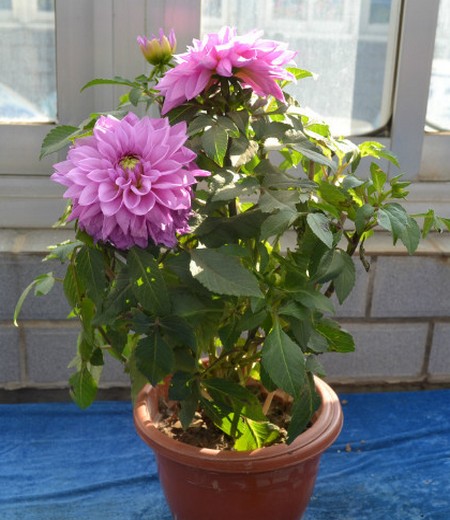
Potting soil:
Dahlias are suitable for loose, humus-rich, well-drained sandy loam soil. For potting dahlias, the planting soil is generally a culture soil prepared with garden soil (50%), leaf mold (20%), sandy soil (20%) and dried manure (10%). Compacted soil easily causes waterlogging and root rot, so it must not be used. In daily management, loosen the soil in time and drain excess water from the pot. If the fleshy tuberous roots of the dahlia contain too much water in the soil, air permeability will be poor, and rot will occur at that time.
Light:
Dahlias like light. If placed in a shaded place for a long time, they will grow poorly, causing weak roots, thin leaves and slender stems, small and pale flowers, and even failure to bloom. Therefore, potted dahlias should be placed in a sunny place, with daily light requirements of more than 6 hours, so that the plants are robust and the flowers are large and full. If daily sunlight is less than 4 hours, stem and leaf branching and flower bud formation will be affected to a certain extent. Especially in cloudy and rainy conditions with little sunlight, flowering will be poor, stem and leaf growth will be poor, and they are prone to disease.
Watering:
The amount of watering can control the height of the dahlia plant. During the seedling stage, water should be controlled to promote dwarfing. In summer, to lower the temperature, increase air humidity, and reduce water evaporation from dahlia stems and leaves, water should be sprayed 1-2 times a day. Water once at 3-4 pm, and the amount of water should not be too large.
Shaping:
The pruning of potted dahlias should be flexibly controlled according to the variety. Generally, large varieties use single-stem shaping, and medium varieties use 4-stem shaping. Single-stem shaping means retaining the terminal bud and removing all side buds, so that nutrients are concentrated, forming a low-growing, large-flowered single-stem dahlia.
Inserting stakes to support the plant
The stems of dahlias are both hollow and brittle, and are especially easy to blow over and break in the wind, so bamboo stakes should be inserted in time for support. Inserting bamboo can also prevent branches from growing crooked and improve the ornamental value of potted plants. When the plant grows taller than 30 cm, a small bamboo stick should be inserted beside each branch and tied and fixed with hemp fiber (or fine string). As the plant grows taller and taller, longer stakes should also be replaced in time, and finally the small bamboo inserted should reach the lower part of the flower bud.
Overwintering of the plant
The tuberous roots of dahlias cannot be frozen. In November, after the branches and leaves wither, the aboveground part should be cut off, moved indoors, and stored in the original pot. The tuberous roots can also be taken out and dried for 1-2 days, then buried indoors in slightly moist sandy soil, with the temperature not exceeding 5°C, and potted again in the following spring.
Precautions:
1. Dahlias are sun-loving flowers. They need at least 4 to 5 hours of direct light every day to have lush leaves and abundant flowers. It is best to place them on a rooftop garden or a south- or west-facing balcony. When placed on a balcony, they should be rotated 180° about every 10 days to prevent uneven crown growth. Do not place them indoors or in shaded places without sunlight.
2. Dahlias can adapt between 10°C and 32°C, with 15°C to 25°C being the most suitable. Above 32°C, growth stops, and at this time they can be placed on a cool east- or north-facing balcony. In hot and rainy summers, dahlias placed on rooftop gardens should be shaded and protected from rain to prevent root rot. Dahlias are not cold-tolerant. Once frosted, the underground stems wither and the underground tuberous roots go dormant. South of the Yangtze River, they can overwinter outdoors; north of the Yangtze River, they should be moved indoors to overwinter at a low temperature of 1°C to 10°C.
3. They like a cool environment with good ventilation. With poor ventilation, the stems grow leggy and weak. When encountering strong wind, because the stems are hollow and brittle, they are very likely to lodge and break. Generally, when they grow to 30 cm, use 4 bamboo poles as thick as a little finger or steel bars as thick as chopsticks, insert them around the pot, about 50 cm above the soil, and use plastic, aluminum or copper wire to make 2 or 3 circles, connecting the four small posts to prevent the plant from lodging.
4. Dahlias grow best when planted in sandy loam soil. A loose, fertile, neutral sandy loam can be made by mixing 50% leaf mold, 35% garden soil, 10% sand and 5% plant ash. Every early spring, repot and replace with new soil, otherwise they easily degenerate, with few and pale flowers. Planting in heavy clay easily causes root rot and poor growth.
5. Dahlia plants range from 30 cm to 200 cm in height, with three grades: tall, medium and low. For balcony potting, dwarf varieties of 30 cm to 60 cm should be chosen. If too tall, they not only block light, but also easily lodge in strong wind, and may even be blown over along with the pot and fall, possibly causing accidents that injure people and damage objects.
6. They like a moist environment. During drought, leaves easily shrivel and turn yellow. Watering should be moderate; the soil only needs to be slightly moist. Too wet easily causes leggy growth, and waterlogging easily causes root rot. Therefore, when planting, a layer of broken hard plastic foam blocks should be placed at the bottom of the pot to enhance air permeability and drainage and prevent root rot. While controlling water appropriately, often spray water on the leaves to increase air humidity and benefit their growth.
7. They like fertilizer. When potting, add some bone meal to the soil. During the growing period, apply thin fertilizer frequently, once every 7 to 10 days. It is best to use potassium dihydrogen phosphate solution, with a concentration of 0.1% at the seedling stage and 0.2% at the flowering stage, or use 5% superphosphate. Raw fertilizer and concentrated fertilizer easily burn roots, and using nitrogen fertilizer alone easily causes leggy growth, soft stems and lodging.