How to grow a Sageretia bonsai? A complete guide to care methods and techniques
Sageretia thea, commonly known as shumi and suanwei, is a plant of the genus Sageretia in the family Rhamnaceae. It is native to the coastal provinces and regions of southeastern China, and is also found in Japan and India. Sageretia is a thorny climbing deciduous shrub with nearly opposite, thinly leathery, evergreen or semi-evergreen leaves that are ovate or elliptical with finely serrated margins; it flowers from September to October, with pale yellow, fragrant blooms arranged in spicate branched panicles; the fruit is spherical, ripening in April to May of the following year, purple-black, pleasantly tart, hence the name “suanwei”.
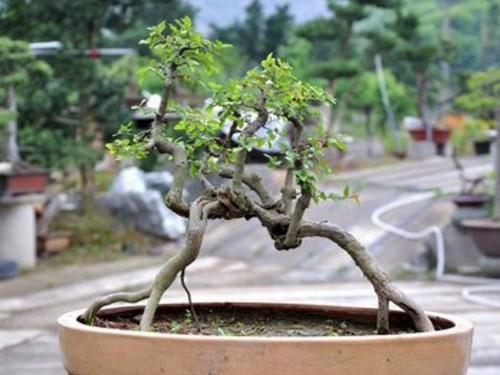
Because a Sageretia bonsai has little soil and few nutrients, it is easily affected by outside climate and attacked by pests and diseases. Therefore, pruning, fertilising, watering, repotting, cold protection and pest and disease control must all be done well; growth should also be controlled to keep the tree's graceful shape.
Shade: a Sageretia bonsai has little soil and shallow roots, so strong sun can easily scorch or kill tender buds, shoots and leaves. Therefore, shade is essential in summer; set up a shade frame or move it indoors, under the eaves, or into tree shade and other places without direct sunlight.
Temperature: a Sageretia bonsai has poor cold resistance and can easily dry out from freezing or even die. So in winter it should be kept indoors with good ventilation, at a room temperature above 5°C; when the room temperature exceeds 25°C, windows can be opened to prevent leggy growth caused by high temperatures; when the room temperature is below 5°C, a plastic cover can be used for insulation (remove the plastic bag once the temperature is above 5°C); when the room temperature is below 0°C, warming methods such as hot water should be used to raise the temperature, ensuring the Sageretia bonsai overwinters safely.
Soil: the potting soil must be good. Sageretia stumps originally grew in the wild with well-developed root systems and tolerance of drought and waterlogging. Once dug up and planted in a shallow pot just inches across, their growing conditions are restricted and they can easily die if not cared for properly, so special care is needed. Choose a well-draining potting medium, and during the care period it is best to put in a thicker layer of potting soil. Replace the soil with new soil every two years and add some base fertiliser to keep the soil fertile, so the stump specimen can grow normally.
Watering: water must be sufficient. Natural water such as river water, pond water and rainwater is best. If tap water is used, it should be stored for one or two days so the chlorine escapes before use, which is safer. Soapy laundry water, as well as water containing oil or salt, must never be used. When watering, take care not to let the potting soil become too wet or too dry. During the dog days, water once in the morning and once in the evening. To shorten the branches and leaves and make the shape more attractive, water can be appropriately restricted during the spring and summer growing seasons.
Fertilising: fertilising must be done carefully. Too much fertiliser causes leggy branches and leaves, while a lack of fertiliser makes branches thin and weak and leaves yellow, making the plant prone to pests and diseases. So fertilising should follow principles: newly planted, newly potted, just repotted, or root-damaged trees must not be fertilised for one month. In spring and summer, when the potted tree is in its peak growing season, more fertiliser must be applied. After autumn begins, when growth slows, less should be applied. In winter, when the potted tree enters dormancy, fertilising can stop. Do not fertilise on rainy days or around midday in midsummer. Liquid fertiliser is best applied on cloudy days or in the evening; when the potting soil is slightly dry, loosen the soil so the fertiliser water can soak into the soil. To speed up the breakdown of the fertiliser, be sure to water the next morning. For a Sageretia bonsai, cake fertiliser and kitchen waste can be sealed in a jar to ferment, then the upper liquid fertiliser is diluted with 4 to 5 times its volume of water and poured on. Sageretia is an acid-loving plant, so 1% ferrous sulfate should be added to the composted fertiliser water before use; when Sageretia sprouts, spray 1 to 2 times with 0.1% urea; before and after flowering, spray once with 0.1% to 0.2% monopotassium phosphate, etc.
Pruning: pruning must be timely. The usual pruning time is late spring and early autumn, the two seasons when Sageretia stumps have the strongest sprouting ability and the most vigorous growth. Water shoots, overlapping branches, crossing branches, radiating branches, dead branches and pest- or disease-infested branches should be cut off at any time. Note, however, that in hot weather pruning can easily scorch new buds and cause leaf curl, so after pruning it is best to place the tree in a cool spot until growth resumes normally before exposing it to strong light. A Sageretia stump bonsai can be pruned and trimmed all year round, removing at any time water shoots and overly dense branches that spoil the design, keeping the stump in a graceful shape with well-spaced branches and leaves, good ventilation and light penetration, and fewer pests and diseases.
Repotting: a Sageretia bonsai should be repotted once every 3 to 4 years, preferably before bud break in spring. When repotting, appropriately cut away some old and dead roots and overly long or dense roots, replace 1/2 of the old soil, and fill in with fertile, loose potting soil to promote new root growth.
Pests and diseases: control is needed. A common pest of Sageretia stumps is the longhorn beetle, commonly known as the “heart-boring worm”. The female longhorn beetle bites through the bark and lays eggs on the branches and trunk; the newly hatched larvae feed under the bark, and when grown they bore into the trunk and roots, and infested plants are often hollowed out and die. To control it, the location of the damage can be judged from the frass, a suitably sized wire can be inserted into the bore hole to stab the larvae to death, or a cotton ball soaked in 200 times diluted dichlorvos can be inserted into the bore hole to poison the larvae, then sealed with wet mud.
The red spider mite, also called the fire spider, is another common pest of Sageretia stump specimens. It is less than 1 mm long and oval, orange-red or reddish-brown. Red spider mites spin webs on the plant's leaves and pierce the branches and leaves with their mouthparts to suck sap; the chlorophyll of damaged leaves is destroyed, the colour turns pale yellow, fine greyish-yellow spots appear on the leaf surface, and the leaves gradually wither and fall, with some plants even losing all their leaves and dying. Spraying 1000 times to 1500 times diluted dichlorvos or dimethoate will eliminate them.
Notes:
With careful winter care, a Sageretia bonsai can keep its leaves from dropping and stay evergreen all year round, with gnarled roots and stems, slanting branches, and small, jade-green leaves, giving it a very antique elegance. Also, a newly planted Sageretia bonsai has suffered some root damage from pruning and other factors, so do not fertilise it for 20 days. After late spring, Sageretia enters its vigorous growing period, and a thin liquid fertiliser of decomposed manure should be applied about once every half month. Fertilising should generally be done when the potting soil is fairly dry, together with watering, following the principle of fertiliser first and water after, so the fertiliser can quickly seep into the lower part of the pot and be absorbed by the roots. In winter, Sageretia enters dormancy, so do not fertilise. That is all for the Sageretia bonsai fertilising methods; I hope it can help everyone.