What are the care methods for a water-absorbing stone bonsai?
No home is elegant without stone. Water-absorbing stone has good water-absorbing properties and can grow all kinds of small trees, flowers, grass, green moss and other vegetation. Its shape is beautiful and unique with high ornamental value. It can be placed in a living room or office, and it is also a fine gift for relatives and friends.
The material of water-absorbing stone is taken from the natural environment and formed through special geological changes. Some water-absorbing stones have traces of leaves and remains of animals and plants on their surfaces. They are living fossils for studying local geological changes and can also be made into bonsai for people to enjoy. Water-absorbing stone is formed through special geological changes, and its surface bears traces of leaves and remains of animals and plants. Water-absorbing stone bonsai are processed and carved into different shapes according to their natural forms, with layered peaks and ridges. Flowers and grass are planted on them and placed in a shallow water basin. The flowers and grass grow, bloom and bear fruit on the water-absorbing stone, giving excellent ornamental value. Water-absorbing stone is also a natural humidifier that can keep indoor humidity at a normal level.
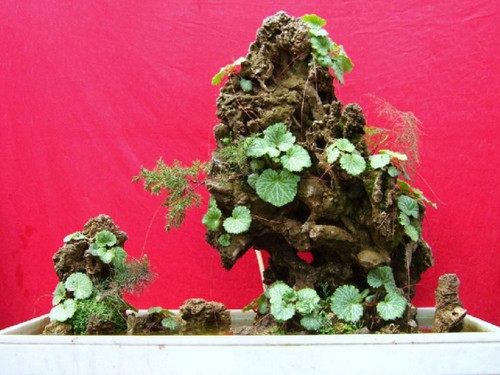
On top of the water-absorbing stone, you can plant all kinds of green plants, large and small, such as pearl grass and asparagus fern…… You can also sprinkle some grass seeds, and then the water-absorbing stone will be covered with small grass, so cute~~ Moreover, these green plants grow lush and full of green relying on the water supplied by the water-absorbing stone, looking especially charming. Water-absorbing stone can serve as a natural humidifier, keeping indoor humidity at a normal level and adding an elegant atmosphere to the whole room.
Water-absorbing stone is a treasure among mountain stones. It is formed from trees buried upside down for many years under the high temperature and high pressure of crustal movement. The stone is extremely hard and brittle, with strong and vigorous lines, and its color is yellow-brown or gray-brown. It is especially suitable for expressing steep rock walls and majestic mountain forms. When making a water-absorbing stone landscape bonsai, pay attention to the unity of color and texture strokes. You can use a chisel to split it along the stone seams, then select a main and a secondary mountain form with a certain outline to join together. The bottom can be cut flat with a cutting machine. The mountain-foot platform and scattered accent stones are the most brilliant parts of a water-absorbing stone bonsai. Plant arrangement can be varied without limitation, but pay attention to spraying water for care.
Because there are many kinds of water-absorbing stone bonsai, different bonsai plants have different living habits. When caring for a water-absorbing stone bonsai, the first thing to pay attention to is the habits of the plants. For example, sun-loving plants should be placed in a sunny and ventilated place, while shade-loving plants should be kept away from light; warm-loving plants should be placed indoors at a suitable temperature, while cold-loving plants can be placed in a more ventilated place, and so on.
Another point to emphasize is to change the water frequently, because the plants in a water-absorbing stone bonsai absorb water from the water-absorbing stone, and the water in the basin does not circulate. If the water is not changed for a long time, it can easily lead to water pollution. The amount of water when changing should also vary with the plants; too much or too little may be harmful to the plants. Adding an appropriate amount of nutrient solution to the water will help the plants grow, but be careful to wash the bottom of the basin frequently to prevent the breeding of bacteria. Dead leaves on the plants should be removed promptly, and pests and diseases should be dealt with promptly when found. These small details may all lead to the death of the plants, thereby affecting the beauty of the whole bonsai.
When a plant dies, there is no need to worry. You can remove the dead plant and plant a new one. Plants suitable for growing on water-absorbing stone include: herbaceous plants such as oxalis, maidenhair fern and saxifrage, as well as small woody plants such as small-leaf Buddhist pine, purple yew and golden larch. When replacing plants, it is best to plant the same plant in the original position. If you must replace the plant, try not to damage the structure of the water-absorbing stone. After all, a bonsai has ornamental value only as a whole.