What to Do When Potted Clivia Leaves Turn Yellow? Causes and Solutions
A reader asked: what should I do when Clivia leaves turn yellow? Why do Clivia leaves turn yellow? There are generally several situations in which Clivia leaves turn yellow. If the lowest leaves grow new roots from the leaf axils and the leaves turn yellow, this is normal metabolism. In one situation, no new roots grow from the leaf axils and the leaves turn yellow; this is mostly due to raw soil with poor aeration, too much fertilizer, or poorly controlled watering dryness and wetness that has caused root rot. All of these can make Clivia leaves turn yellow. If watering does not soak through, the root tips lack water, and the leaf tips will turn yellow and dry out. When this happens, you must water thoroughly. In summer, every 7-10 days you can set the flower pot base in a small basin of water; this ensures thorough watering, and this is called the soaking method.
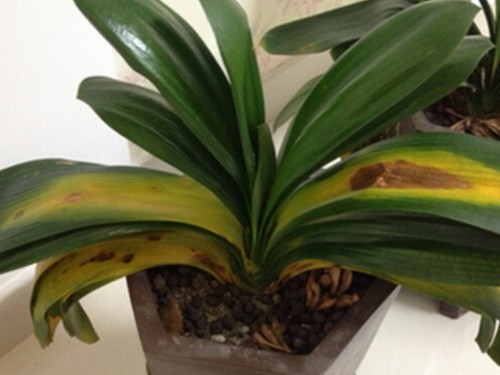
Another situation is the appearance of yellow spots of unequal size on both sides of the leaves, called brown spot disease. This is mainly caused by relatively raw soil and excessive fertilizer. Generally speaking, the potting soil should use leaf mold soil, which has fairly good aeration. Especially when fertilizing in summer, use light fertilizer frequently, and never drip fertilizer water onto the leaves; this can prevent brown spot disease from occurring. In yet another situation, because summer has abundant sunlight and higher temperatures, if Clivia is placed in direct sun, sunscald can also occur: in mild cases the leaves turn yellow, and in severe cases they wilt. In summer, shade should be provided and the plant placed in a ventilated spot, with 50% shading being best; a household south-facing window can use one layer of gauze for shading.
1. Unsuitable light
Clivia likes semi-shade and avoids direct strong light. If it is kept under strong light, especially in summer on a south-facing windowsill or balcony, it is very easy to cause sunscald, which makes Clivia leaves rough and lusterless, with leaf color turning yellow or appearing yellowish-white. If the potted plant is kept in a shaded place for a long time, where it receives no light or very little light, new leaves are also prone to becoming thin and yellow-green or yellow. Therefore, in summer it is best to place Clivia on a north-facing balcony or in a spot indoors with bright scattered light. In spring and autumn, give more light in the morning and evening, and in winter place it in a spot indoors with ample light.
2. Temperature too high or too low
When the temperature exceeds 30°C and the air is dry, and no measures are taken to cool and increase humidity, or when in the hot summer it is placed indoors or outdoors in a stuffy, unventilated spot, Clivia is relatively prone to developing yellow leaves. In winter, because the room temperature is too low (below 10°C) or the plant is directly hit by cold wind and suffers low-temperature injury, the cold-damaged leaf surfaces will turn yellow and gradually scorch.
3. Improper soil
If sticky heavy soil or soil containing more lime is used to plant Clivia, when the soil's physical and chemical properties are poor, its aeration and drainage are poor, and combined with excessive watering and fertilizing, root rot is very easy to cause, leading to Clivia leaves turning yellow. Some people use unfermented, undecomposed horse manure or other organic fertilizer; after being added to the pot it ferments and releases heat, burning the root system and causing the leaves to gradually scorch. Therefore, the soil used for potting should be a loose, fertile, slightly acidic soil with good drainage and aeration.
4. Improper water and fertilizer
During care, if the potting soil is too dry or too wet, especially if it is frequently too wet, it will cause the leaves to turn yellow and scorch. If the potted plant is often exposed to rain in summer outdoors, or when washing dust from the leaf surfaces, water is poured multiple times into the middle of new leaves, this will cause the middle new leaves to rot and scorch. If too much, too concentrated, or unfermented and undecomposed topdressing is applied, the root system cannot absorb it, causing root burn, and the leaves will also turn withered yellow and yellow. Applying too much nitrogen fertilizer, or mixing too much soybean cake crumbs into the soil as base fertilizer, will also produce the same fertilizer damage. In addition, during fertilizing, if fertilizer liquid is accidentally dripped onto the plant and leaves and not washed off in time, yellow spots or scorching will also appear on the leaf surfaces.
Because of the various causes above, ulcer-like symptoms may also accompany them; this is leaf spot disease caused by fungal infection. To prevent or reduce the above diseases, on the one hand use soil, water, and fertilizer correctly; on the other hand, pay attention to the environment, temperature, and light as the seasons change.
Clivia leaves turning yellow is an abnormal phenomenon that commonly occurs in home-grown Clivia. This is mainly a physiological disorder caused by improper management, and in severe cases it can also lead to the death of the entire Clivia plant. Corresponding prevention and treatment methods can be adopted according to the different causes.
Cause 1: Applying raw fertilizer or concentrated fertilizer
Clivia's fleshy root system is thick, plump, and tender, and it most fears too much or too concentrated fertilizer or the application of undecomposed organic raw fertilizer; otherwise, it is very easy to cause root burn. In mild cases it causes Clivia leaves to turn yellow and leaf margins to scorch; in severe cases it leads to the whole plant turning red-yellow and dying.
Treatment methods:
① Immediately increase the amount and frequency of watering to dilute the concentrated fertilizer. Prevent waterlogging.
② If the damage is caused by raw fertilizer, immediately repot and change the soil. Take out the plant, first rinse the root system, cut off the damaged roots, apply charcoal powder to the wounds, and then replant.
Cause 2: Exposure to scorching sun
Clivia likes a cool, moist environment. If Clivia is placed in a stuffy, unventilated spot, or in a high-temperature, dry environment with added exposure to scorching sun, the normal activity of enzymes in the Clivia plant is inhibited, and the chlorophyll in the leaves is destroyed. Then Clivia leaves will turn yellow, especially the tips of young tender leaves turning yellow or the leaf margins scorching.
Treatment methods:
① Move the potted plant promptly to a ventilated, cool spot.
② Shade it to prevent direct sunlight.
③ Spray water around the Clivia plant and on the ground to increase humidity and lower temperature.
Cause 3: Poor drainage
Watering too frequently or long periods of continuous overcast rain keep the potting soil in a waterlogged state for a long time, reducing oxygen in the soil so it cannot meet demand. This causes abnormal life activities in Clivia, root rot, yellowing of the tips of tender leaves, and then yellowing of older leaves.
Treatment methods for Cause 3:
① Immediately control watering.
② Avoid rain exposure.
③ Stop fertilizing.
④ Frequently loosen the soil to increase the soil's oxygen content, improve the root system's absorption capacity, and promote plant growth.
Cause 4: Dry soil
The potting soil is too dry, and the soil lacks water. In severe cases, Clivia's old leaves die and new leaves have dry tips.
Treatment methods:
① First water moderately.
② When the temperature is high and dry, pay even more attention to balanced watering.
③ After Clivia gradually recovers its vitality, return to normal water and fertilizer management.
④ Usually keep the potting soil moist and loose.