How to grow potted hydrangeas? A complete guide to growing methods and precautions
As an important flowering shrub of summer, hydrangeas are planted under open woodland and along the edges of paths for ornamental viewing, and can also be grown in pots on courtyards and balconies. So how are hydrangeas grown? What good methods are there for growing them? And what precautions should be taken when growing hydrangeas? Please read on with your questions and join me below!
Propagation methods:
Cuttings, division, layering and grafting are commonly used for propagation, with cuttings being the main method. During the plum rain season, select vigorous young shoots from a young mother plant as cuttings; the base of each cutting must include a node, dip it in mud slurry, and keep it about 20 cm long, removing the lower leaves.
1. The optimum temperature for cuttings is 13-18°C. After inserting them, shade is needed and they must be kept constantly moist. Roots form in about 15 days to 1 month, and after surviving they can be transplanted the following year.
2. Division propagation is best done in early spring before buds sprout. Separate rooted branches from the mother plant and pot them directly; do not water too much, keep them in semi-shade, and once new buds sprout move them to normal care. Layering can be done when the buds begin to swell; growth occurs after 30 days, and the following spring cut them from the mother plant, transplant with the soil ball, and they can bloom that same year. Air layering is generally done in spring from March to April, roots form by June to July, and they can be cut off and planted separately that same year.
3. For grafting propagation, use seedlings of Chinese snowball viburnum (Viburnum macrocephalum) as rootstock; cleft grafting in spring makes it easy to survive. Transplanting is best done after leaf fall or before bud break, and the original soil must be kept. The main branches tend to send out rampant shoots, so after flowering they need proper pruning to shape the tree.
Growing methods:
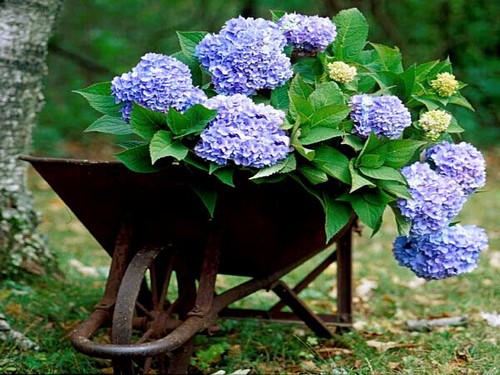
1. Soil: For growing hydrangeas, a loose, fertile, well-drained sandy loam is best. However, flower color is affected by soil pH: in acidic soil the flowers are blue, and in alkaline soil they are red. A fertile, loose, well-drained yet moisture-retaining, slightly acidic light soil is needed. It can be prepared by mixing leaf mold, garden soil and vinegar residue in a 2:2:1 ratio and stirring evenly, then adding an appropriate amount of fully decomposed organic fertilizer.
2. Watering: The potting soil for hydrangeas must stay moist, but do not water too much; especially in the rainy season, pay attention to drainage to prevent waterlogging from causing root rot. In winter, indoor potted plants are better kept slightly dry. If too moist, the leaves rot easily. When repotting in spring or after heavy pruning, water a little more appropriately, and once new buds sprout, control the amount of water. In summer, water once each morning and evening, and spray water on the leaves and around the pot every day to increase air humidity, reduce the plant's evaporation and lower the temperature. In the plum rain season, reduce watering and promptly pour off any standing water in the pot; after late autumn, control watering; in winter, the potting soil should stay 30% moist.
3. Light: Hydrangeas are short-day plants. In normal cultivation, avoid direct sun exposure, and 60%-70% shading is ideal. When sunlight is too strong in midsummer, proper shading can extend the flowering period.
4. Temperature: The optimum growing temperature for hydrangeas is 18-28°C, and the winter temperature should not be lower than 5°C. Flower bud differentiation requires 6-8 weeks at 5-7°C, and a temperature of 20°C can promote flowering. After the flowers appear, maintaining 16°C can extend the flowering period. Note that high temperatures make the flowers fade quickly.
5. Fertilizing: The flowering period of hydrangeas is June to July. During the flowering period, fertilizer and water must be sufficient, fertilizing once every half month. During the growth period, apply a thin, fully decomposed organic fertilizer plus 1 part ferrous sulfate once every 2 weeks; when fertilizing at the bud stage, add 2% potassium dihydrogen phosphate. Fertilize promptly after flowering.
6. Repotting: Every 1-2 years in early spring (mid-March), the plant needs repotting: remove part of the old soil, cut off rotten and old roots, add freshly prepared potting soil, and prune appropriately. After repotting, place the plant in a shaded spot for about 10 days, and after it recovers, gradually expose it to light and return to normal care and management.
7. Pruning: After hydrangeas bloom, be sure to remove the flower stems to encourage new branches; proper pruning keeps the plant shape attractive. When seedlings reach 15 cm tall, pinch out the growing tips; after axillary buds sprout, keep 4 new branches from the middle and upper parts and remove all the rest; when the 4 new branches reach about 10 cm, pinch out the tips a second time. After that, once the flowers fade, promptly shorten the branches, keeping 2-3 buds on each branch, and when the new shoots reach 10 cm, pinch out the tips again, repeating this cycle, and after autumn cut off the tips of the new shoots.
8. Pests and diseases: Hydrangeas mainly suffer from wilt disease, powdery mildew and leaf spot. Spray 65% zineb wettable powder at 600 times dilution for control. Pests include aphids and mirid bugs, which can be killed by spraying 40% omethoate emulsifiable concentrate at 1500 times dilution.
Precautions:
Key watering points: The potting soil for hydrangeas must stay moist, but do not water too much; especially in the rainy season, pay attention to drainage to prevent waterlogging from causing root rot. In winter, indoor potted plants are better kept slightly dry. If too moist, the leaves rot easily.
Applying fertilizer: The flowering period of hydrangeas is June to July. During the flowering period, fertilizer and water must be sufficient, fertilizing once every half month.
Pruning essentials: After hydrangeas bloom, be sure to remove the flower stems to encourage new branches; proper pruning keeps the plant shape attractive.
Changing the potting soil: For potted hydrangeas, generally repot and change the soil once a year. It is best to repot and change the soil in early March. When repotting, prune the plant's root system, cutting off decayed roots, rotten roots and overly long rootlets. After moving the plant into the new pot, press the soil firm, then water thoroughly, place it in a shaded spot for about 10 days, then move it outdoors for normal management.