How to grow Anthurium hydroponically? Learn the correct cultivation method
Anthurium is a plant in the Araceae family and also a plant with fairly strong water-loving tendencies. However, growing it hydroponically is somewhat difficult.
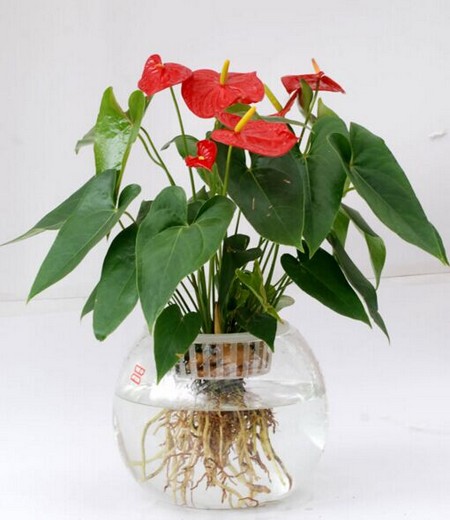
When growing Anthurium hydroponically, half of the root system should be exposed to the air so that the roots can breathe in the air (as shown in the illustration); otherwise, root rot is very likely to occur. The root system of hydroponic plants grows exposed, and after contact with light, plant cells carry out photosynthesis, and the same is true for the roots. It is normal for them to appear green. As long as they are not in direct sunlight, healthy root growth can usually be ensured. Not all hydroponic plant roots will eventually become green in color and healthy. For example, some are brown.
Some of the secondary fibrous roots of the pink Anthurium (Pink Champion) appear brown, which is abnormal. Fibrous roots of this color should feel soft to the touch. These are rotted roots and should be cleaned away promptly, and the frequency of water changes should be increased to control their spread.
It is generally a mistaken idea that they can survive just by being placed in water. Because of their strong water-loving tendency, they can still survive for several months even when placed in water.
The roots of Anthurium breathe very strongly, and placing them directly in water easily hinders their breathing. The best method is to use a substrate, and the best substrate is expanded clay pebbles. Since Anthurium roots are fleshy roots and the leaves emerge from the roots, the usual method of custom orchid mix + stones + easy medium does not easily produce small leaves. Expanded clay pebbles, however, are light in texture and provide ample space, making it easy for small leaves to emerge... The Anthurium I currently grow hydroponically in the office uses expanded clay pebbles, and it has already been grown for 2 years, with each plant producing 3-4 flowers.
To grow Anthurium hydroponically with expanded clay pebbles, first wash the roots clean, prune old roots and residual roots, and remove flowers... Then place the plant into the container. Fill it with expanded clay pebbles, then dilute rooting powder according to the ratio, spray the expanded clay pebbles damp, and be careful not to let too much water accumulate below; if there is too much water, pour it out... After a long wait, you will be pleasantly surprised to find that the thick, white fleshy roots of the Anthurium are growing in all directions, all clinging to the edge of the container. At this point, congratulations: a hydroponic Anthurium is considered complete, and what remains is to regularly add nutrient solution and care for its growth...
When growing Anthurium hydroponically, the key is still to pay attention to the following two points:
1. Suitable humidity
Anthurium likes an environment with relatively high humidity. The humidity mentioned here refers to the relative humidity in the air, not merely the water content in the planting medium. Humidity is also a variable, because when humidity rises and dry winds increase (especially in northern China), if water is not replenished, then humidity will decrease. Generally speaking, the humidity required by Anthurium should preferably be maintained at 70%-80% (temperature 20-28°C). The level of humidity can play a role in regulating humidity for Anthurium, that is, regulating the transpiration from the leaf surface of Anthurium.
If the relative humidity is too low, causing drought and water shortage, the edges of the leaves and spathes will dry out, and the spathes will be uneven. The water temperature for watering Anthurium should be maintained at around 15°C (including the nutrient solution used for watering); this point is especially important in severe cold and intense heat. The moisture in the medium should not be too wet, because the roots of Anthurium are semi-fleshy, and the roots themselves store a large amount of water. Too much water in the medium causes a lack of oxygen in the medium, obstructs root respiration, and long-term excessively wet conditions will cause root rot. You can use discarded cola bottles or mineral water bottles, fill them with tap water, let them stand for 3-4 days, then pour the water into a spray bottle and spray the leaf surface of the Anthurium. In summer, spray once at 10:00-11:00 and once after 15:00, but the pH value of the sprayed water should be low.
2. How to manage
After adding nutrient solution, it should also be left to stand as described above before use. On the one hand, the chlorine in tap water can volatilize; on the other hand, water that has been left to stand can remain consistent with room temperature. Do not put standing water in the sun, to avoid the growth of green algae. Using cooled boiled water is also feasible. When growing Anthurium hydroponically, the speed of inducing new roots takes a relatively long time compared with plants such as Aglaonema; however, its root system is relatively vigorous, and once hydroponic roots are formed, it is very easy to care for. Therefore, healthy, virus-free Anthurium plants should be selected, and after disinfection with agricultural streptomycin, they can be acclimated with flower nutrient solution.
Related questions:
Question 1: The Anthurium at the office had most of its root system rotted because it was watered too much. I cut off the rotten roots and put it in a plastic bottle for hydroponics, with the water level only reaching the roots, using tap water, changing the water once every two days. I wonder whether the Anthurium can recover this way? Should the tap water be changed to purified water?
Answer: It is entirely possible. It needs to be changed to mineral water or purified water, it should not be exposed to direct sunlight, and the water also needs to be changed regularly to keep it clean.
Question 2: Hydroponic Anthurium has nutrient solution added, and the water also needs to be changed frequently. Isn't the cost too high?
Answer: It does not need to soak in nutrient solution. Just spray leaf fertilizer from time to time.
Question 3: I am growing an Anthurium hydroponically, and I tried adding some liquid fertilizer, but after a few days the water becomes cloudy. I wonder if there is a good solution.
Answer: In soil cultivation, plants absorb the elements they need from the soil to complete growth. Soilless cultivation means finding out all the elements plants need and making them into a complete fertilizer with 100% useful ingredients. Then it is diluted and applied according to the concentration required by the plant.
Question 4: I have just put the Anthurium into water, because the more I looked at it while it was planted in soil, the more something seemed wrong. The roots have all dried up, and I do not know whether it can survive if grown in water.
Answer: An Anthurium with a "poor appearance" will take on a completely new look after being put into water, though it takes some time. I have a potted Anthurium grown in soil that looked very bad after winter, so I put it into water in spring, and now it has grown many new leaves. If the room temperature is around 28, it can be put into water; it is relatively suited to a high-temperature environment.