How to Care for Phalaenopsis (Moth Orchid) as a Household Potted Plant and How to Prevent and Control Pests and Diseases
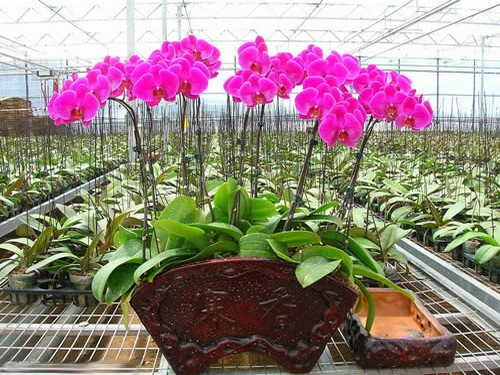
Phalaenopsis is a well-known genus of cut flowers. The moth orchid is a monopodial epiphytic orchid with a short stem, large leaves, and one to several arching flower spikes with large blooms; it gets its name because its flowers resemble butterflies. Its elegant flower posture and gorgeous colors make it a treasure among tropical orchids, earning it the reputation of "queen of orchids." The moth orchid is named for its graceful, butterfly-like flowers and is widely cultivated in countries around the world. The moth orchid is a treasure among tropical orchids and is deeply loved by refined enthusiasts. To grow a gorgeous, multi-formed moth orchid, mastering its care methods is essential.
1. Temperature
When growing moth orchids at home, temperature must be ensured first. Moth orchids like a hot, humid environment. During the growing period, the minimum temperature should be kept above 15°C, and the suitable growing temperature for moth orchids is 16-30°C. When temperatures are low in autumn and winter, at the turn of winter and spring, and in winter, pay attention to raising the temperature. Generally, in rooms with heating equipment in winter, this temperature is not difficult to reach, but be careful not to place the flowers directly on the radiator or too close to it.
When summer temperatures are on the high side, cooling is needed, and attention should be paid to ventilation. If the temperature is above 32°C, moth orchids usually enter a semi-dormant state, so continuous high temperatures should be avoided. The peak flowering period is around the Spring Festival; appropriately lowering the temperature can extend the viewing time. During flowering, the nighttime temperature is best controlled between 13-16°C, but it must not be lower than 13°C.
2. Humidity
Moth orchids originated in primeval forests with abundant mist and higher temperatures. Moth orchids do not have thick pseudobulbs to store nutrients. If the air humidity is insufficient, the leaf surface becomes wrinkled and weak. Therefore, moth orchids should be cultivated and cared for in a ventilated, high-humidity environment.
3. Light
Although moth orchids are relatively shade-loving, the plants still need to receive some light. Especially before and after the flowering period, appropriate light can promote flowering and make the blooms more colorful and longer-lasting. Generally, they should be placed in a spot with diffused indoor light, and direct sunlight should be avoided.
4. Watering
To avoid root rot in moth orchids, watering must be done in the right amount. Never water too much. Before watering, it is best to check whether the growing medium is dry, so as to avoid root rot.
The suitable air humidity for growing moth orchids is 60%-80%. During the vigorous period of new root elongation, water more; during the dormant period after flowering, water less. In spring and autumn, water once daily around 5 p.m. In summer, when the plants grow vigorously, water once each at 9 a.m. and 5 p.m. In winter, with weak light and low temperatures, watering once every other week is enough, preferably before 10 a.m. If a cold wave arrives, do not water; keep it dry, and resume watering after the cold wave passes.
The principle of watering is to water when dry and let it dry when wet: when the surface of the growing medium becomes dry, water thoroughly again, and the water temperature should be close to room temperature. When the indoor air is dry, you can use a sprayer to spray directly onto the leaf surface; it is enough for the leaf surface to become moist, but note that during the flowering period, do not spray water mist onto the flowers. Tap water should be stored for more than 72 hours before use for watering.
5. Fertilizing
Moth orchids should be fertilized throughout the year. Unless low temperatures persist for a long time, fertilizing should not be stopped. Winter is the flower bud differentiation period for moth orchids; stopping fertilizer can easily lead to no flowers or few flowers. Spring and summer are the growing period, when a dilute liquid fertilizer can be applied once every 7-10 days, preferably organic fertilizer; a special nutrient solution for moth orchids can also be used, but do not apply it when there are flower buds, otherwise the buds may easily drop early. In summer, when leaves grow (that is, after the flowering period), nitrogen fertilizer and potassium fertilizer can be applied as a top dressing. In autumn and winter, during the flower spike growth period, phosphorus fertilizer can be used, but it should be dilute, applied about once every 2-3 weeks. Fertilize in the afternoon after watering. After fertilizing several times, flush the orchid pot and plants with plenty of water to avoid residual inorganic salts harming the roots.
6. Ventilation
The normal growth of moth orchids requires circulating fresh air, so when grown at home, ventilation must be good, especially during the high-humidity period in summer. Good ventilation must be used to prevent heat stress, and it can also help avoid infection by pests and diseases.
7. Management
The flowering period of moth orchids is generally around the Spring Festival, and the viewing period can last as long as 2-3 months. When the flowers wither, the faded flowers must be cut off as early as possible, which can reduce nutrient consumption. If the flower spike is cut at 4-5 nodes from the base, it can bloom again after 2-3 months. However, this consumes too much of the plant's nutrients and is not conducive to growth the following year. If you want it to bloom well again the next year, it is best to cut the flower spike from the base. When the growing medium ages, it should be replaced in a timely manner; otherwise, air permeability worsens, causing root rot and weakening the plant or even death. Generally, repotting in May, when new leaves grow out, is preferable.
8. Pest and Disease Prevention and Control
Bacterial diseases:
This type of disease initially mostly multiplies in the internal tissues, then spreads to the leaf surface and the surface of the plant body. Common symptoms include exuding sap and rot, mostly caused by excessive watering or spread through contact with insects or between plants. Black rot symptoms: a common disease of orchid plants. When moth orchids are affected, the whole plant usually rots and dies, making it a fairly serious disease.
Control tips: Special attention should be paid to greenhouse ventilation, and the temperature should also be appropriately lowered. If an orchid plant has this disease, avoid spraying water to prevent the disease from spreading. Use fungicidal powder to spray and prevent unaffected orchid plants, and remove diseased plants as soon as possible.
Brown rot:
This is one of the rather difficult orchid diseases to deal with. In the early stage, pale spots appear on the plant body or leaf surface, then gradually become more concentrated and turn dark brown, and cause the plant body to wrinkle. Brown rot spreads quite quickly. From initial onset to wrinkling and rot takes only one day; usually, infection in the morning means rot begins in the evening, making it a rather troublesome moth orchid disease. Brown rot mostly occurs in environments with high air humidity, and is most likely to occur in spring and summer. At this time, air humidity is relatively high and orchid plants grow relatively quickly. Once an orchid plant becomes diseased, it can easily cause surrounding orchids to become diseased as well.
Control tips: Brown rot easily occurs in environments with high air humidity. If diseased plants are found, watering should be stopped, the diseased parts should be cut off, and fungicides should be applied. If the condition is severe or there is concern that it will expand, diseased plants can be removed or isolated. If other orchid plants are at risk of infection, fungicidal powder can be sprayed for prevention. In spring and summer, humidity must also be strictly controlled, and the orchid garden should be kept ventilated and clean.
Mold:
Too great a change in environmental humidity, or damage to the plant caused by soil and nutrient solution fertilizer factors, can lead to mold attacking orchid tissues. In addition, gray mold on orchid petals is also a mold disease, forming small spots on orchid flowers. The cause of this disease lies in excessive moisture or too high relative humidity, requiring temperature and humidity control.
Control tips: Pay attention to lowering the EC value of irrigation water, reducing moisture in the medium, and also doing a good job controlling temperature and humidity.
Leaf spot disease:
It mostly occurs on leaves. In the early stage, round dark brown spots form on the leaf surface. The spots gradually spread and finally cause the orchid plant to rot. It belongs to a type of fungal disease and mostly occurs in low-temperature, humid, and poorly ventilated environments in autumn and winter.
Control methods: This disease mostly occurs in low-temperature, humid, and poorly ventilated environments. The primary control method is to improve moisture conditions and keep the leaf surface dry. On cold days, water as little as possible, raise the environmental temperature, and maintain ventilation, so as to prevent moist water from stagnating on the plant body.
Leaf blight:
In the early stage of leaf blight, the leaf tip begins to change color, then it gradually spreads to the whole leaf and whole plant, and finally the entire orchid plant turns dark brown, and the affected orchid plant body hardens and dies.
Control methods: This disease is also caused by an overly humid environment, so attention should be paid to humidity control.
Scale insects:
Scale insects mainly parasitize orchid leaves, leaf sheaths, and pseudobulbs, using piercing-sucking mouthparts to penetrate orchid stomata and suck nutrients. In severe cases, leaves yellow, wither, and fall off. They mostly occur in cultivation sites with high humidity, poor ventilation, and insufficient sunlight. These pests secrete honeydew, inducing sooty mold, which affects plant growth and ornamental value.
Control tips: When only a small number occur, use a soft-bristled brush dipped in water to brush off the eggs, or cut off the affected parts and remove them for burning. Ladybugs are natural enemies of scale insects and can prey on large numbers of them, thereby suppressing their occurrence. When scale insects occur in larger numbers, spray 50% Sumithion emulsion at l000 times dilution or 50% Malathion emulsion at 800 times dilution, spraying once every 7-10 days for 3 consecutive sprays.
Aphids:
Aphids mainly cause damage in spring and early summer, sucking the sap and nutrients of tender leaves, tender buds, developing flower spikes, and flower buds, causing growth to be inhibited and leaves and flower spikes to become deformed, twisted, and poorly developed. The honeydew they secrete attracts ants and triggers sooty mold or other fungal diseases.
Control tips: Use omethoate or pyrethrin at l000 times dilution alternately for spraying. Natural enemies such as Chilocorus kuwanae, Japanese square-headed beetle, and Chilocorus rubidus play a good role in preying on aphids.
Whiteflies:
Whiteflies usually cluster and parasitize orchid plants. In severe cases, the entire leaf, leaf sheath, and pseudobulb are covered with whiteflies. Their reproductive capacity is very strong and can cause orchid leaves to dry up and fall off.
Control tips: When whiteflies cause damage, spray 50% Sumithion emulsion at l 000 times dilution or 50% Malathion emulsion at 800 times dilution, spraying once every 7-10 days for 3 consecutive sprays.
The moth orchid is a relatively famous flower variety, creating an elegant home style, but moth orchids are relatively difficult to cultivate. There are many pests and diseases, and moth orchids have relatively weak resistance, so extra attention is needed. The above are some common insect pests and diseases in moth orchid cultivation, as well as the corresponding control tips. We hope they are helpful to everyone.