What are the cultivation methods and precautions for potted roses?
Everyone knows that the rose is a symbol of love, so many people grow roses. In the language of flowers in ancient Greek mythology, the rose combines love and beauty; it is both the embodiment of the goddess of beauty and infused with the blood of the god of love. It can be said that, worldwide, the rose is the universal language for expressing love. Every Valentine's Day, roses become even more valuable and are the darling of lovers and couples. Roses represent love, but roses of different colors and different numbers of blooms also carry other auspicious meanings.
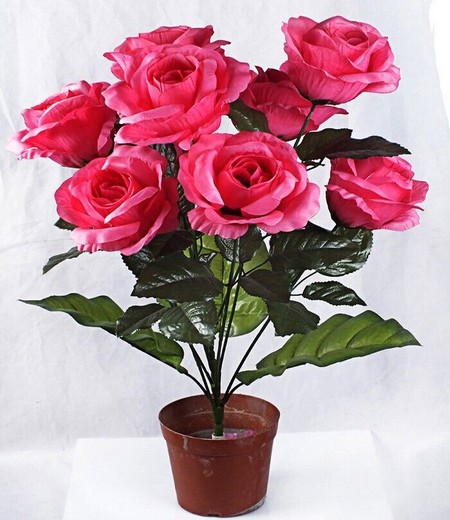
The rose is an ideal flower and tree for urban greening and landscaping; it is suitable for use as a flower hedge, and is also material for street, courtyard and garden greening, flower paths, flower beds and hundred-flower gardens; it can be pruned into shapes on its own, dotted around squares, lawns, embankments and flower ponds, and planted in masses as flower clusters. Today let us take a look at the methods for growing roses.
The rose has low requirements for soil; it only needs a fairly good growing medium containing a certain amount of humus and granular structure. As long as the following three points are done well, it will grow very well:
Tools/materials:
Cling film, fertilizer, pot
Steps/methods:
1. The rose is a drought-tolerant plant that fears waterlogging; almost all xerophytic plants are afraid of waterlogging. If growing in a pot, use an unglazed clay pot, and strictly follow the principle of "do not water if dry, and water thoroughly when watering." If roses are watered frequently (excessive watering on humid, rainy days with little evaporation is especially taboo), the rose roots will become waterlogged and rot like "pickled vegetables" (fundamentally different from the principle of hydroponics) and die.
2. When growing plants indoors, they must not be placed in a dim room for a long time; they should be regularly moved to a sunny place to supplement light. Without photosynthesis, plants will stop producing the nutrients necessary for growth, and the physiological cycle of water and nutrient transport (the light pump effect) will fail; yellow leaves, rotting leaves, rotting roots and eventually death will occur.
3. All plants only like light fertilization. Applying heavy fertilizer (especially chemical fertilizer) will cause localized root rot and death. According to the size of the plant and pot, every 1-1.5 months evenly apply 20-40 granules of compound fertilizer (or nitrogen fertilizer) 1 cun below the soil at the edge of the pot, or water once or twice a month with lightly fermented rice-washing water or other mild liquid fertilizer. As long as the leaves are green, the flowers are bright and the growth is good, there is no need to fertilize again.
4. Use a sowing tray or pot. The medium used for sowing must be clean, free of pests and diseases, and free of fertilizer. After filling with the medium, water it first. When sowing, you can broadcast or sow in spots, but sowing in spots saves seeds; sow each seed one by one, and the spacing between seeds can be based on the width of one finger. After sowing, lightly cover with clean medium; the covering thickness should preferably not exceed twice the thickness of the seed. Very small seeds may be left uncovered.
5. After sowing, seal the surface of the pot with cling film and poke several holes in the cling film. This both retains moisture and prevents the seeds from being affected by external forces. Finally, place the seeds in a cool, ventilated place and wait quietly for germination. Once germination is found, move the pot to a bright place, but do not expose it directly to the sun. When the seedlings grow tall enough to touch the cling film, the cling film can be removed. When the seedlings have grown two leaves, they can be placed in a spot with direct morning and evening sunlight to prevent leggy growth. At this time, you can also begin fertilizing, using a quick-acting fertilizer with an NPK ratio of 20-20-20, diluted 2000 times, applied once a week. When the seedlings have about 5 or more leaves, they can be transplanted into other pots.
Precautions:
The growth habits of roses and Chinese roses are completely the same. The main pests and diseases that commonly occur are downy mildew and aphids (other pests are fewer and also easy to catch).
Roses do not have very strict requirements for soil. When grown in an outdoor garden, it is enough to choose a spot that faces the sun, is not low-lying or prone to water accumulation, and does not have many trees around it; soil that contains a certain amount of aged humus is sufficient. Loosen the soil once before the beginning of spring each year (taking the opportunity to deeply apply 20-30 grams of compound fertilizer 200 cm from the roots), and frequently remove surrounding weeds. Roses are highly prone to aphids and some other leaf-eating pests, which can be killed with ordinary pesticides (alternate several kinds to prevent pest resistance).
Frequent rain causes the air humidity to be too high, and the leaves are very prone to downy mildew, which can be controlled with pesticides specifically for downy mildew.
For aphids infecting potted Chinese roses, use a cotton swab dipped in liquor of 50 degrees or above and apply it several times to kill them (aphids will drop to the potting soil to hide) (pesticides should not be used indoors).