How to grow Clivia miniata so it blooms? Master these care tips
How to grow Clivia miniata so it blooms? This question is one that Clivia growers care about greatly. We grow Clivia not only to enjoy the foliage, but more importantly to enjoy the flowers. So, how do you grow Clivia so it blooms most beautifully? Actually, it is quite simple: in everyday care, you need to pay attention to every step:
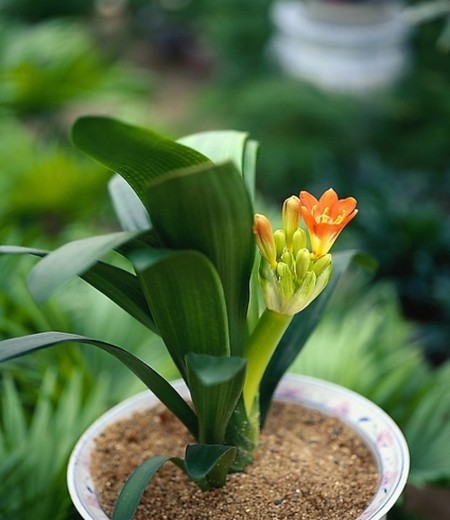
For Clivia care, use a loose, fertile neutral or slightly acidic humus soil. The growing medium can be mixed from 65% humus soil, 20% clean sand and 15% fine furnace ash. The relative humidity of the soil should be around 40%. If the soil becomes compacted and drains poorly, it will cause root rot. For Clivia, apply a solid fertilizer once in winter, use less nitrogen fertilizer, and apply more phosphorus and potassium fertilizer. Eggshell powder and thoroughly decomposed fishy water are very good phosphorus fertilizers, while bran ash and tobacco ash are easily obtained potassium fertilizers. You can also apply a nitrogen, phosphorus and potassium compound fertilizer to encourage it to sprout more new shoots and leaves.
Temperature: The suitable temperature for Clivia growth is 15-25°C. When the temperature exceeds 30°C for a long time in summer, growth is inhibited. If the air humidity at this time is below 60%, the leaves of Clivia will become paler and yellow and even wilt; if the humidity is above 90%, the stems and leaves will grow leggy. To prevent these undesirable phenomena, lower the temperature appropriately, and pay attention to ventilation and light transmission, and control humidity. When the temperature drops below 5°C, Clivia basically stops growing. If the temperature drops to around 0°C, frost damage may occur, causing the leaf tips and leaf margins to lose green and turn yellow, and even yellow-white necrotic spots may appear. Therefore, in winter, do a good job of keeping Clivia warm to prevent frost damage.
Light: Clivia is a semi-sun-loving flower and prefers diffused light. Too strong light is unfavorable to its growth and easily causes sunscald. However, if the placement site is too dark and light is insufficient for a long time, the leaves will also lose their luster, the old leaves will turn dark green, and the new leaves will become thinner and turn yellow or yellow-green. Some people call this yellow-leaf phenomenon shade yellowing. At this time, move the Clivia to a place with slightly stronger light. If it is not suitable to move it, use artificial light to supplement the lighting.
Watering: The soil should not be too dry or too wet. Each watering must soak through, and after budding, water a little more. About every 20 days, combine watering with applying fermented soybean cake water, diluted fishy water, water from soaking water chestnuts, etc., combining watering and fertilizing. When the room temperature is low, control watering to prevent the potting soil from becoming too wet. Too wet potting soil will cause the plant to rot at the roots and die, but the potting soil must not be allowed to become too dry either.
Fertilizing: Apply once bone meal, well-fermented fish innards, and soybean cake water. This can make the flower color vivid, the flowers larger, and the leaves thick. Otherwise, small flowers, few in number, and pale flower color are likely to occur. At the same time, be careful to avoid applying too much nitrogen fertilizer and insufficient phosphorus and potassium fertilizer, which can lead to weak growth or leggy leaves and affect bud formation and flowering.
Clivia needs careful care. In addition to changing the soil once every spring, do not water too much at ordinary times, and control watering even more in summer; pay attention to keeping the leaf surface clean to promote photosynthesis. You can often gently wipe the leaves with a soft cloth dipped in tea water, which can keep the leaves glossy and shiny and also helps bud formation and flowering. If you can pay attention to the above points for Clivia, especially applying more phosphorus and potassium fertilizer, it will certainly bloom every year.