How to grow Bird of Paradise in pots? Cultivation methods and precautions
Bird of Paradise (Strelitzia reginae) is a flower with exceptional ornamental value. Its blooming period runs from September to June of the following year, and the flower's shape resembles a crane holding its head high and gazing into the distance, graceful in form, which has won it the affection of many enthusiasts. Bird of Paradise can not only be grown as a potted plant, making it a great helper for home decoration, but can also be placed in a courtyard for free-range growing, achieving both ornamental value and air purification.
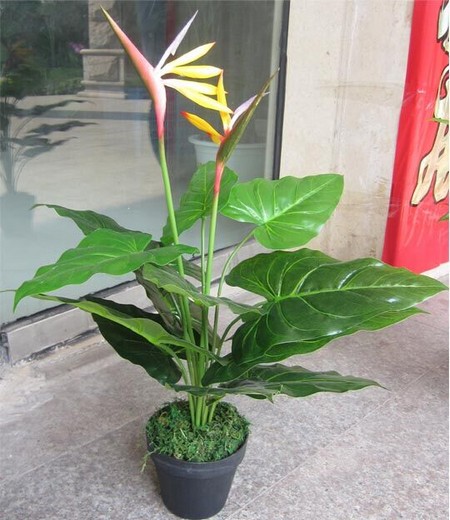
Bird of Paradise, also called the Paradise Bird Flower or Bird of Paradise Flower, is a precious cut flower. The flower is beautiful with a peculiar shape, resembling a crane standing alone, craning its neck to gaze into the distance, or like a bird in flight, or even like the tender, affectionate eyes of a lover. Bird of Paradise has a graceful posture, with colors neither gaudy nor delicate, elegant and refined. Today, the editor shares with you an introduction to the cultivation methods and precautions for Bird of Paradise.
Light: Bird of Paradise likes to grow in an environment with ample sunlight, but in summer it fears intense exposure to strong light, so appropriate shading treatment is needed when cultivating it in summer. The suitable light intensity for Bird of Paradise during the growing period is 30000Lx. In summer, if exposed to excessive sunlight, the leaves will curl inward and growth will slow down. In winter, insufficient sunlight will also cause leggy growth of leaves or thin, weak, and bent leaf stalks, making it difficult to bloom. Therefore, when cultivating Bird of Paradise, it should not be kept in shade in winter nor exposed to the sun in summer, otherwise the yield of cut flowers will be affected.
Temperature: The suitable growing temperature for Bird of Paradise is 18-24 degrees Celsius. In summer, temperatures above 40 degrees Celsius will hinder growth, and in winter, temperatures below 0 degrees Celsius and under will also suffer from frost damage. The general cultivation temperature is no lower than 10 degrees at night in winter, and it can still bloom when daytime temperatures are around 20 degrees. When Bird of Paradise grows within the suitable temperature range, flower buds can form in every leaf axil and send up scapes to bloom. Therefore, controlling the temperature well is the key to increasing the flower quantity of Bird of Paradise.
Soil: Bird of Paradise has fleshy roots that fear waterlogging, so when the soil for cultivating Bird of Paradise is too moist and poorly aerated, it will cause root rot. Generally, during the blooming period and in summer, sufficient water should be supplied. In early spring and after blooming, the amount of watering should be appropriately reduced. To increase air humidity and ensure that Bird of Paradise can fully absorb water, the above-ground parts of the plant also need timely misting, keeping the air humidity during the growing period at 60% to 70%.
Watering: The amount of watering should be determined by seasonal changes, the plant's growth condition, and the actual degree of soil dryness and moisture. Generally speaking, watering should follow the principle of watering when dry and stopping when wet. In summer, watering should be sufficient. In spring and summer, water should also be frequently sprayed on the leaf surface and sprinkled on the ground around the flower pot to increase air humidity, create a cool environment, and benefit its growth and development. After late autumn, watering should be reduced, and in winter, watering should be controlled to keep the potting soil on the drier side.
Fertilizer: During the growing period, Bird of Paradise needs topdressing about every 20 days, preferably with decomposed cake fertilizer water. From flower stem formation to full bloom, compound fertilizer mainly of phosphorus and potassium should be applied 2 to 3 times. In autumn, the amount of nitrogen fertilizer should be appropriately reduced to prevent excessive stem and leaf growth from affecting flower bud development and cold resistance. In summer, because the plant is in a semi-dormant state, the amount of fertilizer water should be reduced; remember to stop fertilizing in winter. Through weeding and hoeing, loosen the soil and increase aeration.
Repotting: Generally, during the seedling stage, it is suitable to repot once a year. For mature plants after blooming, repot once every 1 year. When repotting, dig the entire clump of the Bird of Paradise plant out of the soil (retaining as many roots as possible). After the roots and the gaps between buds can be clearly distinguished, according to the plant size and on the premise of ensuring each small division has 2-3 buds, reasonably choose the cutting entry point, and use a sharp knife to divide the mother plant into 2-3 clumps from the gaps in the rhizome. The cuts should be dipped in plant ash and dried in a ventilated place for 3-5 hours. Overly long roots can be appropriately shortened, and then they can be planted.
Precautions:
1. Summer shading: In the southern subtropical region, using shade nets to shade Bird of Paradise plants in summer can reduce strong sunlight and high temperature exposure and scorching of plants and leaves, keeping the plants growing well. Shading treatment of plants in summer will significantly reduce the first-grade flower rate of the cut flowers produced. Because flower prices in the summer market are low, only about 20% of the peak demand season, the summer cut flower yield should be controlled, the amount put on the market reduced, and the plants protected to smoothly pass through summer, thereby increasing the yield and quality of cut flowers during the peak demand season in winter and spring. From the perspective of annual economic returns, the gains outweigh the losses.
2. Building sheds in winter: In the southern part of this province, temperatures are relatively low from December in winter and spring to March of the following year, and northern cold waves often invade. The cut flower yield of Bird of Paradise is low, while during this stage the market demand for cut flowers increases and prices rise. Experiments show that adopting the measure of building film arch sheds in the field can significantly promote an increase in cut flower yield, with small arch sheds having the best effect; their cut flower yield increases by 300% compared with open field cultivation. Moreover, simple film small arch sheds are easy to source materials for and easy to build, low in cost, and effective in preserving warmth and promoting flowering, making them suitable for adoption by the vast number of rural growers.