How to grow a Chaenomeles speciosa bonsai? Detailed care methods
Chaenomeles speciosa (flowering quince) is native to western and southern China. It is a sun-loving flowering shrub with alternate simple leaves that are oval or oblong-oval with sharply serrated edges. Its flowering period is fairly long, generally from March to May; the flowers appear slightly before the leaves or at the same time as the leaves, clustered in groups of 3 to 5. It bears fruit in autumn. Chaenomeles speciosa can be grown both in the ground and in pots. It flowers before the leaves in early spring, and its bright red blossoms are a delight to the eye, making this the best viewing period. In autumn it bears yellow pear-shaped fruit with a fragrant scent, which also has considerable ornamental value. If Chaenomeles speciosa is moved into a greenhouse after autumn, it can be brought into bloom early, in time for the Spring Festival.
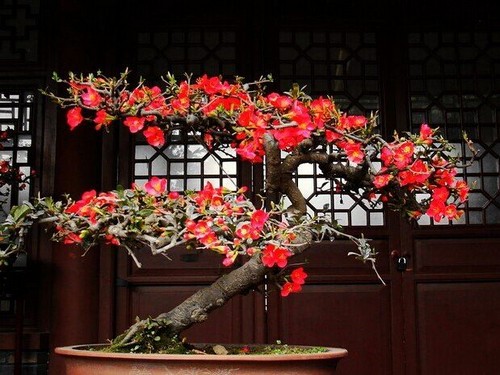
Because Chaenomeles speciosa not only has bright, eye-catching flowers, but also sturdy, slanting, hard and vigorous branches and trunks, it can also be made into a bonsai for viewing both flowers and fruit. The resulting bonsai combines softness with strength, has a strong sense of antiquity, and holds high ornamental value. Below is an introduction to its care methods:
1. Placement:
A Chaenomeles speciosa bonsai should be placed in a spot with ample light and good air circulation. During the high temperatures of midsummer, it should be given appropriate shade to prevent sunscald and scorched leaves. In winter it is fairly cold-tolerant; the pot can be buried in the soil, or it can be placed near a window indoors.
2. Watering:
Normally, just keep the potting soil moist, but be careful to prevent water from accumulating in the pot, otherwise the roots may easily rot. During the spring and summer growing season, the potting soil should not be too dry either; especially during the flowering period, the potting soil must be kept adequately moist.
3. Fertilizing:
In winter, apply sufficient base fertilizer, preferably dry cake fertilizer, decomposed manure, or bone meal. During the growing season, except for the plum rain season, regularly apply additional dilute fertilizer solution.
4. Pruning:
This is mostly done after flowering. Generally, the branches that have flowered are cut short to encourage branching and the formation of flower buds, increasing the number of flowers the following year. At the same time, branches that affect the plant's appearance, such as water sprouts, crossing branches, and overlapping branches, should also be removed promptly. After leaf fall, shaping and pruning can be done during the dormant period, removing diseased, dead, and aged branches to maintain a certain tree form.
5. Repotting:
This should be done once every 2-3 years, preferably after flowering in spring, though autumn is also acceptable. When repotting, combine it with root pruning and place base fertilizer at the bottom of the pot.
6. Pest and disease control:
Chaenomeles speciosa is often attacked by rust disease on its leaves, which can be controlled by spraying 0.5 degree Baume lime sulfur mixture. The main insect pests are aphids, nettle caterpillars, red spider mites, and others. The control methods are the same as for Malus halliana (hall crabapple).
Among the quince family, Chaenomeles speciosa is a relatively common variety. Chaenomeles speciosa is also called iron-foot quince and tiegeng mugua (clinging-stem papaya) because its flower stalks are very short, so when it blooms the flowers look as if they are attached to the branches, hence the name. Its flower colors include crimson, pink, white, and others. When in bloom, the colors are bright and gorgeous, making it very appealing.
[Precautions]
1. Sufficient moisture:
During the growing period of Chaenomeles speciosa, give it sufficient water. Especially in summer when temperatures are high, the potting soil dries out easily, so watering must be plentiful. Note that although Chaenomeles speciosa has a certain drought tolerance, it is very afraid of waterlogging, so be sure to avoid water accumulating in the potting soil, otherwise the leaves will turn yellow and the plant may even die.
2. Strengthen pruning:
After leaf fall in autumn or before bud break in spring, carry out a pruning and shaping, cutting away dead branches, water sprouts, crossing branches, overlapping branches, and other branches that affect the tree shape, so that nutrients are concentrated, consumption is reduced, and ventilation and light penetration are improved. Also cut off the tops of old branches that flowered the previous year, leaving only 20 to 30 cm at the base of the branch, which can promote branching and increase flowering branches. Potted plants should not carry too much fruit; after flowering, thin the fruit promptly, and the fruit left should be in key positions of the branch structure to balance the tree's vigor and highlight the focal points. Although the fruit stops growing after ripening, it still consumes nutrients, so it should be removed. For certain double-flowered varieties grown mainly for their flowers, the spent flowers can be removed after flowering so that they do not set fruit, helping the tree recover its vigor.
3. Repot once every spring
The potting soil should be loose, fertile, rich in humus, and a sandy soil with good drainage and aeration. Place some decomposed cake fertilizer, animal hoof and nails, bones, and other materials at the bottom of the pot as base fertilizer to support the plant's growth and flowering. In June and July, when the fruit gradually swells, increase the amount of phosphorus and potassium fertilizer; a 0.2% potassium dihydrogen phosphate solution can be sprayed on the leaves to meet the needs of fruit development.