How to Grow Potted Pansies and Key Points to Note
Pansy, also known as viola tricolor and "monkey face flower," is one of the three main herbaceous flowers used in spring flower beds in northern China. The pansy originates from Northern Europe and, like the wildflower Viola mandshurica that blooms in early spring in China, belongs to the Violaceae family; all varieties popular today are artificial hybrids. The pansy was originally a perennial herbaceous flower, but after cultivation it has become an annual or biennial herbaceous flower that must be sown every year. In the Yangtze River basin region, it can be sown in all four seasons and flowers are available year-round, but growth is poor in the hot summer.
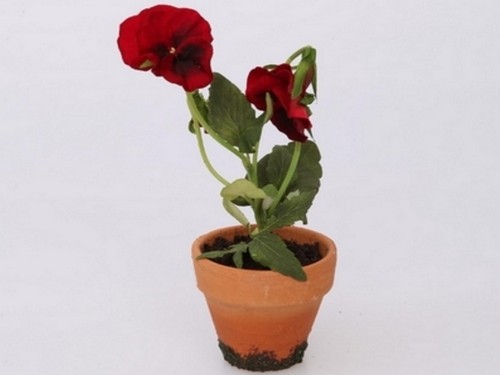
The pansy is a common wildflower species in Europe and is also often cultivated in parks; it is the national flower of Iceland and Poland. Each flower usually has three colors: purple, white and yellow, hence the name viola tricolor. This species is relatively cold-tolerant, prefers cool conditions, and its flowering is greatly affected by light.
[Soil]
For potting, a fertile loam rich in organic matter is best, or mix 30% peat moss, 20% fine tree-fern fiber, 40% loam and 10% decomposed compost. It is not demanding about soil and can tolerate poor fertility; it grows best in fertile, loose soil rich in organic matter, but struggles in damp soil with poor drainage.
[Temperature]
The pansy prefers cool or warm conditions and dislikes high temperature and humidity. The suitable growing temperature is 5-23C. If there is a sudden hot spell with temperatures reaching above 28C, strive to ensure good ventilation to lower the temperature and prevent wilting and death. Night temperature 16°C to 18°C, daytime 18°C to 24°C. When plants are placed outdoors it is very difficult to maintain optimal growing conditions; using a negative day-night temperature difference helps make the plants shorter and of higher quality. Be careful not to let high temperatures occur.
[Light]
The pansy likes abundant sunlight; light is an important limiting factor for flowering, and day length has a greater effect on flowering than light intensity. Poor sunlight results in poor flowering. During cultivation, ensure the plants receive no less than 4h of direct sunlight each day. It is relatively sensitive to light response: with sufficient light and long day length, the stems and leaves of the pansy grow luxuriantly and flowering is earlier; if light is insufficient and day length is short, the viola tricolor flowers poorly or flowering is delayed.
[Watering]
The pansy likes a slightly moist soil environment and is not drought-tolerant. Keep the soil moist during the growing period, but on the drier side in winter; each watering should follow the principle of watering when the surface dries and stopping when it is moist. When the plant is flowering, maintaining sufficient moisture is necessary for enlarging the flowers and increasing the number of blooms. In seasons with higher temperatures and strong light, water promptly. Maintaining sufficient moisture is necessary for enlarging the flowers and increasing the number of blooms. But do not overwater, because the pansy grows in cool, shaded areas where moisture does not evaporate quickly and it does not need much water.
[Fertilizing]
During the growing period, apply fertilizer once every 20-30 days; various organic fertilizers or nitrogen, phosphorus and potassium are all suitable. During the growing period, apply dilute fertilizer frequently, and carry out loosening of the soil, pinching and normal watering. On the other hand, during the growing period, once every 2 to 3 waterings, apply fertilizer as a nutrient solution at a concentration of 100-150ppm, mainly calcium-containing compound fertilizer. In the early stage, mainly nitrogen fertilizer; near the flowering period, phosphorus fertilizer can be increased.
In addition, during the flowering period, if there is sufficient light and a cool environment, it can bloom continuously as one flower fades and another opens, lasting for one to two months. Removing spent flowers promptly can extend the flowering period. When the temperature stays above 30°C for several consecutive days, it will stop flowering.
[Pruning]
During the growing period, promptly remove withered branches and spent flowers; for leggy branches, control growth by pinching to encourage new branches, making the plant full and well-shaped and also extending the flowering period. Immediately after the flowers fade, cut off the spent flowers to encourage reblooming; after late spring, as temperatures rise, flowering gradually decreases and the flowers become smaller.
[Pests and Diseases]
The main diseases harming the stems, leaves, flowers and roots of the pansy include anthracnose, rust, gray mold and root rot. Once disease occurs, spray a 500-600 times dilution of 50% carbendazim or an 800 times dilution of 75% chlorothalonil.